A colourway looks like a decision made on a screen. On the floor it is a production stream: its own material lot, its own webbing, its own hardware, its own thread, its own colour standard, its own bin, and — for one colour in particular — its own tooling discipline.
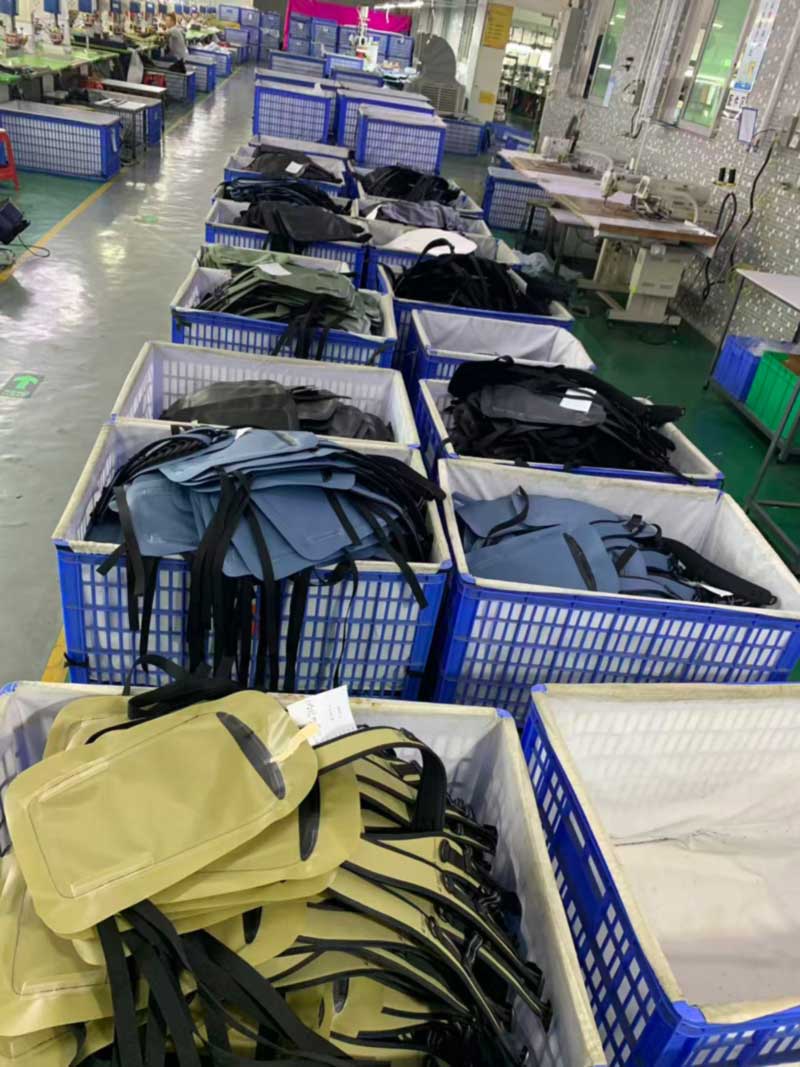
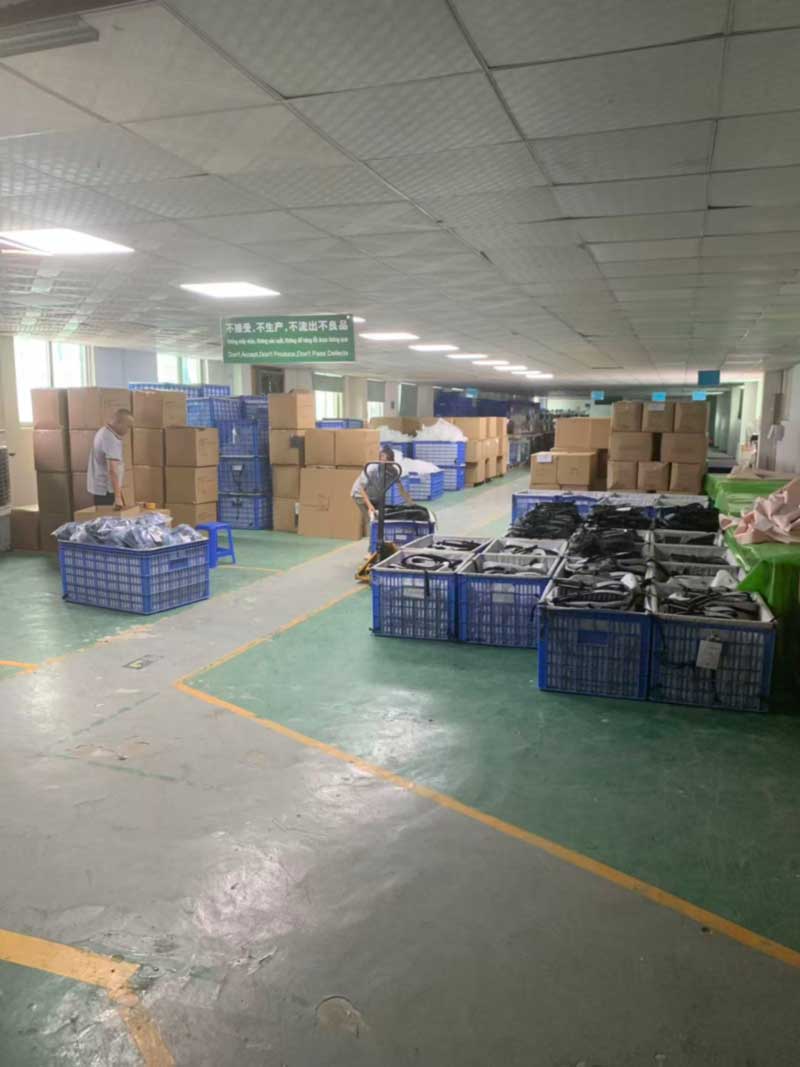
This month our Dongguan line ran a welded waterproof backpack in six colourways at once: white, black, charcoal, slate blue, sand and olive. The bins running down the aisle are the clearest picture of what that actually means, and the white units are the ones the supervisors walk past most often.
Six colourways in sub-assembly, one to a bin. Each bin is a separate stream from cutting to carton.
Why white costs more than black to weld
High-frequency welding works by driving an alternating field through the material so the polymer heats from within and the two layers fuse. Get the dwell, power and pressure right and the seam is as strong as the parent sheet. Push any of the three slightly past optimum and the material at the seam edge discolours.
On black, that discolouration is invisible. On charcoal or olive it is close enough to invisible that only a trained eye at the bench catches it. On white it is a brown witness line running the length of the seam, and there is no rework that removes it. The panel is scrap.
So white runs with a narrower process window than every other colour on the order. Electrodes are kept clean, because a trace of residue from a previous dark run transfers straight onto a white face. First-piece approval is stricter. Operators check the seam edge rather than just the seam. In practice a white run needs more attention per unit and yields slightly fewer good panels per sheet, and any factory quoting white at exactly the same cost as black either has not run much of it or is absorbing the difference somewhere the buyer cannot see.
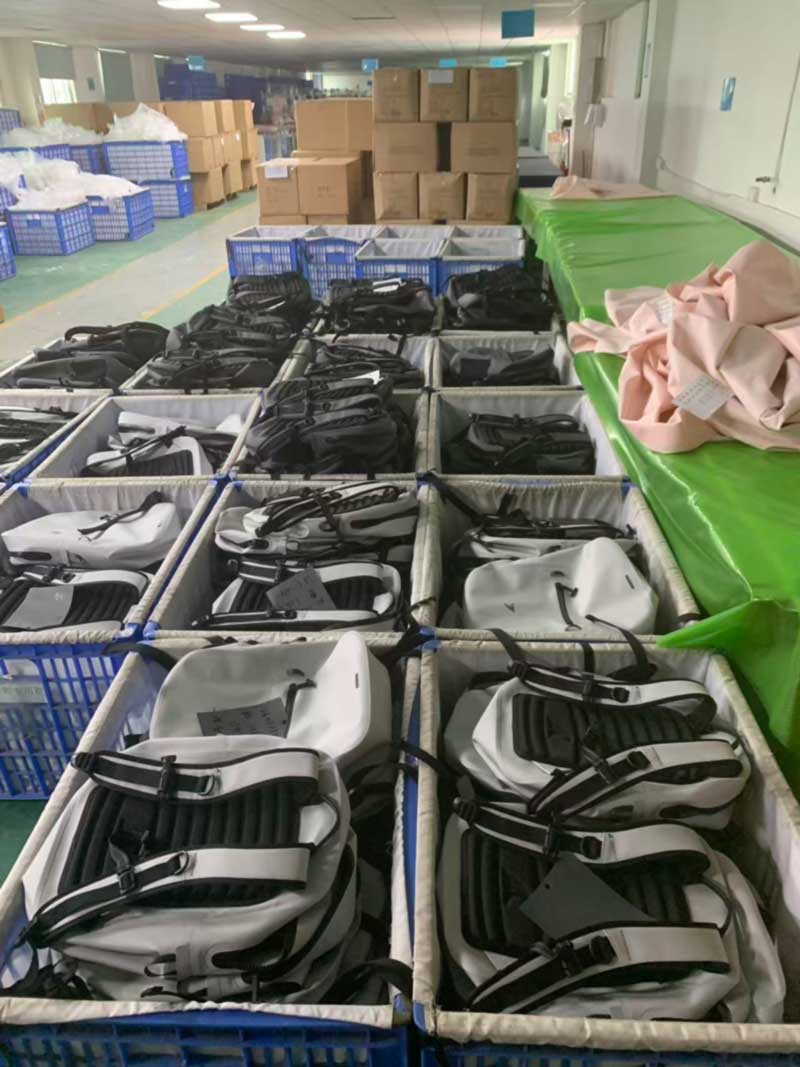
The same logic carries all the way through finishing. A white welded shell shows handling marks, bench residue and scuffs that a black shell hides completely, which is why white units move in cloth-lined bins and get wiped down before they are bagged.
White bodies staged for assembly. The colour that photographs best is the one that hides nothing on the line.
Welded back panels, not quilted ones
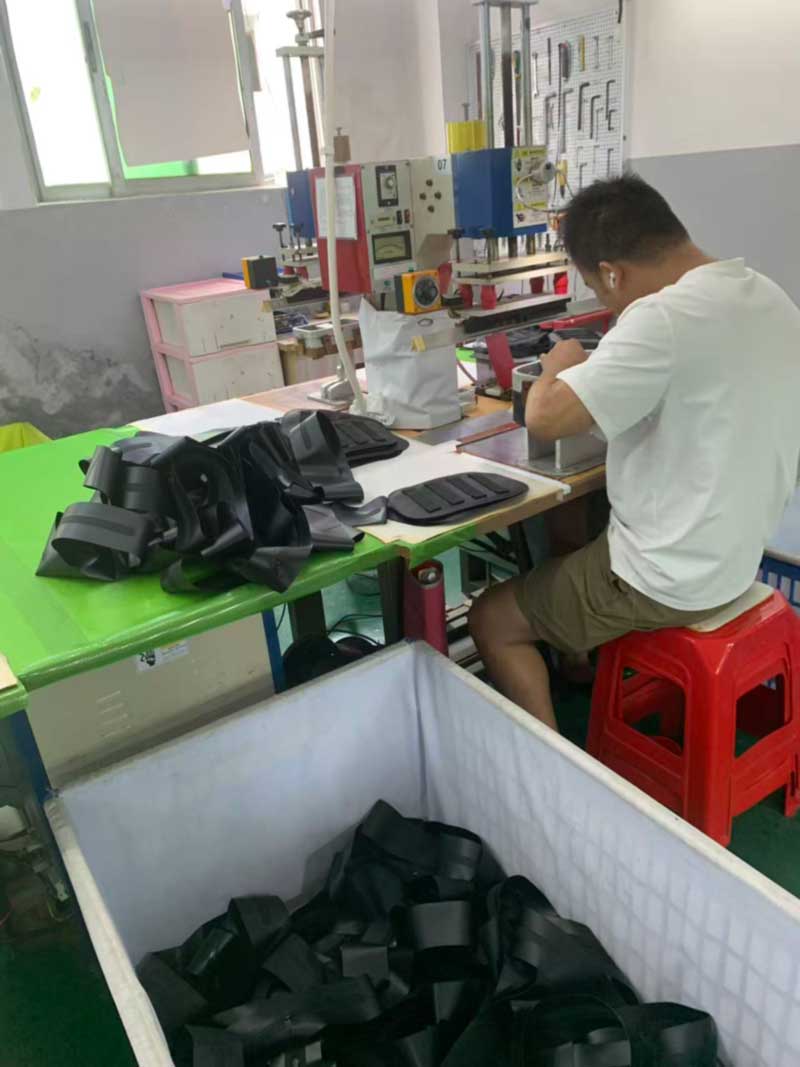
The back panels on this program are welded rather than sewn: foam is enclosed between coated layers and the channel pattern is welded in, which produces raised ventilation ribs with no stitch line anywhere on the surface.
This matters on a waterproof pack specifically. On a conventional quilted back panel the channels are formed by stitching, which means hundreds of needle perforations sitting directly against the wearer's back, on the panel that gets the most sweat, the most pressure and the most flex. Every one of those holes is a capillary path. The panel is not what keeps water out of the main compartment, but it is what soaks up moisture and stays damp, and a back panel that never dries is a real complaint in this category even when the bag itself has never leaked.
Welding the channels instead gives the same ventilation geometry with a sealed surface. The foam stays dry, the panel wipes clean, and there is no seam to abrade against a jacket over a few hundred kilometres. It costs a dedicated die per panel size and a slower cycle than a sewing machine would need — which is the trade, and it is the right one on a pack that is sold as waterproof.
Welding the channel pattern into a padded back panel — ventilation ribs with no stitch holes.
Where the sewing machines still earn their place
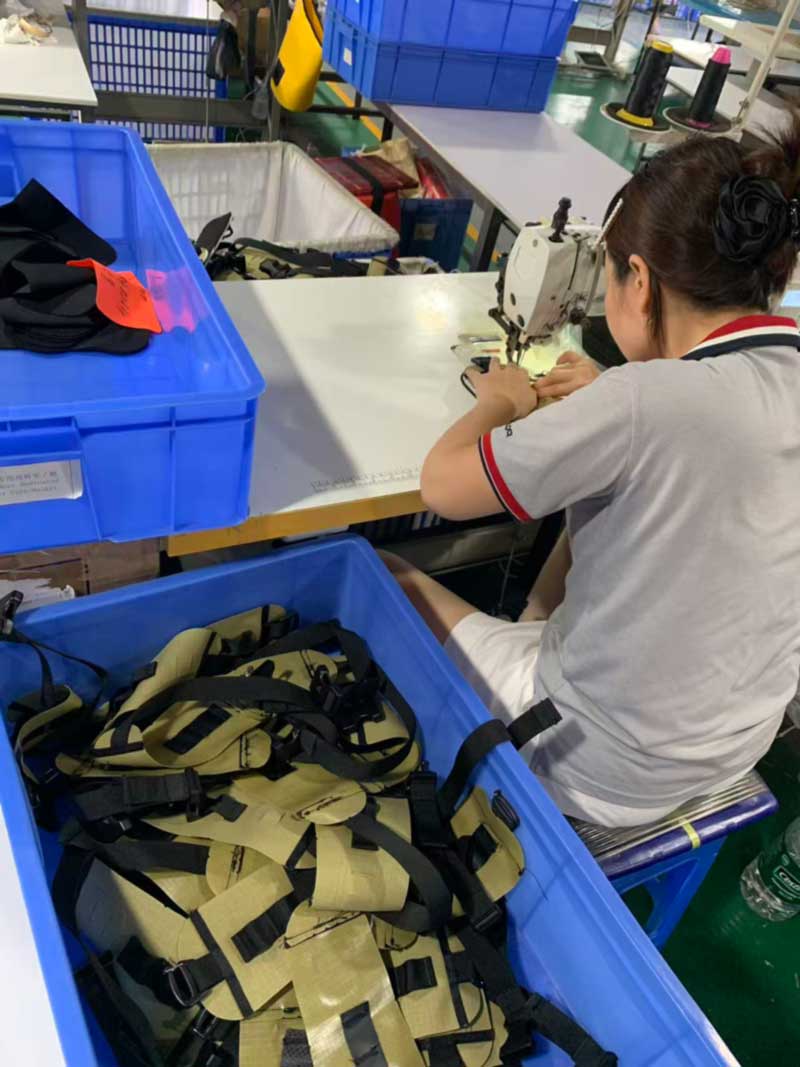
A few metres away the sewing benches are bar-tacking strap assemblies. That is not a contradiction and it is not a fallback.
Welding is correct for the shell, the base, the back panel and the anchor patches that carry load into the body. Sewing is correct for webbing-to-webbing joints, adjuster loops, harness assembly and bound edges, where the joint is textile-to-textile, carries no water-tightness duty, and needs the shear strength and repairability that a bar tack gives. A welded webbing joint on a shoulder harness would be the wrong answer — stiffer, harder to repair, and no drier, because nothing about that joint was keeping water out in the first place.
Our sewing floor is in-house and runs to the same discipline as the welding floor: process cards at each station, first-piece approval, inline checks. On a pack like this the two processes interleave through one build sequence, and the sub-assembly bins in the aisle are how the sequence stays synchronised across six colours at once.
Bar-tacking harness webbing. Textile-to-textile joints are sewn; the waterproof shell is welded.
Six streams, one aisle, no mixing
The real risk on a multi-colour run is not any single process. It is that a slate blue front panel meets a charcoal harness somewhere in sub-assembly and nobody notices until the piece is tagged.
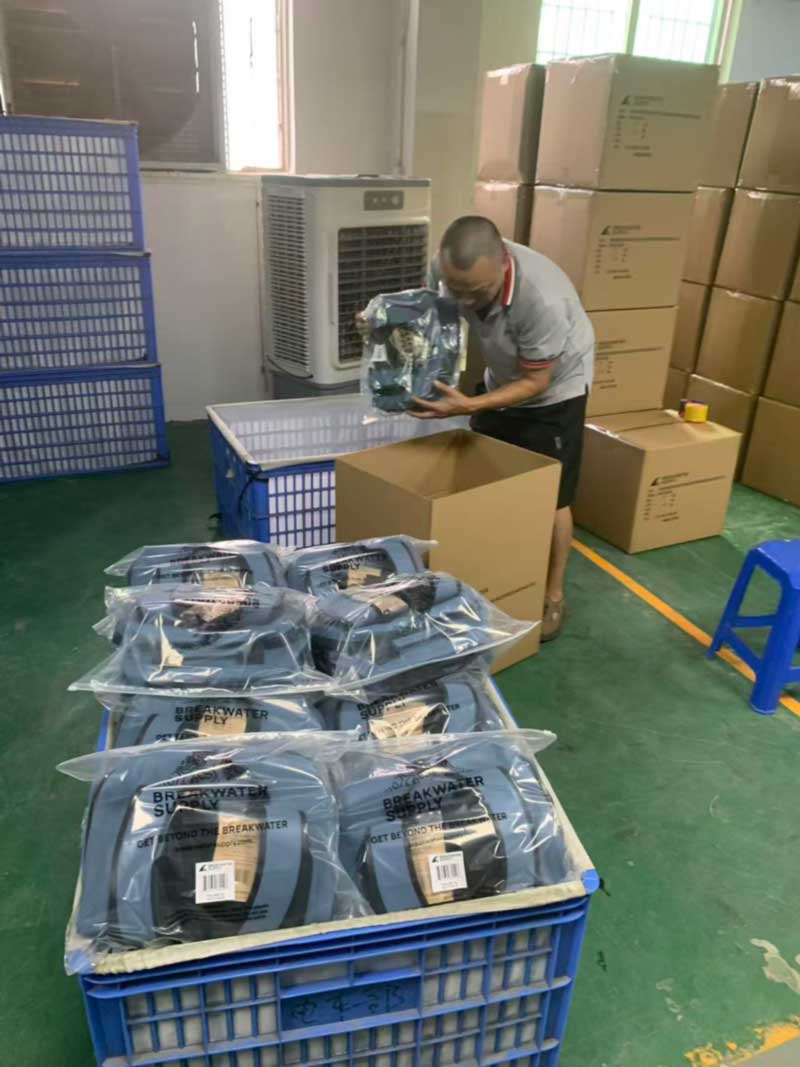
Separation is structural. One colourway to a bin, each bin carrying its own card. Webbing, buckles and hardware are kitted per colourway rather than drawn from a common bulk store, and leftovers go back to stores at the end of the run instead of sitting on the bench for the next one. Counts are hand-written on cards that sit face-up on the goods and travel with them to OQC, where they are reconciled before a carton is taped.
Above the packing floor there is a green banner that reads, in Chinese, Vietnamese and English: don't accept defects, don't produce defects, don't pass on defects. The Vietnamese is not decoration — the same standards, signage and process documents run at our Ho Chi Minh City facility, which is what makes it realistic for a buyer to move an order between origins for tariff reasons without re-approving the whole process.
The packing floor. The banner runs in three languages because the standard runs at both plants.
Colour difference is a measured value, not an opinion
Every colourway on this order carries an approved standard, and finished units are checked against it rather than against each other. That distinction matters more than it sounds. Two bags that look fine side by side on the bench can both sit outside tolerance in the same direction, and the customer who reorders six months later gets a batch that visibly does not match the first one.
Colour difference and colour fastness sit in the inspection set alongside the structural work: bonding strength on welded seams, tensile strength on the base fabric, load cycling on strap anchors, zipper fatigue, abrasion and salt spray, with IQC, IPQC and OQC checkpoints through the order and third-party inspection by SGS or QIMA available on request.
On waterproof rating we stay specific per construction. A welded shell with a roll-top closure is verified to a heavy rain and water-jet protocol, which is what a roll-top actually supports — the same standard behind our 20L roll-top laptop backpack and our 22L commuter bicycle backpack. Immersion claims belong to airtight-closure constructions such as the IPX8 caving pack, which is verified by full water immersion of two hours or more. The rating follows the closure, not the marketing copy.
Individually bagged, counted, carton-marked — one colourway at a time.
For buyers planning a colour range
If you are specifying a range, two practical points come out of this run. First, budget white and other pale colourways realistically — they are a slower, tighter process on welded construction, and a quote that treats them as identical to black is hiding the difference rather than removing it. Second, keep the number of colourways in the first production run smaller than the number you eventually want; a six-colour launch multiplies material lots, hardware kits and colour standards before you have any sell-through data telling you which colours matter.
Sealock has built welded waterproof gear for over 20 years, with high-frequency welding and in-house sewing running side by side in Dongguan and at our facility in Ho Chi Minh City. Standard terms are FOB Guangdong, 7–15 days for sampling, 30–45 days for mass production, and MOQ from 300 pieces on most models, with Pantone matching available on body fabric, webbing and hardware.
We use cookies to offer you a better browsing experience, analyze site traffic and personalize content. By using this site, you agree to our use of cookies.
Privacy Policy