
- English
- Español
- Português
- русский
- Français
- 日本語
- Deutsch
- tiếng Việt
- Italiano
- Nederlands
- ภาษาไทย
- Polski
- 한국어
- Svenska
- magyar
- Malay
- বাংলা ভাষার
- Dansk
- Suomi
- हिन्दी
- Pilipino
- Türkçe
- Gaeilge
- العربية
- Indonesia
- Norsk
- تمل
- český
- ελληνικά
- український
- Javanese
- فارسی
- தமிழ்
- తెలుగు
- नेपाली
- Burmese
- български
- ລາວ
- Latine
- Қазақша
- Euskal
- Azərbaycan
- Slovenský jazyk
- Македонски
- Lietuvos
- Eesti Keel
- Română
- Slovenski
- मराठी
- Srpski језик

Motorcycle Waterproof Bag Factory with RF Welding Technology
Sealock manufactures motorcycle waterproof bags at factories in China and Vietnam using in-house 27.12 MHz radio-frequency welding. On most waterproof products a weld has one job: keep water out. On motorcycle luggage it has two — it seals the body and it anchors every strap, D-ring, and mounting panel that holds a loaded bag to a vibrating machine. That dual role, under continuous vibration, is what makes welding capability the decisive factory question in this category.
1. Factory Profile
Sealock (YiFuLong Outdoor Gear Co., Ltd.) has built welded waterproof bags for over 20 years, producing for international outdoor and motorcycle brands including Benelli, Helly Hansen, OSPREY, and CHUMS.
- Facilities: Dongguan, China | Ho Chi Minh City, Vietnam — either origin available on any model
- Welding: in-house RF welding at 27.12 MHz, running alongside industrial sewing lines
- Capacity: up to 30,000 pcs/month on the roll-top luggage line; 15,000 pcs/month on tail bag lines
- Terms: MOQ 300 pcs per model (500 on the single-side saddle bag), samples 7–15 days, bulk 30–45 days, FOB Guangdong from Shenzhen
- Certifications: ISO 9001, BSCI, SMETA, HIGG, GRS, SCAN
2. Why RF Welding Suits Motorcycle Luggage Materials
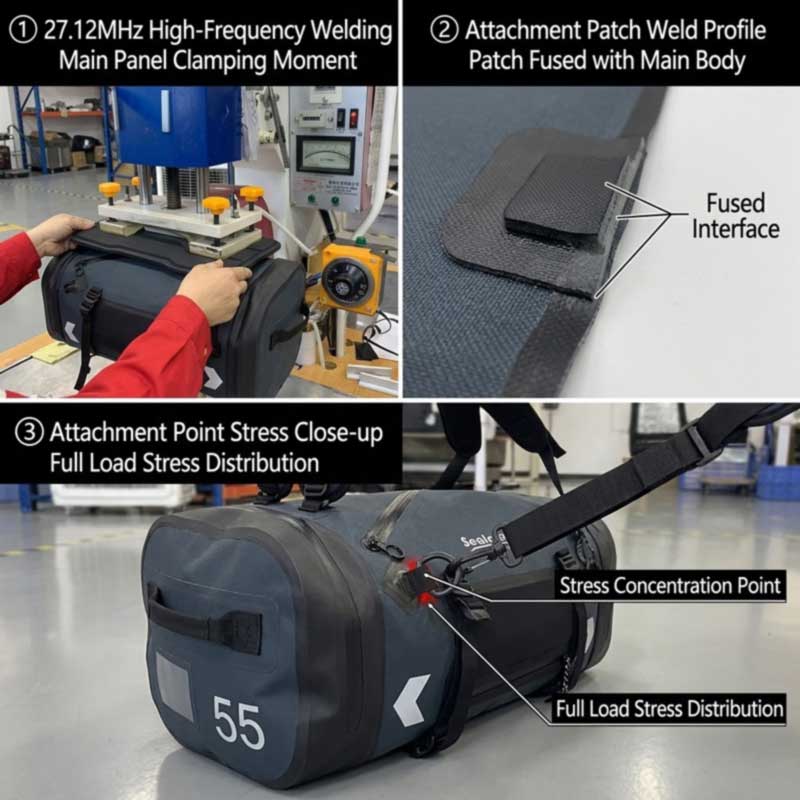
RF welding is a dielectric process: a high-frequency electromagnetic field at 27.12 MHz excites polar molecules inside the material so heat is generated internally rather than conducted in from outside. Both layers reach fusion temperature at the same moment and bond at a molecular level, producing a seam that is typically as strong as the parent material or stronger.
The process has a material preference that happens to match this category exactly. RF welding works best on PVC and PU-coated fabrics, which is precisely what motorcycle luggage is made from — welded 500D PVC tarpaulin across most of the range, and TPU laminate on the premium tier. Both are polar and weld cleanly. That alignment is why the strongest seams in the tarpaulin world are RF welded rather than hot-air or ultrasonically joined.
3. The Weld Does Two Jobs Here
On a dry bag, welds form a sealed envelope and the user carries it. On motorcycle luggage the same welds also carry the load path. The bag is strapped to a rack or pillion seat, loaded to its rated weight — 8–12 kg on the 45L tail bag, 50 kg across a paired saddlebag set — and then subjected to hours of engine and road vibration that works continuously at every attachment point.
This matters because of a well-established failure pattern in welded tarpaulin products: weak reinforcement areas are the most common cause of failure on tarpaulin goods that carry load, notably truck covers and cargo containment. Motorcycle luggage is the same material under the same kind of cyclic stress. A factory that welds a beautiful body seam but treats attachment patches as an afterthought produces bags that stay dry until an anchor lets go.
4. How Attachment Hardware Is Bonded Without Piercing the Shell
Everything a motorcycle bag mounts with has to attach to a sealed body without putting a needle through it. The method is welded reinforcement patches: a patch is RF welded to the outer surface of the body, forming its own waterproof seal at the welded interface, and the load-bearing component sits on that patch rather than on the membrane. Across the range this covers hook-and-loop mounting panels, heavy-duty nylon D-rings, compression and quick-release strap anchors, number-plate patch panels, bungee cord locks, and MOLLE-style lash strips.
Tooling design does real work here. Components of similar shape can be welded with a single die, and two or more components can be bonded in one energisation of a die positioned across both — which is what keeps patch placement identical from the first unit to the last rather than drifting with operator judgement.
5. Mirror-Pair Tooling for Balanced Saddlebags
Paired saddlebags introduce a requirement no other product in the range has: the left and right bodies must be dimensionally identical, because unequal volumes lead to unequal loading, and a motorcycle carrying more weight on one side becomes unsettled in ruts and crosswinds. That makes it a tooling problem rather than an assembly problem — mirror components are welded on matched dies so both sides come off the line to the same dimensions, and the 80L set is built as 40L per side with each bag independently detachable and usable on its own.
6. Two Parameter Sets Across the Range
The range spans two material families, and they do not weld the same way. Welding parameters — power, dwell time, pressure, and cooling time — are qualified separately for 500D PVC tarpaulin and for TPU laminate, and re-qualified when colour or fabric lot changes, since pigments, fillers, moisture, and thickness all alter how a material absorbs RF energy. Thicker materials in particular need stronger welds and tighter control.
The premium tier adds a third case. The SL-E984 55L is built in ripstop TPU laminate with an airtight waterproof zipper welded into the body, rated IPX7 at 1.27 kg — a zipper seat is a more demanding weld than a plain seam because the track has to stay dimensionally true along its whole length while remaining sealed. Peel tests are pulled on sample welds at the start of every run to confirm full fusion before a batch proceeds; a correct weld tears through the base fabric rather than parting cleanly at the interface. The underlying process is set out in the manufacturing process from cutting to RF welding.
7. Line Flow
- Incoming inspection — tarpaulin and laminate checked for coating consistency, thickness, and shade; hardware and reflective materials verified.
- Cutting — panels cut to the marker, with mirror panels for paired products cut together.
- Branding and reflective — logos and reflective applied to flat panels while accessible.
- Structural sewing — load-bearing sub-assemblies built on flat panels before any waterproof seal exists.
- RF welding — body seams, reinforcement patches, mounting panels, and zipper seats welded at 27.12 MHz.
- Cooling — welded seams set under controlled cooling before handling, since releasing pressure early is a common cause of weak welds.
- Trimming and final assembly — flash removed, then buckles, straps, and closures fitted.
- Testing and packing — leak testing, then packing to carton specification, one piece per PP bag with 20 per carton on tail bag lines.
8. Testing Built Around Vibration
Because anchors rather than fabric are what fail on motorcycle luggage, testing weights toward them. Load cycling over 1,500 cycles targets mounting straps, D-rings, and handles, alongside tensile and bonding strength on the welds themselves, salt spray for hardware exposed to coastal air and salted winter roads, friction resistance, colour fastness, and colour difference. Waterproof verification runs as immersion testing for IPX7 models and rain and jet testing for IPX6.
Every batch runs three-stage control: IQC on incoming tarpaulin, hardware, and reflective materials; IPQC on welds and mounting-point construction in process, including peel tests at run start; and OQC with AQL sampling, batch testing, and signed gold-sample comparison. The full customer inspection procedure — unboxing, vacuum extraction, a 24-hour static rest, and air-leak determination — can be witnessed end to end, with third-party inspection through SGS or QIMA available. Standards are set out in the quality control standards for waterproof production.
9. Products Built on These Lines
Models organized by type rather than priority:
| Image | Model | Capacity | Material | Welded construction | Product Page |
|---|---|---|---|---|---|
|
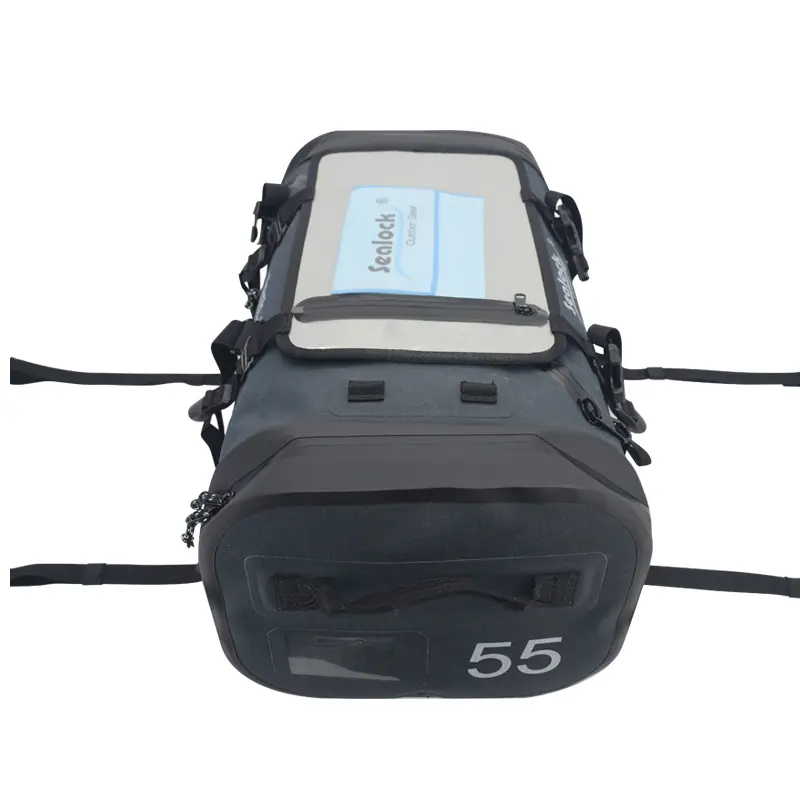
SL-E984 | 55L | 420D / 501D ripstop TPU | Welded body + airtight zipper seat · IPX7 · reflective panels and piping | View |
|
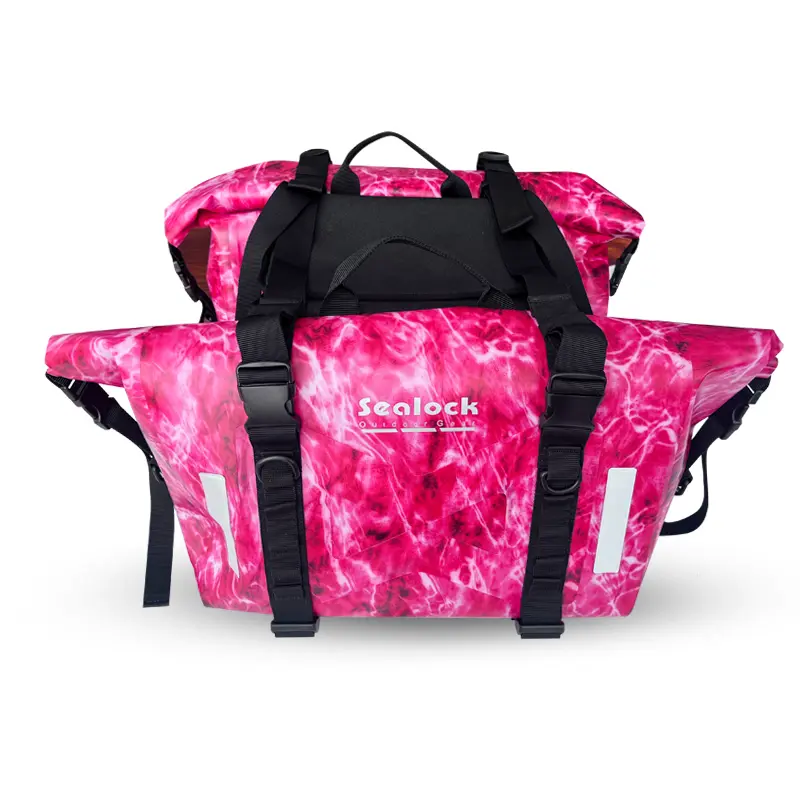
SL-C807 | 45L | 500D PVC / 420D TPU | HF-welded seams + welded hook-and-loop mounting panel · IPX6 · rated 8–12 kg | View |
|
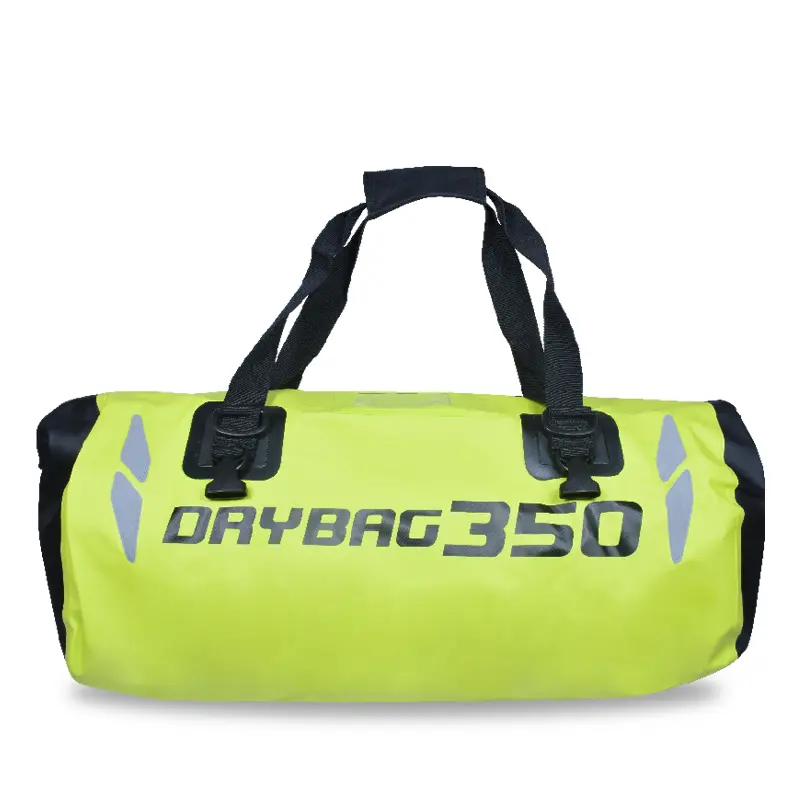
SL-C619 | 35 / 50L | 500D PVC tarpaulin | HF-welded + PVC reinforcement panels, welded D-ring anchors · IPX6 | View |
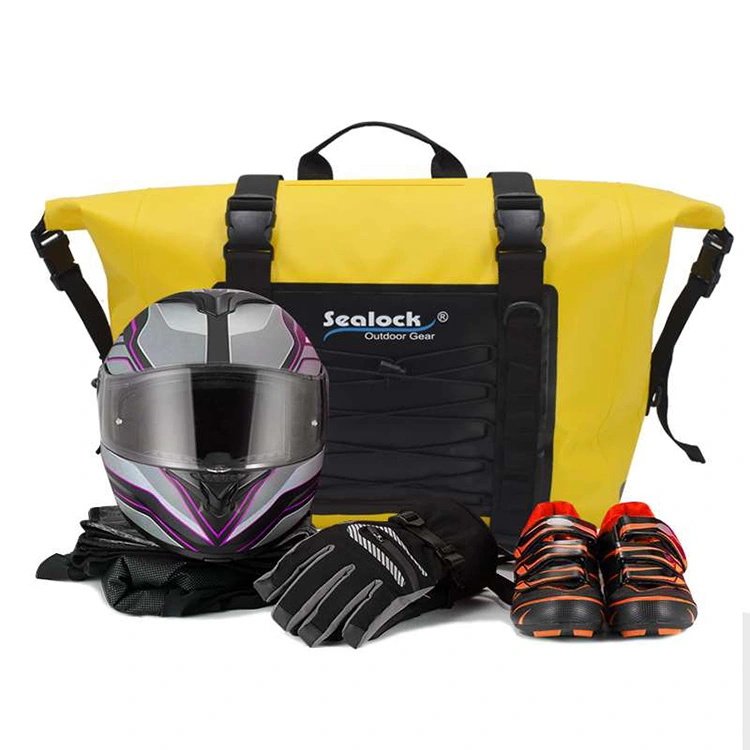
|
80L Saddlebags | 80L (40L × 2) | Welded PVC | Mirror-pair welded bodies · 50 kg · dual-side reflective | View |
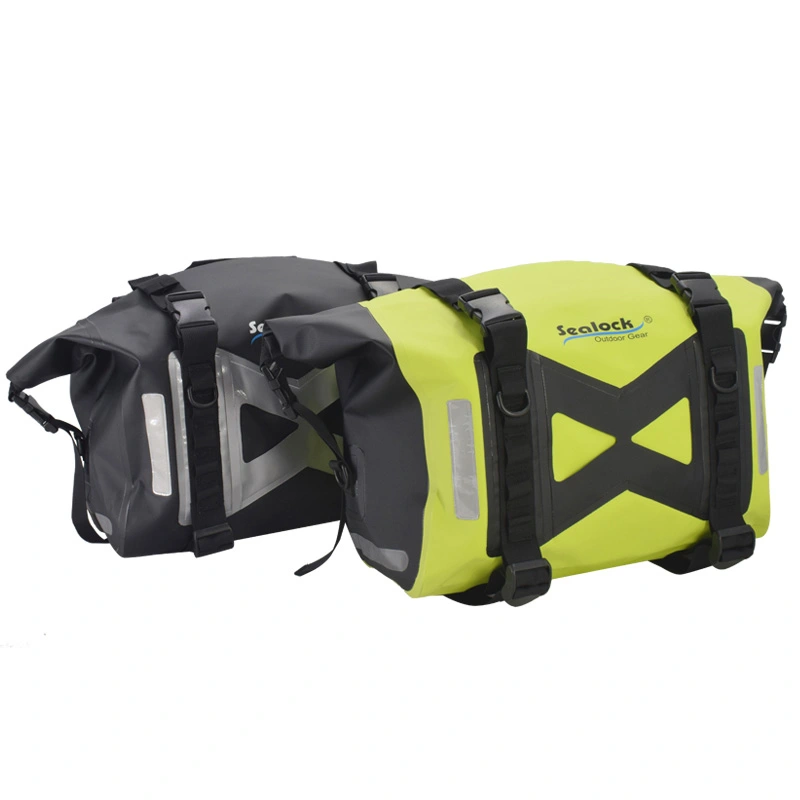
|
60L Saddlebags | 60L | Welded PVC | Seamlessly welded, both sides detachable · 50 kg | View |
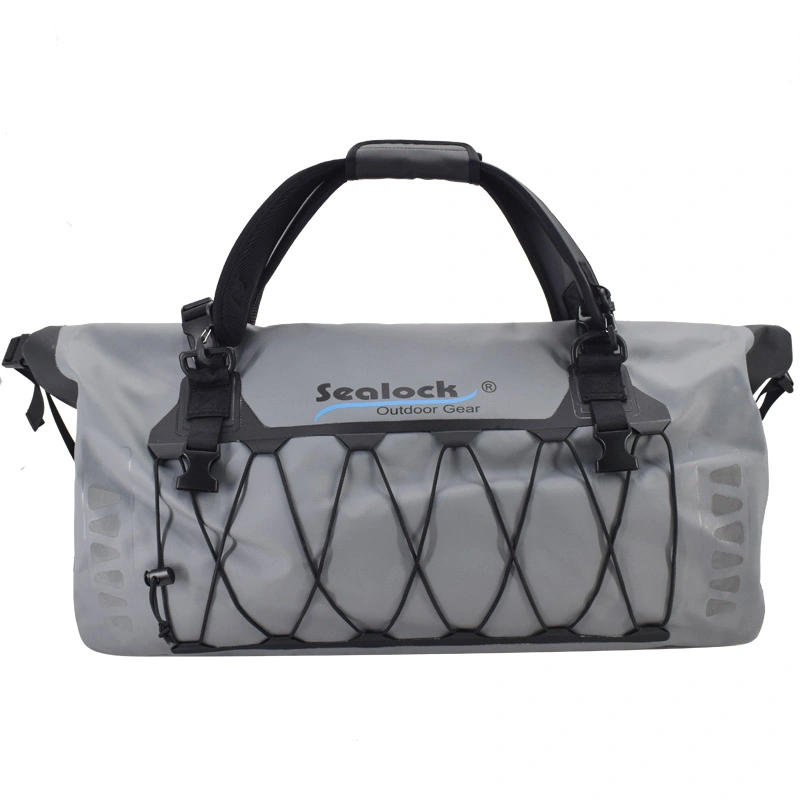
|
SL-C629 | 40 / 60 / 90L | 500D PVC tarpaulin | Welded backseat / tail rack bag · one-year warranty | View |
Full categories sit under waterproof bags, duffels, and dry bags. Design requirements for the category are covered in the guide for adventure brands, and how to verify a factory's claims in the supplier selection guide.
10. Custom Development
New geometries require their own machined dies, quoted separately and built before sampling starts, and tooling is engineered for repeatability across thousands of units rather than one good sample. Within that, ground-up development from a sketch, sample, or target spec is supported — capacity, closure type, mounting system including backing plates cut to a named rack pattern, fabric and denier, reflective coverage, and rated load. Note that the 55L three-way model's appearance is protected by a registered design patent; OEM partners receive distinct original development rather than copies of protected artwork.
11. FAQ
Q: Why is RF welding used rather than hot-air or stitching?
A: RF generates heat inside the material so both layers fuse simultaneously, producing a seam typically as strong as the base material and reliably airtight. It also suits PVC and PU-coated fabrics specifically, which is what motorcycle luggage is made from. Stitching perforates the waterproof layer and relies on tape that lifts with flexing, heat, and abrasion.
Q: How are straps and D-rings attached if the body can't be sewn through?
A: With welded reinforcement patches. A patch is RF welded to the outer surface, forming its own waterproof seal at the interface, and the load-bearing hardware sits on the patch rather than on the membrane. Hook-and-loop mounting panels, MOLLE strips, and bungee anchors are attached the same way.
Q: Where does motorcycle luggage actually fail?
A: At reinforcement and attachment areas, not in the middle of a panel. Weak reinforcement is the established failure pattern on load-carrying tarpaulin products, and vibration on a motorcycle accelerates it. That is why anchor construction and load cycling matter more here than on any other waterproof bag.
Q: How do you keep paired saddlebags balanced?
A: Through tooling. Mirror components are welded on matched dies so both bodies come off the line to identical dimensions — an 80L set is 40L per side. Unequal volumes lead to unequal loading, and a bike carrying more weight on one side is unsettled in ruts and crosswinds.
Q: Do PVC and TPU models run the same welding settings?
A: No. Parameters are qualified separately per material family and re-qualified when colour or fabric lot changes, because pigments, fillers, moisture, and thickness all change how the material absorbs RF energy. Thicker materials need stronger welds and tighter control.
Q: Can we commission a shape that isn't in the catalogue?
A: Yes. A new geometry needs its own machined die, quoted separately and built before sampling, which is a normal step in ground-up development. Share the launch date at enquiry so tooling and sampling can be scheduled against it.
Request a Factory Review
For a video walk of the welding line, weld test data, tooling quotations, or a sample built to your specification, submit an inquiry. Sealock responds to procurement enquiries within 24 hours, with production from Dongguan, China or Ho Chi Minh City, Vietnam.