
- English
- Español
- Português
- русский
- Français
- 日本語
- Deutsch
- tiếng Việt
- Italiano
- Nederlands
- ภาษาไทย
- Polski
- 한국어
- Svenska
- magyar
- Malay
- বাংলা ভাষার
- Dansk
- Suomi
- हिन्दी
- Pilipino
- Türkçe
- Gaeilge
- العربية
- Indonesia
- Norsk
- تمل
- český
- ελληνικά
- український
- Javanese
- فارسی
- தமிழ்
- తెలుగు
- नेपाली
- Burmese
- български
- ລາວ
- Latine
- Қазақша
- Euskal
- Azərbaycan
- Slovenský jazyk
- Македонски
- Lietuvos
- Eesti Keel
- Română
- Slovenski
- मराठी
- Srpski језик

Motorcycle Waterproof Bag Supplier Selection Guide
Sealock is a motorcycle waterproof bag supplier and OEM manufacturer serving distributors, dealer networks, and adventure brands from factories in China and Vietnam. Vetting a supplier in this category is not the same exercise as vetting a general bag factory. Motorcycle luggage is mounted to a vibrating machine, sits near an exhaust, carries a rated load, and — uniquely in the waterproof range — carries a legal exposure most buyers never think to check. This is the verification sequence worth running before a purchase order.
1. Why Motorcycle Supplier Vetting Is Different
A dry bag supplier proves capability with welding. A motorcycle luggage supplier has to prove three additional things: that its mounting systems survive continuous vibration, that it can state and defend a load rating, and that it understands the thermal and safety context the bag operates in. A factory can weld beautifully and still produce luggage that works loose at 100 km/h, has no published load figure, and puts reflective material where a following driver's headlights never fall.
2. The Capability Checklist
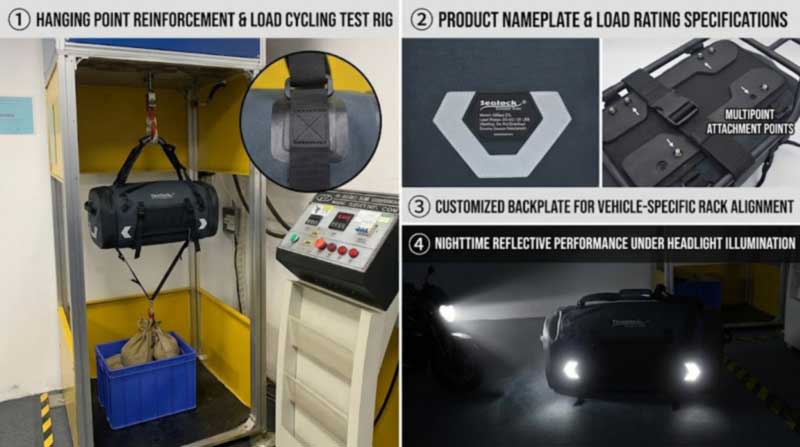
- How are mounting points tested? Vibration attacks anchors, not fabric. Ask what load-cycle testing runs on mounting straps, D-rings, and handles, and how anchors are reinforced. Sealock runs load cycling over 1,500 cycles on these points.
- What load is the bag rated for, and where is it published? Most suppliers avoid the question. A supplier that states a figure — 8–12 kg on the 45L tail bag, 50 kg carrying capacity on the paired saddlebags — is one a dealer can quote without guessing.
- Can mounting hardware be developed to a specific rack pattern? A supplier that only offers universal straps cannot serve a market where particular models dominate. Custom moulded nylon or CNC-aluminium backing plates cut to an existing rack pattern is the capability to ask about.
- Is the reflective specification real? Reflective printing, film panels, and piping perform differently and age differently. Ask what is used, where it sits, and whether coverage is on both sides — rear-mounted luggage sits exactly where following headlights land.
- Can they build both tiers? A supplier limited to one construction cannot serve a full price ladder. Welded PVC roll-top at IPX6 covers the volume tier; welded TPU with an airtight zipper at IPX7 covers premium. Both should be in the catalogue, not one plus a promise.
- What is the real capacity and lead-time structure? Ask for capacity per line and lead time by quantity band rather than a single headline number. Honest answers here look like 30,000 pcs/month on one line and 15,000 on another, with production running roughly 35, 40, and 45 days as quantities step up.
- Is there a stated warranty? Several models in this category carry a one-year warranty; a supplier unwilling to state any warranty position is telling a buyer something about its confidence in the anchors.
3. Test the Sample on a Motorcycle, Not on a Desk
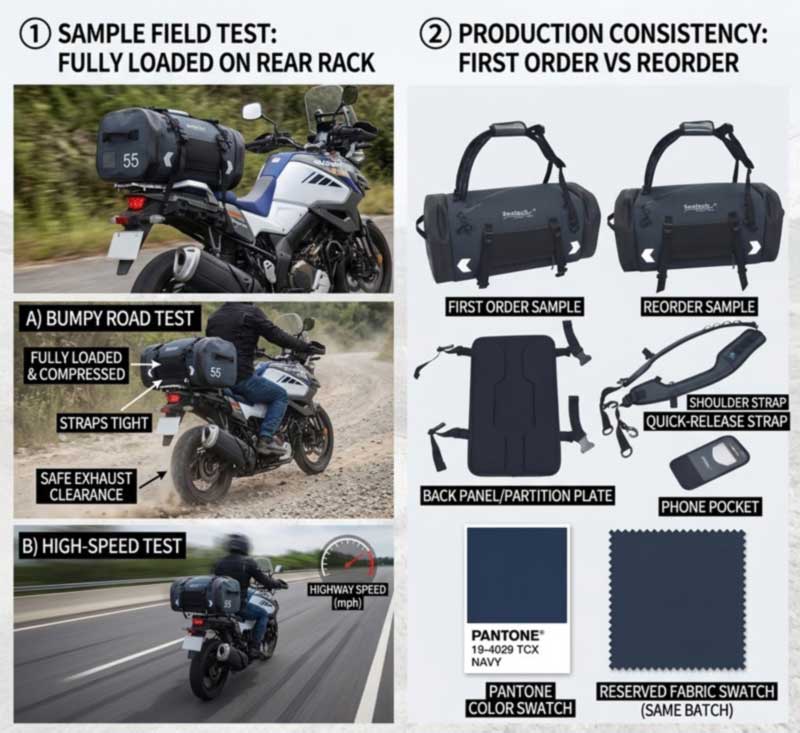
The single most common vetting mistake in this category is evaluating a sample indoors. Mount it. Load it to the rated weight, strap it to a rear rack or pillion seat, and ride it — the failures that matter only appear under vibration and airflow. Specifically, check whether the bag stays put under braking and over rough surfaces, whether it balloons or flutters at speed without compression straps cinched, whether the mounting hardware can be operated with gloves on, whether it sits clear of the exhaust on the machines your market actually rides, and whether the closure still seals after an hour of driven rain.
How the supplier behaves during sampling is diagnostic in itself. One that asks which motorcycles the bag will be fitted to, and raises exhaust clearance before you do, understands the product. One that treats it as a generic bag with straps does not.
4. The Legal Question Buyers Rarely Ask
This is the risk unique to accessory categories with strong visual identity, and it lands on the importer rather than the factory. If a supplier offers a design that copies a protected product, the buyer importing it carries the exposure — apparel and accessories consistently top customs intellectual property seizure statistics, seized goods can be detained, forfeited, and destroyed, and penalties for infringing imports rank among the most severe civil penalties customs authorities impose. The factory in another jurisdiction rarely bears any of that.
Two practical checks follow. First, ask directly whether a design being offered is the supplier's own or a copy of another brand's product — a supplier that cannot answer clearly is a liability. Second, ask what happens when you commission your own design: a supplier that develops distinct original work for OEM partners, rather than reissuing a shape already in the market, gives a distributor something it can defend rather than something a competitor can also buy. Sealock's own 55L three-way model carries a registered appearance-design patent, and OEM partners receive original development rather than copies of protected artwork — the same protection a buyer should want on its own programme.
5. Verifiable Numbers to Request
| Item | What to ask for |
|---|---|
| Anchor and strap durability | Load cycling results at mounting points — 1,500+ cycles here |
| Rated load | A published figure per model, not a category claim |
| Waterproof rating | IPX level tied to a named test — immersion for IPX7, rain and jet for IPX6 |
| Hardware corrosion | Salt spray results, relevant for coastal and winter-salted roads |
| UV and colour | Colour fastness and colour difference against a signed reference |
| Capacity and lead time | Per line and per quantity band, in writing |
Standards and defect classification behind these are set out in the quality control standards for waterproof production.
6. Red Flags
- No load rating anywhere. If a supplier will not commit to a number, it has not tested to one.
- Fluent on price, vague on welding, testing, or mounting. A real manufacturer explains its process in detail.
- Offering a well-known brand's silhouette. The importer carries that risk, not the factory.
- Reflective as an afterthought. A single small logo patch on a rear-mounted bag is decoration, not visibility.
- One construction only. A supplier without both roll-top PVC and airtight-zipper TPU cannot cover a dealer network's price ladder.
- Reluctance to allow inspection. Factory audits, video walks of the line, buyer-appointed inspectors, and third-party pre-shipment inspection should all be welcomed.
7. Prove It With a Trial Order, Then Check the Reorder
Samples establish capability; a trial order proves consistency. An MOQ of 300 pcs per model — 500 on the single-side saddle bag — keeps a first production run practical rather than a leap. Before that first order, confirm what governs the reorder: whether fabric lot, colour, and hardware can be reserved or matched, whether a signed gold sample is held by both sides, and whether colour-difference testing runs on every batch. A dealer network cannot absorb colour drift between shipments, and it is screenable in advance rather than discovered at replenishment.
8. Sealock Capability Summary
Sealock (YiFuLong Outdoor Gear Co., Ltd.) has built welded waterproof bags for over 20 years, producing for international outdoor and motorcycle brands including Benelli, Helly Hansen, OSPREY, and CHUMS. In-house 27.12 MHz high-frequency welding runs alongside industrial sewing lines. Terms: MOQ 300 pcs per model (500 on the single-side saddle bag), samples 7–15 days, bulk 30–45 days by quantity, FOB Guangdong loading from Shenzhen, T/T 30% deposit and 70% balance against a passed pre-shipment inspection. Capacity runs up to 30,000 pcs/month on the roll-top luggage line and 15,000 pcs/month on tail bag lines. Either origin — Dongguan, China or Ho Chi Minh City, Vietnam — is available on any model. Compliance covers ISO 9001, BSCI, SMETA, HIGG, GRS, and SCAN, and buyers are welcome to send their own or a third-party inspector.
9. Range to Evaluate Against
Models organized by type rather than priority:
| Image | Model | Capacity | Material | Closure / verification points | Product Page |
|---|---|---|---|---|---|
|
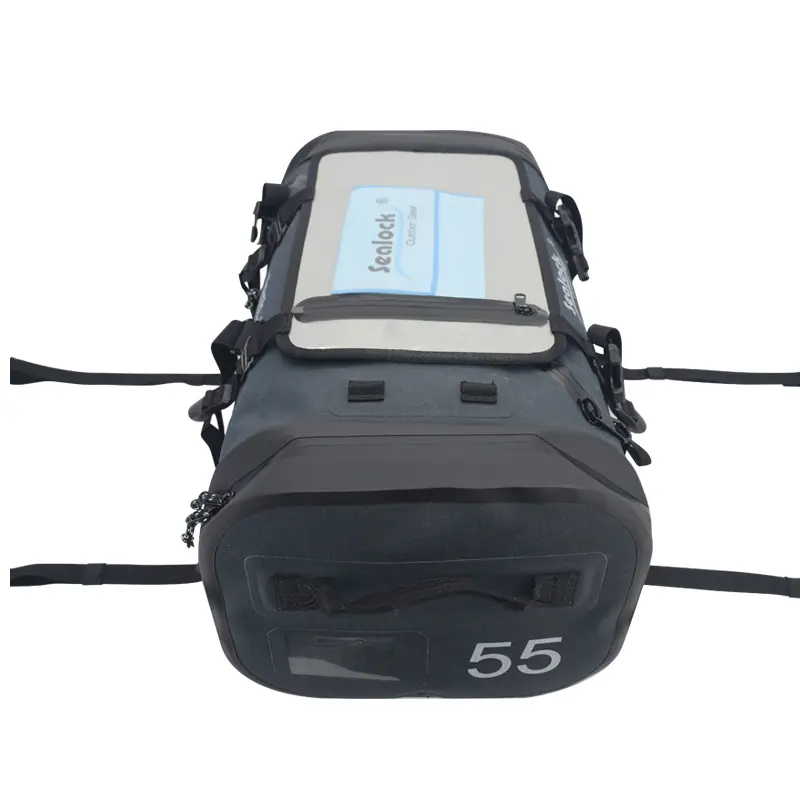
SL-E984 | 55L | 420D / 501D ripstop TPU | Airtight zipper · IPX7 · registered design patent · reflective panels and piping | View |
|
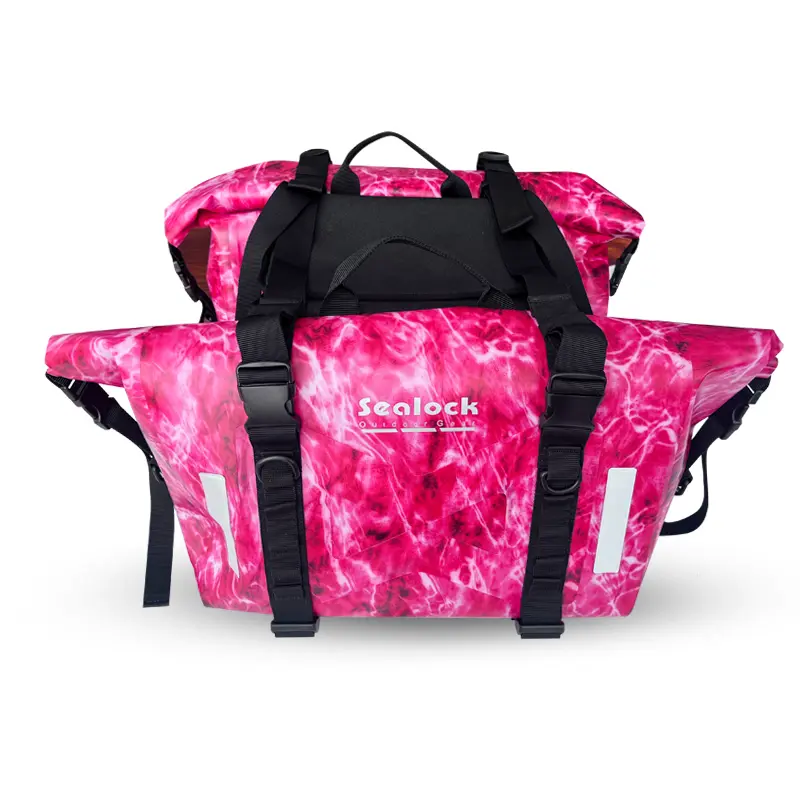
SL-C807 | 45L | 500D PVC / 420D TPU | Roll-top · IPX6 · rated 8–12 kg · dual-side reflective | View |
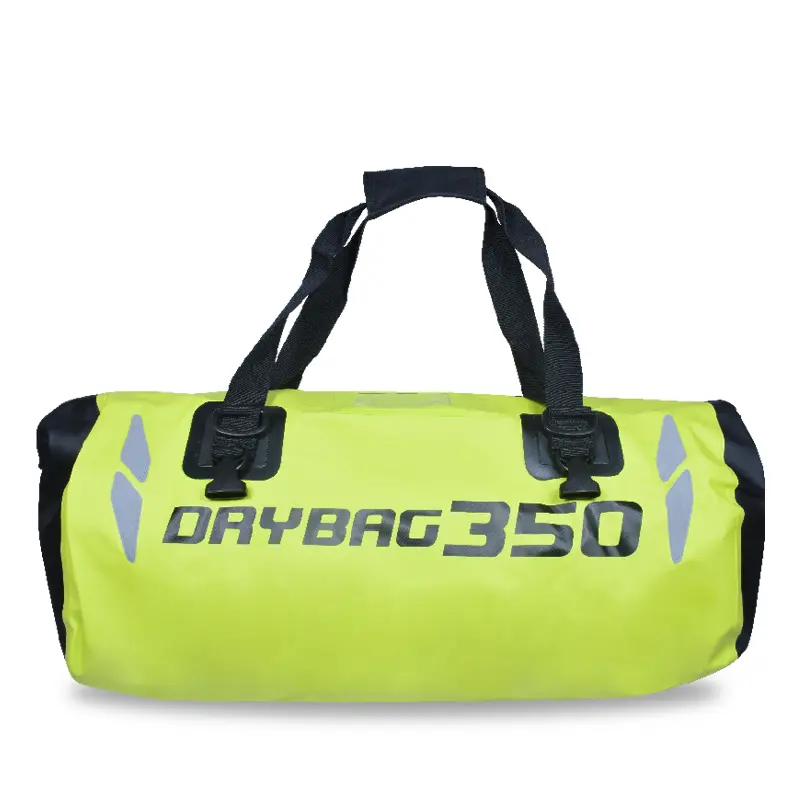
|
SL-C619 | 35 / 50L | 500D PVC tarpaulin | Roll-top · IPX6 · POM buckles, heavy-duty D-rings, reflective print | View |
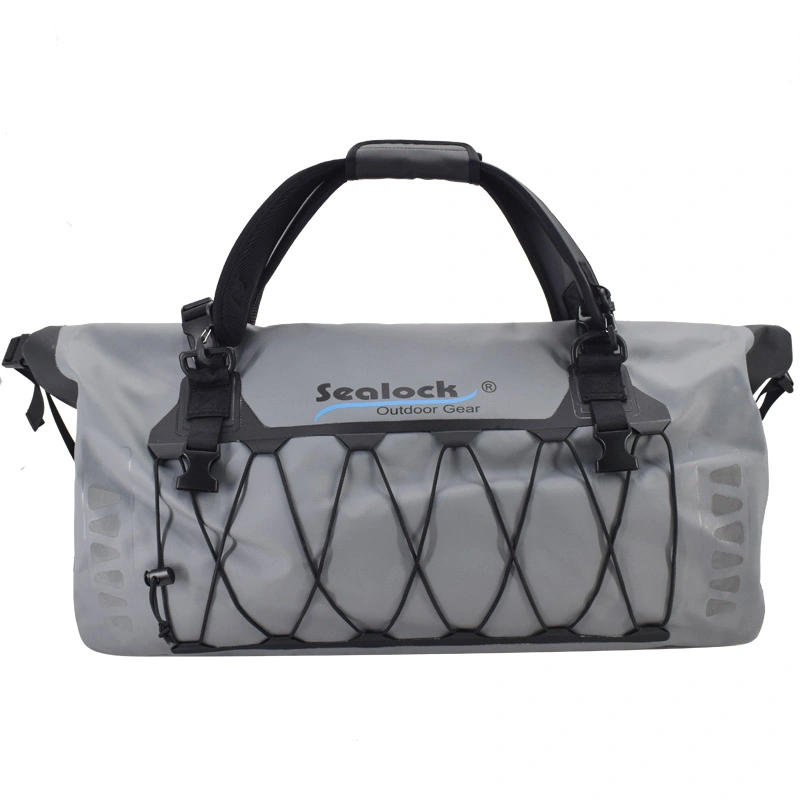
|
SL-C629 | 40 / 60 / 90L | 500D PVC tarpaulin | Backseat / tail rack · one-year warranty | View |
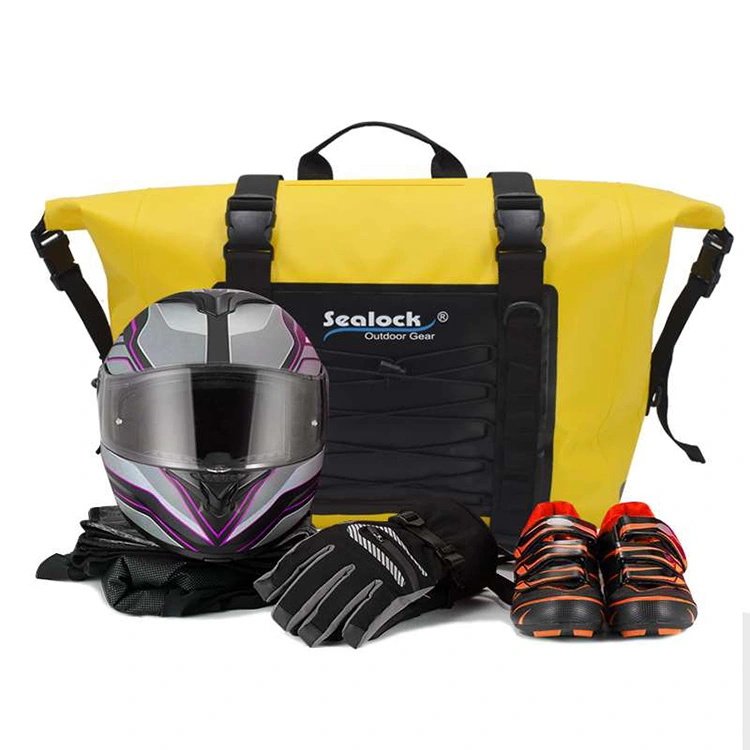
|
80L Saddlebags | 80L (40L × 2) | Welded PVC | Both sides detachable · 50 kg · dual-side reflective | View |
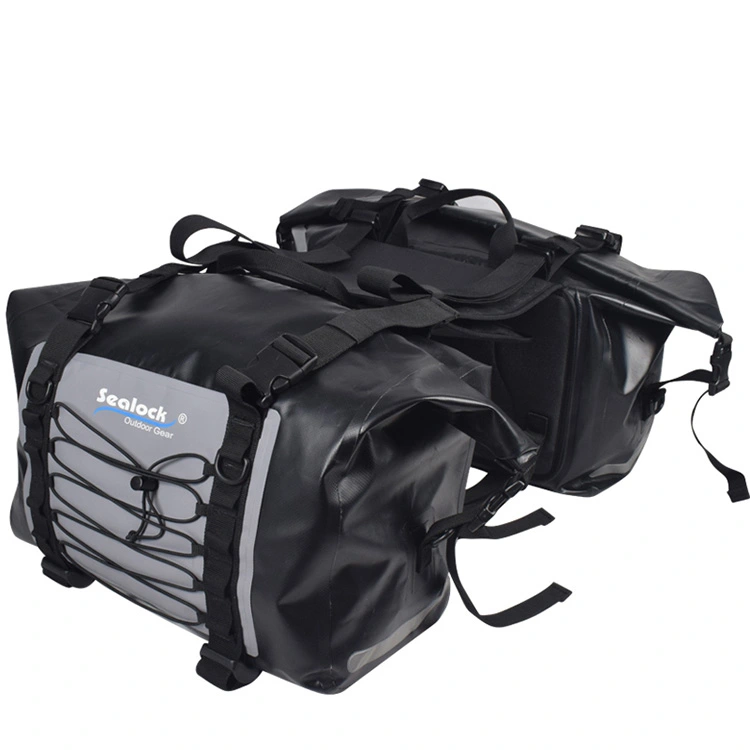
|
SL-C700 | 40L | 500D PVC tarpaulin | Single side · one-year warranty · MOQ 500 pcs | View |
Full categories sit under waterproof bags, duffels, and dry bags. The engineering requirements are set out in the guide for adventure brands, own-brand programme structure in the guide for global distributors, and order timing in the wholesale sourcing guide.
10. Quality Control
Every batch runs IQC on incoming tarpaulin, hardware, and reflective materials; IPQC on welds and mounting-point construction in process, including peel tests on sample welds at run start; and OQC with AQL sampling, batch immersion testing, and signed gold-sample comparison. The full customer inspection procedure — unboxing, vacuum extraction, a 24-hour static rest, and air-leak determination — can be witnessed end to end by a buyer's inspector, with third-party inspection through SGS or QIMA available on request.
11. FAQ
Q: A supplier makes good dry bags — can it make good motorcycle luggage?
A: Not automatically. Welding is only part of it. Motorcycle luggage has to survive continuous vibration at the anchors, carry a stated load, mount securely enough not to shift onto an exhaust, and put reflective material where following headlights fall. Ask about all four, not just the seams.
Q: How should I test the sample?
A: On a motorcycle, loaded to the rated weight, ridden over rough surfaces and at speed. Check retention under braking, flutter without compression straps, glove operability, exhaust clearance on the bikes your market rides, and sealing after sustained rain. A desk inspection reveals none of these.
Q: A supplier offered us a copy of a well-known brand's bag. What's the risk?
A: It sits with you. Apparel and accessories consistently lead customs IP seizure statistics, infringing imports can be detained, forfeited, and destroyed, and civil penalties for infringing imports are among the most severe customs authorities impose. Commission original development instead — it also gives you something competitors cannot buy.
Q: Why does the load rating matter so much?
A: Because it is the number dealers get asked and warranty claims turn on. A supplier that publishes a figure has tested to it; one that avoids the question has not. Note also that a motorcycle's rack rating is a separate figure describing what the rack may carry, not what the bike can carry.
Q: What lead time and capacity answers should I expect?
A: Specific ones. Capacity per line rather than a headline number, and lead times by quantity band — production stepping through roughly 35, 40, and 45 days as volume rises, with larger programmes quoted individually. Vagueness here usually means the order will be queued behind others.
Q: How do I stop the second shipment differing from the first?
A: Confirm before the first order whether fabric lot, colour, and hardware can be reserved or matched, hold a signed gold sample on both sides, and require colour-difference testing on every batch. Screening this in advance is far cheaper than discovering it at reorder.
Evaluate Sealock as a Supplier
To assess capability the practical way — request a video walk of the welding line, load-cycle and immersion test data, and a sample built to your specification for on-bike testing — submit an inquiry. Sealock responds to procurement enquiries within 24 hours.