
- English
- Español
- Português
- русский
- Français
- 日本語
- Deutsch
- tiếng Việt
- Italiano
- Nederlands
- ภาษาไทย
- Polski
- 한국어
- Svenska
- magyar
- Malay
- বাংলা ভাষার
- Dansk
- Suomi
- हिन्दी
- Pilipino
- Türkçe
- Gaeilge
- العربية
- Indonesia
- Norsk
- تمل
- český
- ελληνικά
- український
- Javanese
- فارسی
- தமிழ்
- తెలుగు
- नेपाली
- Burmese
- български
- ລາວ
- Latine
- Қазақша
- Euskal
- Azərbaycan
- Slovenský jazyk
- Македонски
- Lietuvos
- Eesti Keel
- Română
- Slovenski
- मराठी
- Srpski језик

Motorcycle Saddlebag Manufacturer for Adventure Motorcycle Brands
Sealock manufactures motorcycle saddlebags and soft panniers for adventure brands and OEM programmes from factories in China and Vietnam. Saddlebags are the most demanding position in motorcycle luggage to engineer, because a bag hanging beside the rear wheel sits close to a hot exhaust, close to a spinning tyre, and on a machine whose handling depends on the two sides being balanced. Tail bags forgive a loose specification; saddlebags do not. This covers what an adventure brand has to get right.
1. Company and Terms
Sealock (YiFuLong Outdoor Gear Co., Ltd.) has built welded waterproof bags for over 20 years, producing for international outdoor and motorcycle brands including Benelli, Helly Hansen, OSPREY, and CHUMS.
- Facilities: Dongguan, China | Ho Chi Minh City, Vietnam — either origin available on any model
- MOQ: 300 pcs per model (500 on the single-side saddle bag) | Samples: 7–15 days | Bulk: 30–45 days
- Terms: FOB Guangdong from Shenzhen, T/T 30% deposit and 70% balance against inspection
- Certifications: ISO 9001, BSCI, SMETA, HIGG, GRS, SCAN
2. Heat Is the Defining Failure Mode
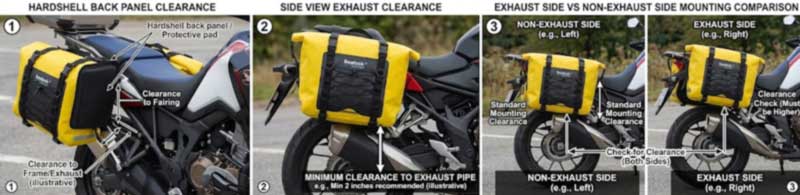
A melted pannier is the signature saddlebag failure, and it escalates: a bag that shifts and presses onto a hot silencer starts as melted luggage and can end far worse. The industry position is more candid than most brands admit — across published soft luggage ranges, no vendor documents its bags as clearing a stock exhaust by design. Roughly half ship a heat shield for at least some listed machines, some require one to be bought separately, and a number publish no heat answer at all.
For an OEM programme that means heat has to be answered in the product rather than left to the customer. The available design responses:
- A rigid backing panel on the inboard face, which spaces the bag off the bike, protects paintwork, and provides a measure of thermal separation.
- Cut geometry that lifts the lower inboard corner clear — the same approach sport-bike throw-overs use, and the reason that cut suits machines with upswept exhausts.
- Supplying a heat shield in the box for the machines a brand's market actually rides, rather than treating it as an accessory.
- Rack compatibility, since a rack is the only mounting that reliably holds a bag off the pipe and the side panels.
One thing worth stating plainly in customer-facing material: a heat shield does not rescue a poorly mounted bag. Where a choice exists between packing slightly narrower and preserving exhaust clearance, clearance wins.
3. The Wheel Clearance Test Most Specifications Skip
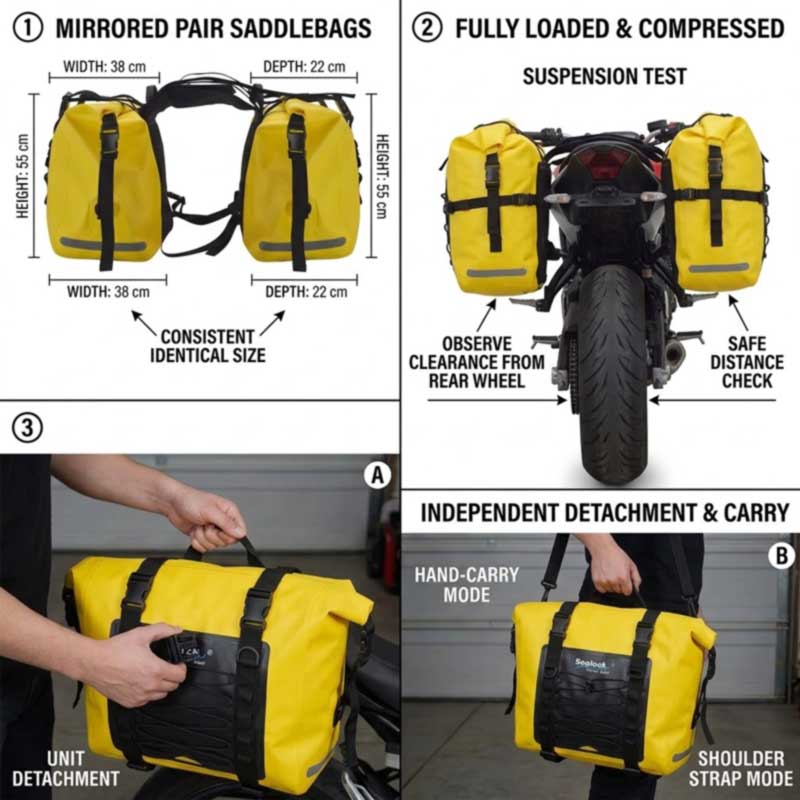
Empty saddlebags sit fine in a showroom and sag into the rear wheel once loaded with tools, water, and spare layers. A meaningful clearance check has to be done under real conditions: the bike on level ground, bags loaded close to how a customer would actually pack them, then the rear suspension compressed while watching what the bag does and how the strap angle changes.
Two product answers follow. Structural stiffeners hold shape under load so the bag does not deform toward the wheel, and forward stabilising straps to a fixed point on the bike stop the bag swinging or migrating rearward over rough ground. Both belong in an OEM specification rather than being discovered during sampling.
4. Symmetry Is a Tooling Problem
Paired saddlebags introduce a requirement no other bag in the range has: the two bodies must be dimensionally identical, because unequal volumes invite unequal loading, and a motorcycle carrying more weight on one side becomes unsettled in ruts and crosswinds. That is solved upstream — mirror components are welded on matched dies so both sides leave the line to the same dimensions. The 80L set is built as 40L per side, and each bag is independently detachable and usable on its own.
There is a deliberate exception worth knowing. Some premium ADV brands specify the exhaust-side bag slightly smaller than the other, trading a few litres for clearance on machines where the pipe intrudes. It is a legitimate design choice rather than a manufacturing error, and if a brand wants it, the asymmetry must be intentional and stated on the listing so the customer understands why the two bags differ.
5. Throw-Over or Rack-Mounted
|
|
Throw-over / rackless | Rack-mounted |
|---|---|---|
| Mounting | Joined over the seat by a hook-and-loop panel, with adjustable straps and a forward stabiliser per side | Attached to a frame at multiple points |
| Fitment breadth | Fits most machines; moves between bikes | Requires the matching rack |
| Exhaust and wheel clearance | Depends on straps, cut, and shields | Held clear by the frame — the most reliable answer |
| Narrowness | Narrower overall | Wider, because the rack adds offset |
| Cost to the customer | No rack purchase | Rack adds weight and cost |
Both are viable, and most adventure ranges eventually carry both. A practical rule for a first programme: throw-over reaches the wider market, but any set above roughly 25 litres per side benefits from at least a light rack or support to stop the bag shifting onto the silencer.
6. Detachability and Off-Bike Use
Saddlebags spend part of their life off the machine, and how easily they come off decides how well the product reviews. Independent detachment per side, quick-release strap sets, and a shoulder strap for carrying a bag into accommodation are all specifiable. On the current sets, both bags detach independently and can be used separately, with sturdy shoulder straps included.
7. Construction and Materials
The sets are built from welded PVC — seamlessly welded so there are no needle holes, waterproof, dustproof, and weatherproof, and easy to rinse clean of road film and mud. PVC is the mainstream choice in this position for good reason: it resists abrasion where a bag contacts a rack or the bike, holds structured shape when strapped down, and keeps the price point competitive. TPU laminate is available where lower weight and cold flexibility matter more.
Both current sets carry a stated 50 kg carrying capacity, which is a figure a dealer can quote. Reflective markings on both sides are specified rather than decorative — saddlebags occupy exactly the width a following driver needs to see at night. The welding behind this construction is set out in the RF welding factory guide.
8. OEM Scope
Beyond logo and colour, a saddlebag programme can specify capacity per side and total, symmetric or intentionally asymmetric volumes, closure type from roll-top to airtight zipper, fabric and denier in PVC or TPU, backing panel and stiffener construction, cut geometry for exhaust clearance, mounting architecture including throw-over panels or rack compatibility, strap set composition and forward stabilisers, heat shield inclusion, reflective placement, rated load, detachment method and shoulder straps, and packaging. New geometries need their own machined dies, quoted separately and built before sampling, so launch dates should be shared at enquiry. Ground-up development from a sketch, sample, or target spec is supported.
9. Saddlebag Range
Models organized by type rather than priority:
| Image | Model | Capacity | Material | Mounting / features | Product Page |
|---|---|---|---|---|---|
|
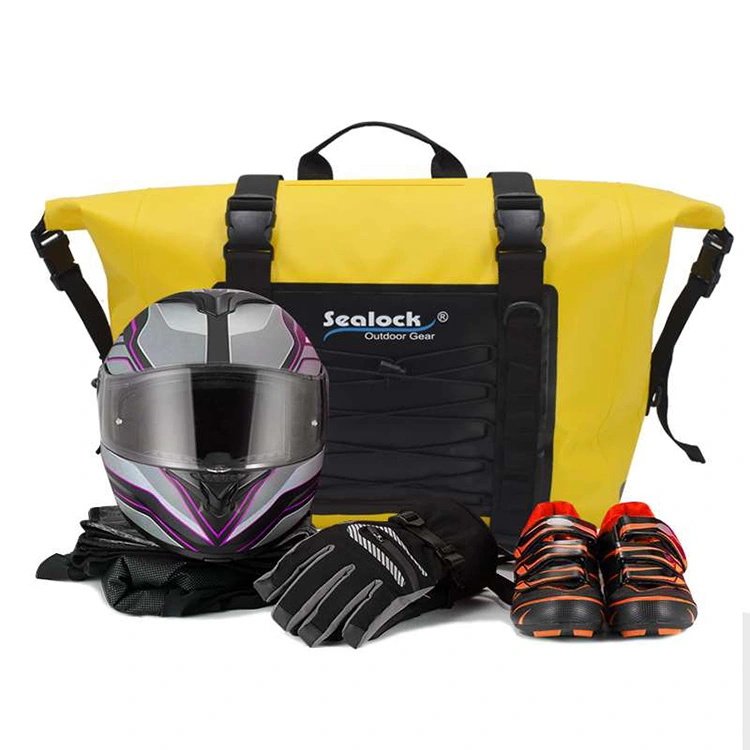
80L Saddlebags | 80L (40L × 2) | Welded PVC | Hook-and-loop + two adjustable straps · 50 kg · both sides detachable · dual-side reflective | View |
|
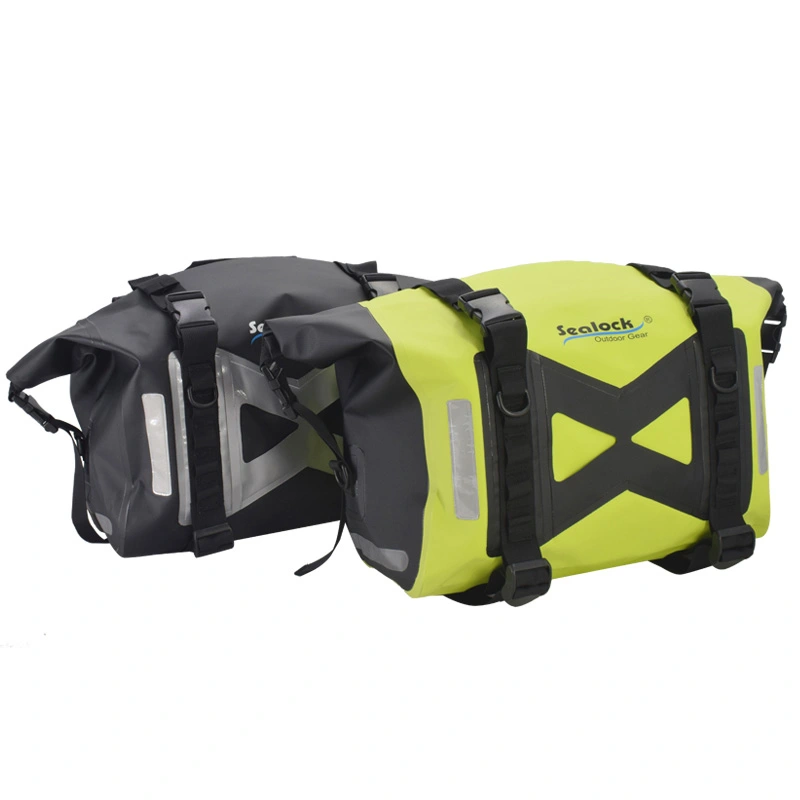
60L Saddlebags | 60L | Welded PVC | Both sides detachable · 50 kg · dual-side reflective · holds helmet | View |
|
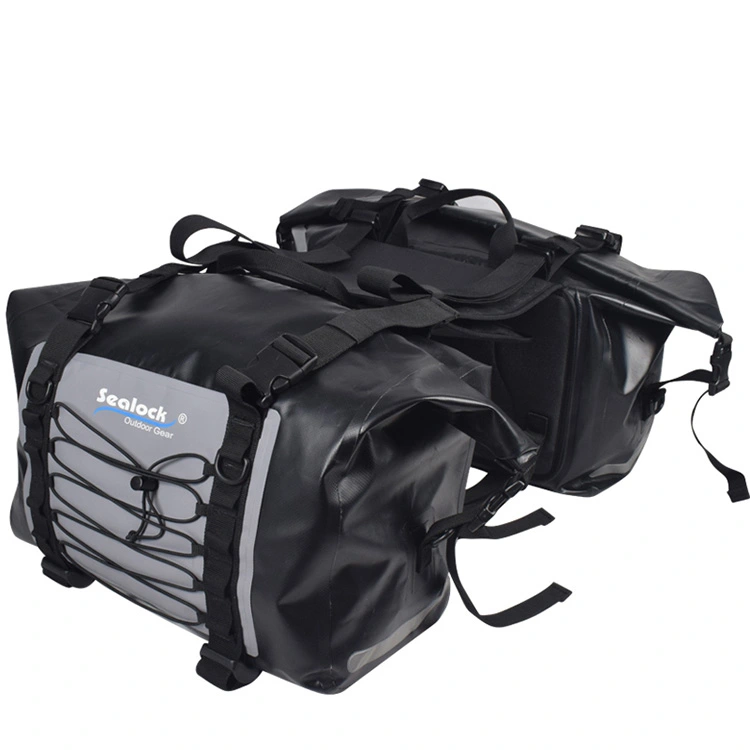
SL-C700 | 40L single side | 500D PVC tarpaulin | Single-side mount · one-year warranty · MOQ 500 pcs | View |
|
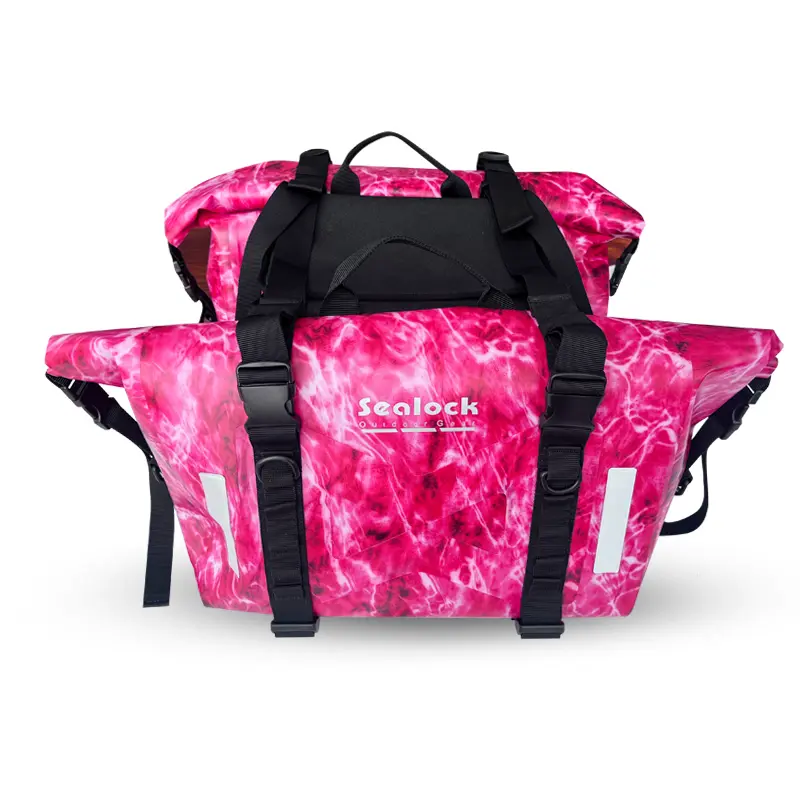
SL-C807 | 45L | 500D PVC / 420D TPU | Tail position · roll-top · IPX6 · rated 8–12 kg | View |
|
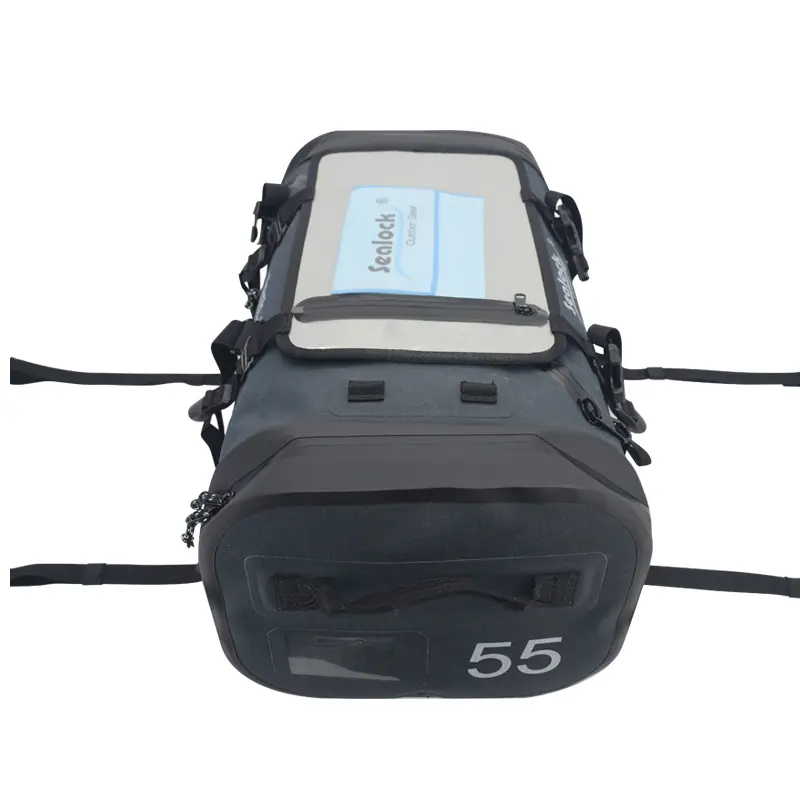
SL-E984 | 55L | Ripstop TPU | Tail position · airtight zipper · IPX7 · three-way carry | View |
Saddlebags and tail bags are complementary positions rather than competing products — a full adventure range covers both. Tail bag platform selection is set out in the tail bag OEM guide, and category engineering in the guide for adventure brands. Full categories sit under waterproof bags and dry bags.
10. Quality Control
Every batch runs IQC on incoming tarpaulin, hardware, and reflective materials; IPQC on welds and mounting-point construction in process, including peel tests at run start; and OQC with AQL sampling, batch testing, and signed gold-sample comparison. Load cycling over 1,500 cycles targets mounting straps, D-rings, and handles, alongside tensile and bonding strength, salt spray for coastal and salted-road exposure, friction resistance, colour fastness, and colour difference. Paired sets are additionally checked for dimensional match between left and right bodies against the signed sample. The full customer inspection procedure — unboxing, vacuum extraction, a 24-hour static rest, and air-leak determination — can be witnessed end to end, with SGS or QIMA inspection available. Standards are set out in the quality control standards for waterproof production.
11. FAQ
Q: How do we stop saddlebags melting on the exhaust?
A: In the product, not the manual. A rigid inboard backing panel for standoff, cut geometry that lifts the lower inboard corner, a heat shield supplied for the machines your market rides, and rack compatibility for heavier sets. Be candid in the listing too — no soft luggage on the market is documented as clearing every stock exhaust by design.
Q: Why do bags that fit fine empty end up rubbing the wheel?
A: Because clearance was checked unloaded. Bags sag once packed with tools and water, and compressing the rear suspension changes both the gap and the strap angle. Specify structural stiffeners and forward stabilising straps, and test loaded with the suspension compressed.
Q: Should both sides be the same size?
A: Usually yes — unequal volumes lead to unequal loading and a bike that wanders in ruts, so mirror bodies are welded on matched dies. Some ADV brands deliberately make the exhaust-side bag slightly smaller for clearance; if you want that, make the asymmetry intentional and state it on the listing.
Q: Throw-over or rack-mounted for a first range?
A: Throw-over reaches more customers, needs no rack purchase, and sits narrower. Rack-mounted is the more reliable answer for clearance and stability. Above roughly 25 litres per side, at least a light support is worth recommending to keep the bag off the silencer.
Q: What load should we publish?
A: A real figure. The current sets carry a stated 50 kg capacity. Publishing it lets dealers answer the question customers actually ask, and it protects the brand when a bag is overloaded beyond what was specified.
Q: Can each bag be used independently?
A: On these sets, yes — both sides detach and can be used separately, with shoulder straps for carrying off the bike. Independent detachment is worth specifying, because it is what riders use at overnight stops.
Request a Saddlebag OEM Proposal
For capacity and clearance development, mounting architecture, samples, or a full OEM proposal for an adventure range, submit an inquiry. Sealock responds to procurement enquiries within 24 hours, with production from Dongguan, China or Ho Chi Minh City, Vietnam.