
- English
- Español
- Português
- русский
- Français
- 日本語
- Deutsch
- tiếng Việt
- Italiano
- Nederlands
- ภาษาไทย
- Polski
- 한국어
- Svenska
- magyar
- Malay
- বাংলা ভাষার
- Dansk
- Suomi
- हिन्दी
- Pilipino
- Türkçe
- Gaeilge
- العربية
- Indonesia
- Norsk
- تمل
- český
- ελληνικά
- український
- Javanese
- فارسی
- தமிழ்
- తెలుగు
- नेपाली
- Burmese
- български
- ລາວ
- Latine
- Қазақша
- Euskal
- Azərbaycan
- Slovenský jazyk
- Македонски
- Lietuvos
- Eesti Keel
- Română
- Slovenski
- मराठी
- Srpski језик

Dry Bag Manufacturer: OEM Waterproof Bag Solutions for Global Brands
Sealock is a dry bag manufacturer offering OEM and ODM waterproof bag production for global brands, importers, and private-label programs. An OEM waterproof bag is the sum of its material, closure, hardware, seam, and carry choices — and a brand that specifies each of those deliberately gets a product that fits its market rather than the factory's default. This guide walks through every component a brand can customize, how to verify a real factory, and how to run a program from brief to bulk.
1. Why the Factory Choice Decides the Product
China produces most of the world's dry bags, but "made in China" is not a quality grade — the supply base runs from sticker-and-stitch trading offices to vertically integrated plants with in-house welding lines and pressure testing. A dry bag looks simple, yet it has many failure points: coating quality, seam width, roll-top stiffness, buckle strength, strap reinforcement, print adhesion, and consistency across a bulk run. The factory a brand picks determines whether those points hold up in the field or turn into returns. Sealock has built welded waterproof bags for over 20 years across categories that share one core process — high-frequency welding — from roll-top dry bags and dry backpacks to duffels and motorcycle luggage.
2. Material Choices in OEM Waterproof Bag Production
Material is specified against the brand's target weight, cost, cold-weather behavior, and market compliance:
| Material | Character | Typical use |
|---|---|---|
| PVC tarpaulin (500D / 840D / 1000D) | Rugged, rigid, low cost, weldable, pliable and crack-resistant at low temperature | Heavy-duty dry bags, motorcycle and marine luggage |
| Recyclable TPU and TPU-coated nylon (210D / 420D / 840D) | Lighter, flexible in cold, low odor, no plasticizers, more puncture- and abrasion-resistant per gram | Performance packs and duffels; REACH/RoHS-sensitive markets |
| Ripstop nylon (lightweight) | Very light, packable, grid-reinforced against tear propagation | Ultralight, rain-resistant rather than submersible |
Two denier weights can be combined in one build — a lighter 420D TPU body to save weight with a heavier 840D or 1000D base and side panels for abrasion where the bag is dragged. TPU is generally preferred where cold flexibility and an environmental profile matter, since it carries no plasticizers; PVC still wins on ruggedness and cost.
3. The Closure Layer Selection
The body can be engineered to a high standard and still underperform if the closure does not match the end use. There are two architectures, and the choice is driven by access pattern and exposure, not by what is easiest to make:
- Roll-top closure: a TPU- or PVC-reinforced collar folded three to four times and buckled. It has no moving parts and no seal to degrade — it works the same on day one and day five hundred — and it lets a brand purge air so the bag floats. Best where access is infrequent but protection must be absolute. A twin-stiffener collar can be specified to make a clean seal more intuitive for the end user.
- Waterproof zipper: a sealed zipper gives fast, clean access and true submersible performance when rated. It is heavier and pricier, relies on a rubberized coating that needs periodic silicone lubricant, and can stiffen in the cold — so it suits frequent-access products where speed matters. An abrasion over-flap protects the zipper track.
- Drawstring / dry-wet split: for splash-level and dry/wet-separation use, a drawstring or twin-chamber layout suits swim, beach, and gym lines rather than submersion.
4. The Zipper Selection
When a sealed zipper is specified, the brand of zipper is itself a decision, since the zipper is often the first component to fail. Sealock specifies rated airtight sliders as incoming components, each pressure-tested for submersibility before it enters production:
- YKK AquaSeal (VISLON molded teeth): the common standard on submersible bags — molded plastic teeth, RF-weldable into PU/TPU panels, widely serviceable.
- TIZIP MasterSeal: favored where a flatter lay, lighter weight, and easier long-term maintenance matter; users report it packs flatter and snags fabric less.
- Sizing and orientation: zipper size (tooth width) is matched to load and open/close frequency rather than defaulting to the largest, since an oversized zipper is not automatically more durable.
5. The Hardware Layer
Buckles, rings, and anchors carry the load and take the most abuse, so hardware is specified rather than left generic:
- Buckles: UTX-Duraflex heavy-duty POM or break-resistant PA side-release buckles in sizes from 10 mm to 38 mm; aluminum dual-adjust buckles where strap load is high.
- Corrosion resistance: non-corrosive polymer hardware for saltwater programs, where plain metal seizes and rusts.
- D-rings and lash points: heavy-duty polymer D-rings and MOLLE anchor points welded onto TPU/Hypalon reinforcement patches on the exterior — never sewn through the waterproof membrane — so load-bearing capacity is added without piercing the seal.
- Air valves: an optional purge (oral-inflation) valve lets the user burp out trapped air for a tighter pack, or inflate the bag for use as a flotation aid.

6. The Carry and Reinforcement Layer
How the bag is carried, and where it is reinforced, is specified to the use case:
- Carry systems: grab handles, single shoulder strap, convertible duffel-to-backpack straps, or a full ergonomic backpack harness with an S-curved shoulder strap, sternum buckle, and hip belt for load-bearing packs.
- Back panel: a padded or 3D honeycomb ventilated back panel offsets the heat of a non-breathing waterproof shell on packs.
- Reinforcement: laser-cut Hypalon or TPU patches at strap anchors and high-stress corners, an abrasion-resistant base panel, and secondary perimeter seam welding around zippers to stop teeth separating under packing pressure.
- Mounting: custom molded-nylon or CNC-aluminum backing plates for motorcycle racks and bike seat rails, cut to a brand's existing hardware for flush fitment.
7. The Seam and Weld Layer
The seam matters more than buyers usually weight, because a bag fails at its seams long before the fabric does. Sewn-and-taped seams put needle holes through the waterproof layer and rely on tape that can lift; welded seams fuse the coated layers into one continuous skin with no penetration. High-frequency welding at 27.12 MHz bonds the material at the molecular level, and a welded seam withstands roughly twice the stress of a sewn-and-taped one. If submersion matters to the end customer, welded is not optional — it is what allows a bag to be fully immersed and stay dry.

8. Branding and Finishing Options
Beyond structure, the brand-facing finishing is fully customizable: logo by silkscreen, heat transfer, welded emboss, or woven label; color to a Pantone standard across the range; reflective printing for night visibility; and custom retail or bulk packaging. Color is held to the approved standard by color-fastness and color-difference testing, which addresses the batch-to-batch color drift buyers frequently complain about.
9. Verifying a Real Factory and Running the Program
Before committing, a brand should confirm the checks that separate factories from resellers: in-house welding and its frequency; the exact IPX standard the bag is tested to, with proof; stated MOQ and lead time; customization depth beyond a logo; certifications; and origin options. Sealock welds in-house at 27.12 MHz, validates by full water immersion testing, holds ISO 9001, BSCI, SMETA, HIGG, GRS, and SCAN, and runs facilities in Dongguan, China and Ho Chi Minh City, Vietnam so a brand can shift country of origin to ease tariff exposure.
The program itself runs as a controlled development project: a product brief (drawings, reference samples, target capacity and use); quotation and terms; sampling, with one approved gold sample held by each side as the inspection reference; bulk production under IQC, IPQC, and OQC; and pre-shipment inspection, with optional SGS/QIMA third-party audit before balance payment. Sealock offers full ground-up development from a sketch or sample, which runs longer than modifying an existing model, so a brand should schedule against its launch date.
10. Production Range: One Factory Across Categories
A brand launching a line often needs several bag types under one logo, colorway, and packaging spec, built in the same workshops and shipped in one run. Representative categories and models, organized by type rather than priority:
| Image | Category | Representative model | Material | Product Page |
|---|---|---|---|---|
|
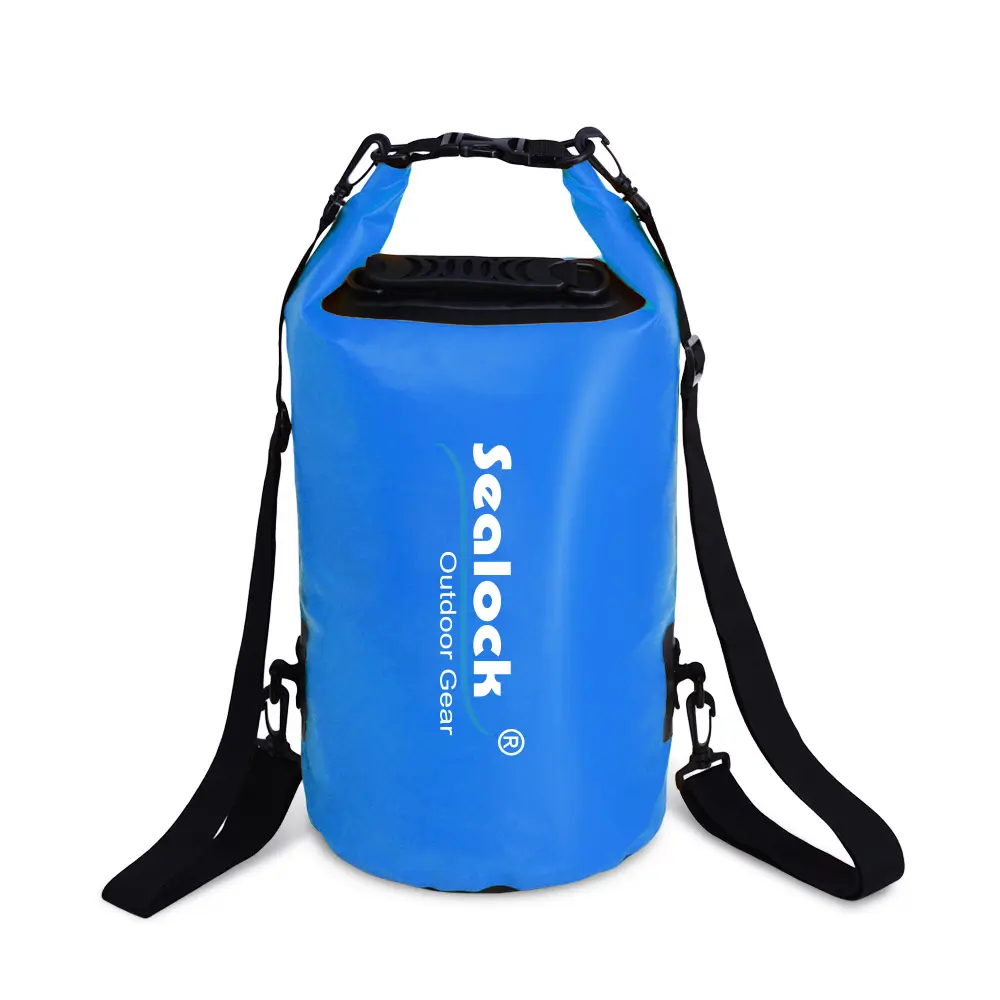
Roll-top dry bag | 500D PVC UTX Buckle Dry Bag (SL-D002), 5–63L | 500D PVC | View |
|
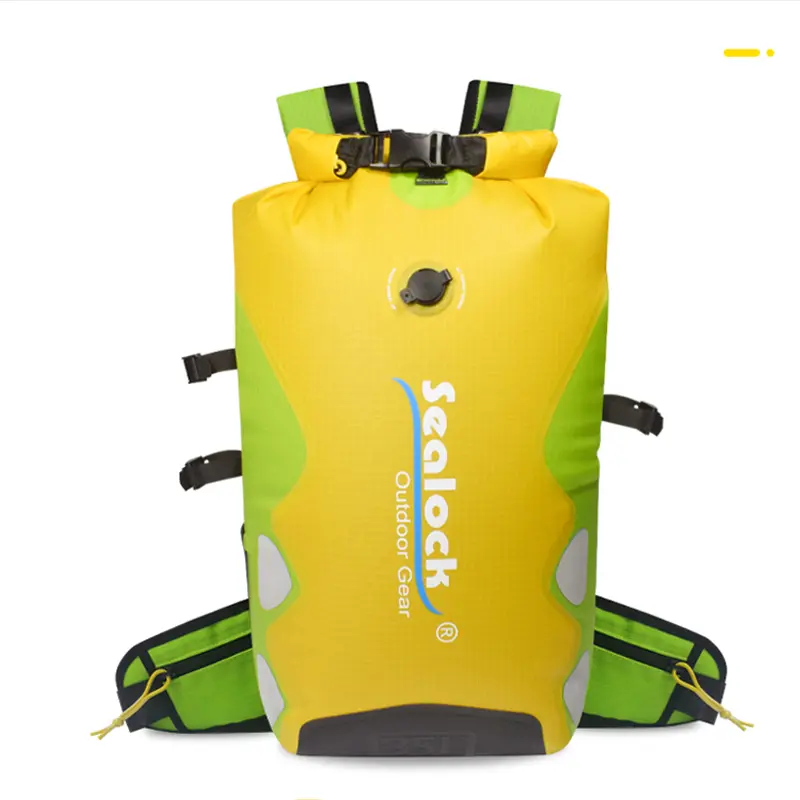
Dry backpack | 35L Roll-Top Backpack (SL-E801), air valve | 420D TPU | View |
|
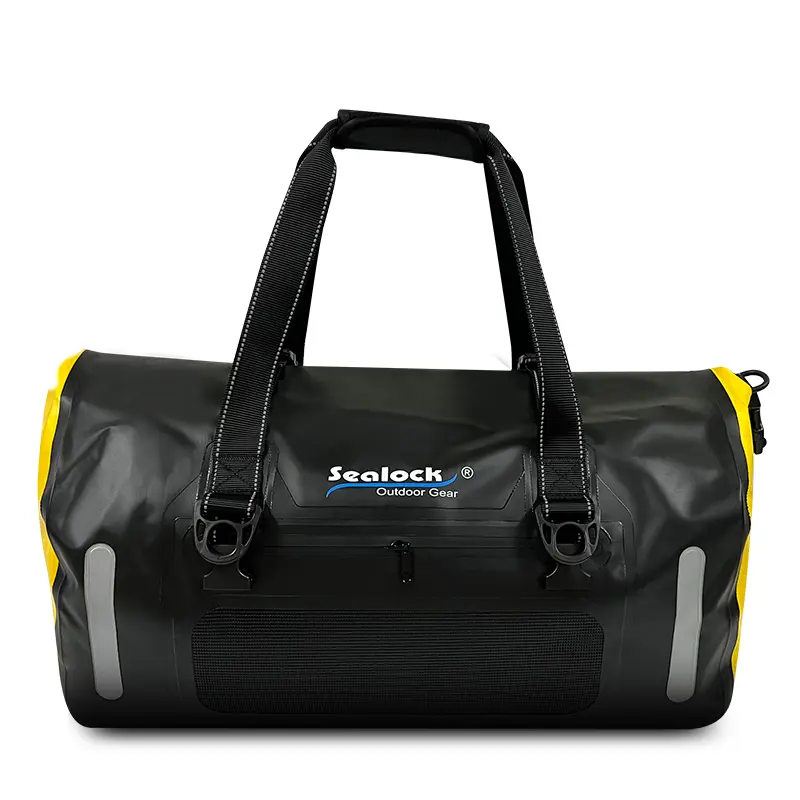
Waterproof duffel | 40L / 60L Roll-Top Duffel (SL-K099) | 840D TPU | View |

|
Zippered duffel | Waterproof Duffle for Kayaking, IPX8 zipper | TPU composite | View |
|
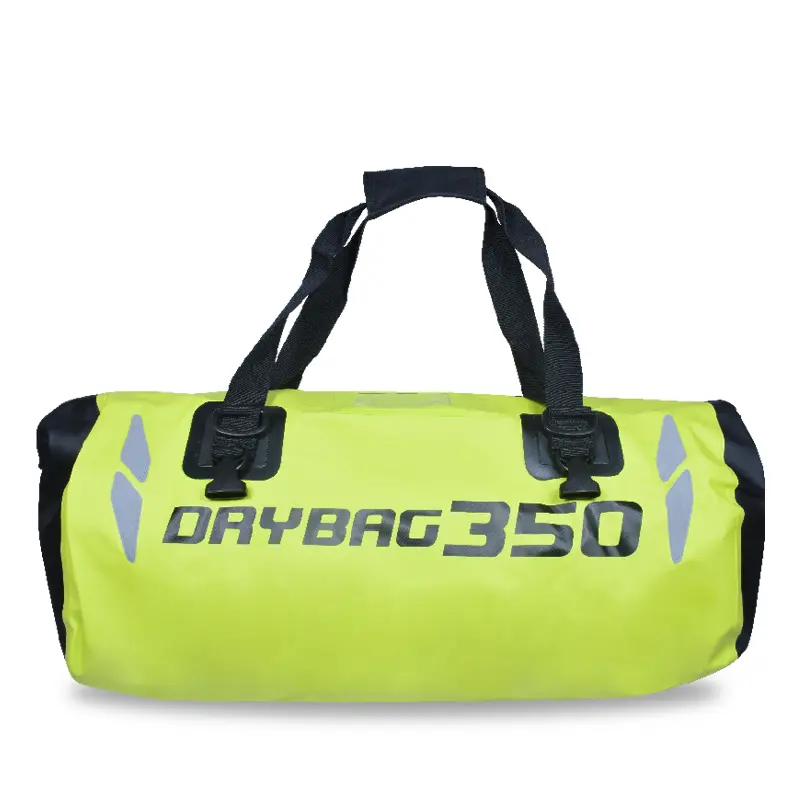
Motorcycle luggage | 50L Motorcycle Luggage Bag (SL-C619), 35/50L | 500D PVC | View |
|
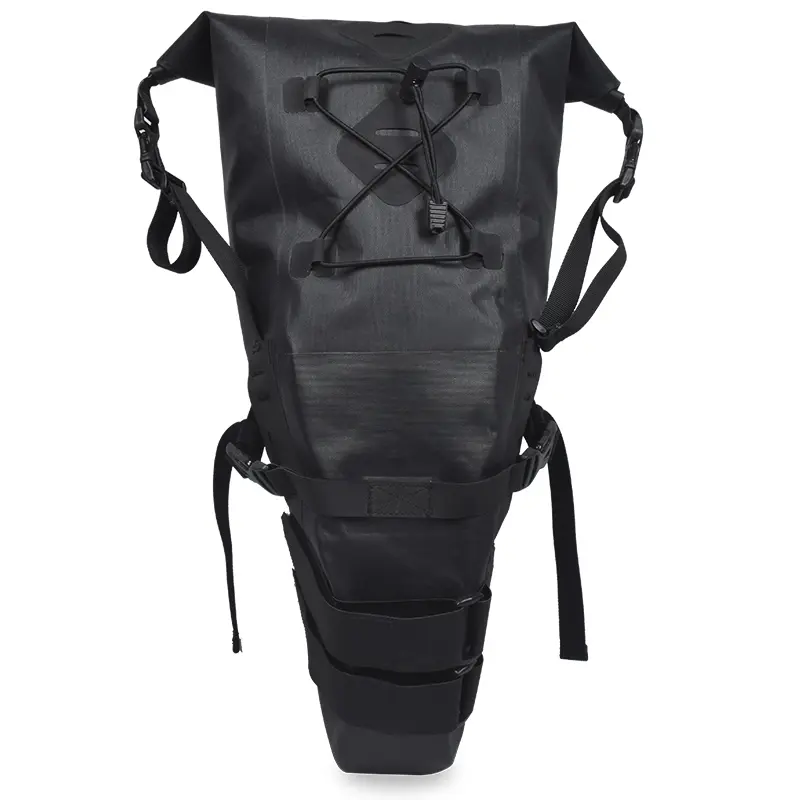
Bikepacking / cycling | Bikepacking Saddle Bag (SL-K022), 10–14L | 420D/600D TPU | View |
11. Quality Control and Compliance
Sealock applies a three-stage control to every batch before shipment. The laboratory test suite covers a load test of over 1,500 cycles, 3,000 sealed-zipper cycles for zippered models, tensile strength, bonding strength, salt spray, friction resistance, color fastness, and color difference, plus a full water immersion test to confirm the interior stays dry. Inspection runs in three stages: IQC on incoming fabric, zippers, and hardware; IPQC on welds and processes in line; and OQC with AQL sampling, batch immersion testing, and signed gold-sample comparison, with optional SGS/QIMA third-party inspection on request.
12. FAQ
Q: Buyers report bags that leak along the zipper seam — how is that prevented?
A: Zipper-seam leakage is one of the most common dry-bag complaints, and it traces to the seam, not just the zipper. Welding the zipper into the panel rather than stitching-and-taping it removes the needle-hole path, secondary perimeter welding stops the teeth separating under pressure, and every batch is immersion-tested with the closure shut.
Q: Some waterproof zippers get stiff and hard to open in the cold — is that avoidable?
A: Reviewers note certain waterproof zippers stiffen in freezing temperatures. Material and component choice drive this: TPU-laminated fabric stays flexible in cold, and a lighter molded zipper such as TIZIP lays flatter and moves more easily than a stiff coil — worth confirming at sampling for cold-market lines.
Q: Owners find the zipper's sealing gasket deteriorates after a few years — how is longevity built in?
A: Long-term users report the rubberized seal that forms a zipper's closure can degrade and let air, then water, through. Specifying a rated slider pressure-tested as an incoming component, an abrasion over-flap, UV-stable materials, and a maintenance step of periodic silicone lubricant all extend seal life; a roll-top avoids the issue entirely by having no gasket.
Q: D-rings and straps tear off under load — how is that engineered out?
A: Attachment failure is a common heavy-use complaint. Welding D-rings and MOLLE anchors onto reinforcement patches rather than sewing them through the membrane keeps load off the waterproof layer, Hypalon patches back the high-stress points, and anchors are load-tested over 1,500 cycles.
Q: Color varies between batches with no Pantone match — how is that controlled?
A: Inconsistent batch color is a recurring B2B complaint. A signed gold-sample reference plus color-fastness and color-difference testing against a Pantone standard keep repeat orders matched to the approved sample rather than drifting.
Q: How does a brand avoid buying from a reseller posing as a factory?
A: Ask about in-house welding and its frequency, the exact IPX test with proof, MOQ and lead time, customization depth, certifications, and origin options — and request close-up images or video of welded seams, corners, and attachment points. A real factory answers all plainly; a reseller cannot.
Request an OEM Proposal
For a quote, samples, or a full OEM/ODM proposal across any category in the range, submit an inquiry. Sealock responds to procurement enquiries within 24 hours and can route production through China or Vietnam to suit a brand's tariff position.