
1. About the Manufacturer
Sealock (YiFuLong Outdoor Gear Co., Ltd.) has designed and produced welded waterproof bags for over 20 years, and produces for international outdoor and marine brands including OSPREY, Helly Hansen, West Marine, Musto, and CHUMS. Production runs across two facilities — one in Dongguan, China, and one in Ho Chi Minh City, Vietnam. The dual-country footprint is a practical point for buyers rather than a marketing line: the Vietnam site gives importers a route to manage tariff exposure and country-of-origin requirements without changing supplier or re-qualifying the product.
- Established: 2003 (20+ years in waterproof bag manufacturing)
- Facilities: Dongguan, China | Ho Chi Minh City, Vietnam
- Certifications: ISO9001, BSCI, SMETA, HIGG, GRS, SCAN, CSR
- Capability: in-house HF welding, cutting, sewing, and QC; OEM / ODM through to full ground-up development

2. What Separates a Manufacturer From a Trader
The most useful question a buyer can ask is whether the supplier actually builds the bag or simply resells it. The difference shows up in five verifiable places, and it directly affects consistency, defect rates, and how far a product can be customized:
- Sealing method: welded seams versus stitched-and-taped. Welding fuses the fabric with no needle holes; taped stitching relies on an adhesive layer that can lift over time. A manufacturer welds in-house and can show the process — see how this is done on the waterproof dry bag range.
- Testing regime: whether waterproofing is proven by immersion on every batch or merely stated on a spec sheet. Ask what percentage is tested and by which method.
- Compliance documentation: social-audit and material certificates that survive a buyer's own audit, not just logos on a page.
- Customization depth: whether the supplier can only re-color a stock bag or can develop an original pattern, which only an in-house factory with tooling can do.
- Traceability of capacity: real monthly output and honest lead times, rather than a number that collapses under a large order.
As a manufacturer rather than a trading company, Sealock controls each of these from incoming fabric through to final inspection, which is what keeps quality stable across a repeat order.
3. OEM / ODM Supply Terms
Confirmed commercial terms for brand and distributor orders, so a buyer can plan against them:
- MOQ: 300 pcs per model
- Sampling: 7–15 working days
- Bulk lead time: 30–45 days, confirmed at quotation by quantity and customization scope
- Monthly capacity: up to 30,000 pcs on high-volume lines such as roll-top luggage
- Trade terms: FOB Guangdong; other terms negotiable
- Customization: logo, color, capacity, fabric, and closure, through to full ground-up development
4. Product Specifications Across the Range
A dry bag manufacturer is judged on the span of specifications it can hold consistently. Each spec axis below carries an engineering consequence a buyer should weigh, not just a number to pick.
4.1 Capacity
The range runs from 2L personal pouches to 63L+ expedition sizes, in standard 5L / 10L / 15L / 20L / 30L / 40L / 60L steps. Capacity is not just volume: a roll-top loses roughly 15–20% of its rated height to the three-to-four folds needed to seal, so a rated 20L packs closer to 16–17L in use. Sizing to the load — rather than to the maximum — keeps the closure sealable and the bag stable.
4.2 Fabric and Denier
Fabric sets weight, abrasion resistance, and cold behavior. The range spans 500D PVC tarpaulin (0.5 mm) for rugged, rigid, cost-driven builds; 420D, 600D, and 840D TPU laminate for lighter, more flexible, cold-tolerant bags; and reinforced panels where a base or mount takes extra wear. As a rule, higher denier buys abrasion resistance at the cost of weight, and TPU buys flexibility and UV endurance at a higher material cost than PVC.
4.3 Closure and Waterproof Rating
Closure and rating must be read together. A roll-top folded three to four times seals against sustained rain and brief immersion and traps air to float; an IPX8 airtight zipper adds fast, clean access rated for continuous submersion. Ratings map to use: IPX6 handles rain and pressurized jets, while IPX7–IPX8 handle immersion. Fully submersible builds pair a welded body with a sealed closure.
Representative models across the specification span, with verified data — organized by specification coverage, not by rank:
| Image | Model / Series | Capacity | Material | Closure / Rating | Product Page |
|---|---|---|---|---|---|
|
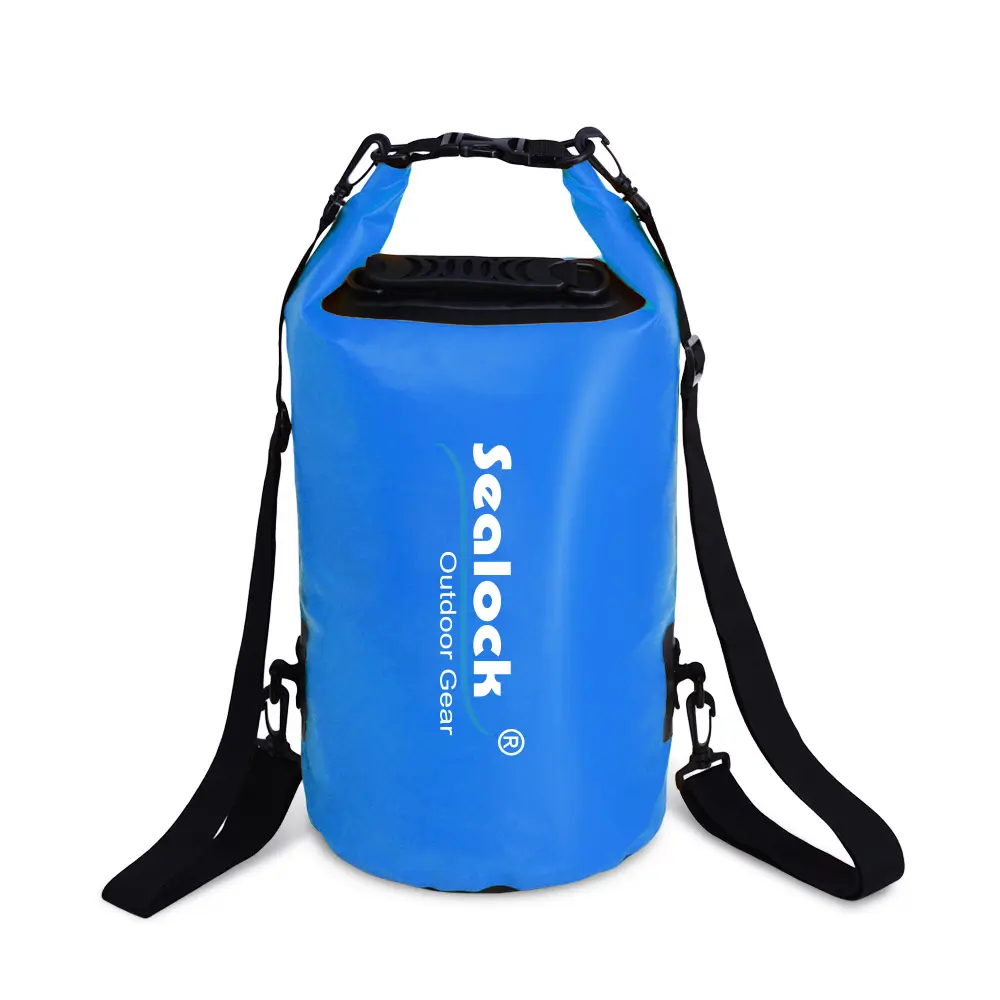
500D PVC Dry Bag (SL-D002) | 5 / 10 / 15 / 20 / 63L | 500D PVC, 0.5 mm | Roll-top, IPX7 | View |
|
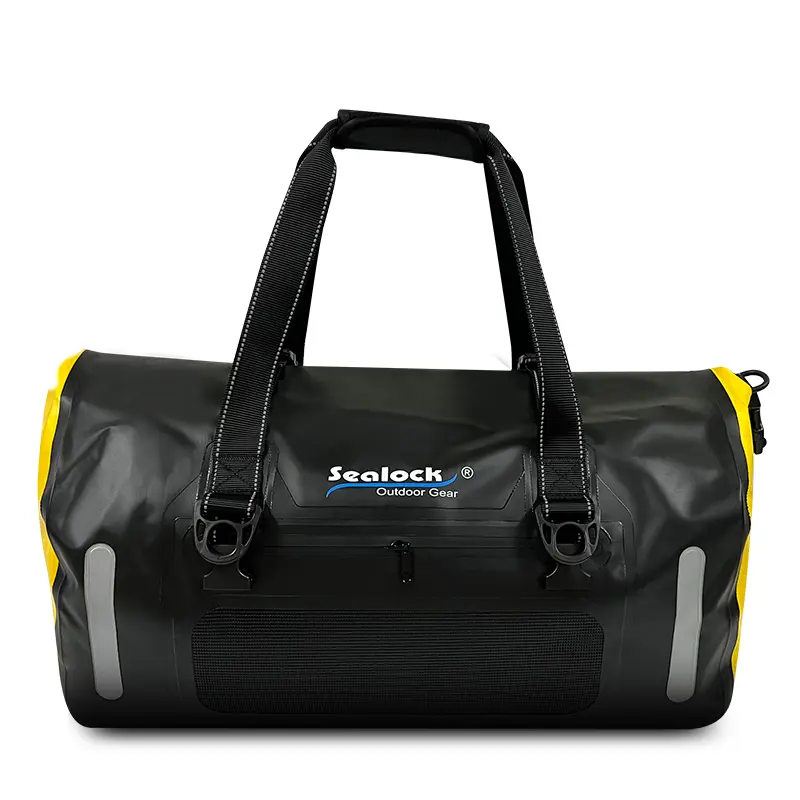
40L / 60L Roll-Top Duffel (SL-K099) | 40 / 60L | 840D TPU, heavy-duty | Roll-top, IPX7 | View |
|
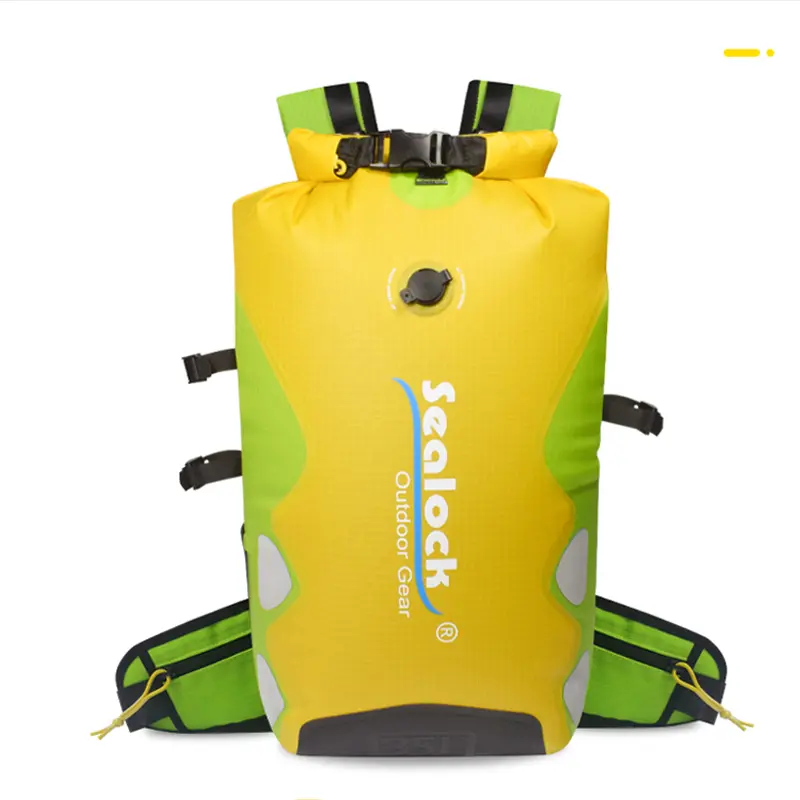
35L Roll-Top Backpack (SL-E801) | 35L | 420D TPU | Roll-top, IPX7, air valve | View |
|
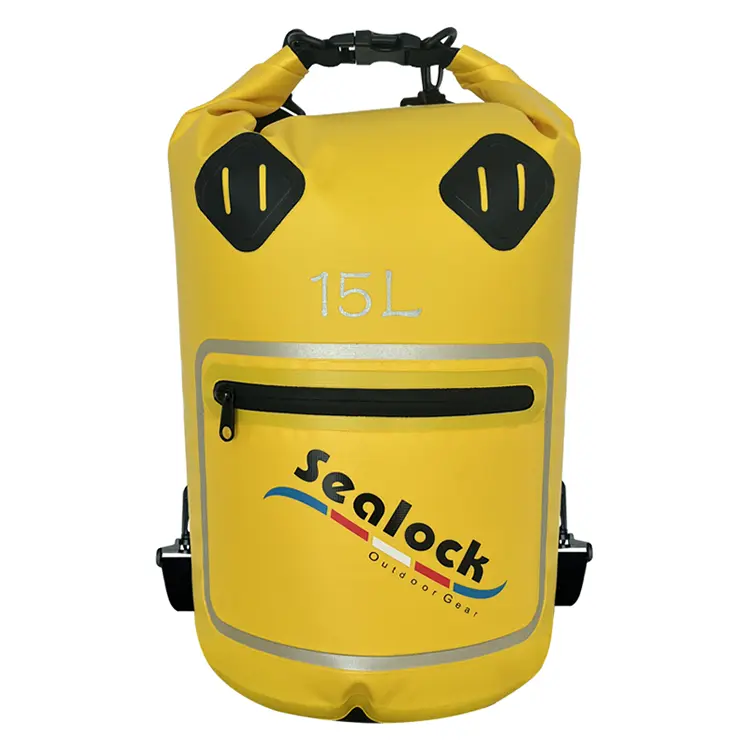
15L / 20L Window Dry Bag (SL-D693) | 15 / 20L | 500D PVC | Roll-top, IPX7 | View |
|
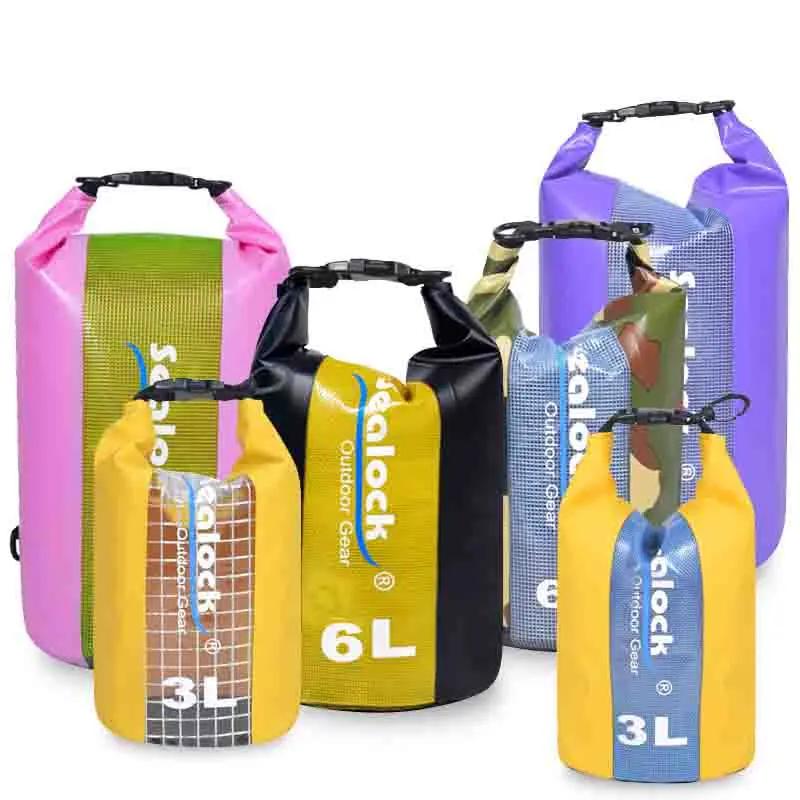
Clear Window Dry Bag | 3 / 6 / 10L | PVC | Roll-top, quick-release | View |


5. Applications the Range Is Engineered For
Specifications are chosen for the environment a product ships into. Read from the product side, the range covers several distinct demands:
- Marine and sailing: welded PVC and TPU bags with corrosion-resistant hardware, because salt attacks metal fittings long before it defeats the fabric.
- Kayaking and rafting: IPX7–IPX8 roll-top and zippered bags and roll-top duffels that seal against a capsize and float when closed, rather than merely shedding spray.
- Fishing: airtight-zipper bags, shoulder packs, and hip packs that keep tackle and electronics dry stream-side and on the boat.
- Motorcycle touring: welded rack and tail luggage with reflective detailing, built for rain driven at speed and hours of vibration.
- Cycling and bikepacking: frame, saddle, and roll-top mounted bags in 420D–600D TPU sized for trail spray and repeated mounting.
Because the same welding and testing standards run across every category, a buyer can source multiple product lines from one manufacturer without the build quality drifting between them.
6. Manufacturing and Quality Capability
6.1 RF / HF Welding
Seams are bonded by 27.12 MHz high-frequency welding rather than stitched and taped. The process fuses the coated fabric into one continuous waterproof skin with no needle perforations, which removes the single most common leak path in a waterproof bag. Weld quality is the real dividing line between a genuine dry bag manufacturer and an assembler, because a poor weld fails under exactly the pressure and flex the bag is bought to survive.
6.2 Testing and Quality Control
Every batch passes a three-stage inspection. The laboratory test suite covers a load test of over 1,500 cycles, 3,000 sealed-zipper cycles on zippered models, tensile strength, bonding strength, salt spray, friction resistance, color fastness, and color difference, plus a full water immersion test. Inspection runs as IQC on incoming fabric and hardware, IPQC on welds and processes in line, and OQC with AQL sampling, batch immersion testing, and signed gold-sample comparison. Third-party inspection by SGS or QIMA can be arranged where a buyer's program requires it.
6.3 Customization and Ground-Up Development
Customization runs on two levels. The first is straightforward — logo, color, capacity, fabric, and closure on an existing platform. The second is full ODM development: a buyer supplies a sketch, a sample, or a target spec, and the factory develops the pattern, structure, fabric, and hardware into an original finished bag. Ground-up development takes longer than modifying a stock model, so a launch date should be planned with that extra lead time built in.

7. FAQ
Q: What makes a supplier a true dry bag manufacturer rather than a trader?
A: In-house welding, tooling, testing, and QC. A manufacturer controls the build from incoming fabric to final inspection and can develop original patterns; a trader resells finished bags without that control, which limits both consistency and customization.
Q: What is the minimum order quantity and lead time?
A: MOQ is 300 pcs per model, samples in 7–15 days, and bulk production in 30–45 days depending on quantity and customization, with capacity up to 30,000 pcs per month on high-volume lines.
Q: Can you develop an original bag rather than re-brand an existing one?
A: Yes. Ground-up ODM development builds an original bag from a buyer's sketch, sample, or target spec — pattern, structure, fabric, and hardware included — not just a re-colored stock model.
Q: Which fabric and waterproof rating should a buyer specify?
A: Match them to use: 500D PVC for rugged, cost-driven bags; 420D–840D TPU for lighter, cold-tolerant, longer-folding bags; IPX6 for rain, IPX7–IPX8 for immersion. The factory can advise against a target weight, cost, and durability.
Q: Do you provide compliance documentation and third-party inspection?
A: Yes. Production is certified to ISO9001, BSCI, SMETA, HIGG, and GRS, with documentation for regulated markets and optional SGS or QIMA inspection.
Request a Quotation
For OEM, ODM, or wholesale supply of waterproof dry bags, submit an inquiry. Sealock responds to procurement enquiries within 24 hours. To browse construction and specifications first, see the full waterproof dry bag range.