
How professional buyers vet a waterproof dry bag factory in 2026 — from materials and weld integrity to MOQ, lead time, certifications, and the China-plus-Vietnam tariff question.
If you are sourcing waterproof dry bags for an outdoor brand, a retail program, or a private-label line, the manufacturer you choose decides three things at once: whether the product actually stays dry, whether it ships on time, and whether your margin survives tariffs. China remains the deepest supply base for dry bags — but "China" is not a quality grade. Factories range from sticker-and-stitch trading offices to vertically integrated plants with high-frequency welding lines and in-house pressure testing.
This guide walks through exactly what to check before you place a purchase order, in the order a seasoned buyer checks it. It is written from the factory floor, not from a directory listing.
Key takeaways
- The single biggest quality variable in a dry bag is the seam — welded seams outperform sewn-and-taped seams for true submersion.
- Ask for the test standard in numbers (e.g. 1.0 bar hydrostatic, or a specific IPX level), not the word "waterproof."
- Confirm MOQ, sampling time, and production lead time in writing before you fall in love with a sample.
- A China + Vietnam footprint can materially change your landed cost depending on your destination market's tariff schedule.
1. Why China is still the default — and where it varies
China's advantage in dry bags is not just labor cost; it is the concentration of the entire supply chain in one place: tarpaulin and TPU film mills, RF/HF welding equipment, airtight zipper suppliers, hardware, and printing, often within a few hours of each other. That density is why sampling is fast and customization is cheap relative to other regions.
The variance shows up in capability. A capable dry bag factory owns its welding process; a weaker supplier outsources it and cannot guarantee weld consistency batch to batch. Your first filter is simple: does the factory weld in-house?
2. Materials: PVC vs TPU (and what each is for)
Most dry bags are built from coated tarpaulin (commonly PVC) or thermoplastic polyurethane (TPU) film. They are not interchangeable, and a good manufacturer will recommend based on your use case rather than push one material.
| Factor | PVC tarpaulin | TPU film |
|---|---|---|
| Cost | Lower | Higher |
| Weight | Heavier for same strength | Lighter |
| Cold-flex / abrasion | Good, can stiffen in cold | Excellent, stays flexible |
| Eco / compliance | Watch for phthalates & PFAS | Easier to spec PFAS-free |
| Typical fit | Value lines, high-volume retail | Premium, marine, technical |
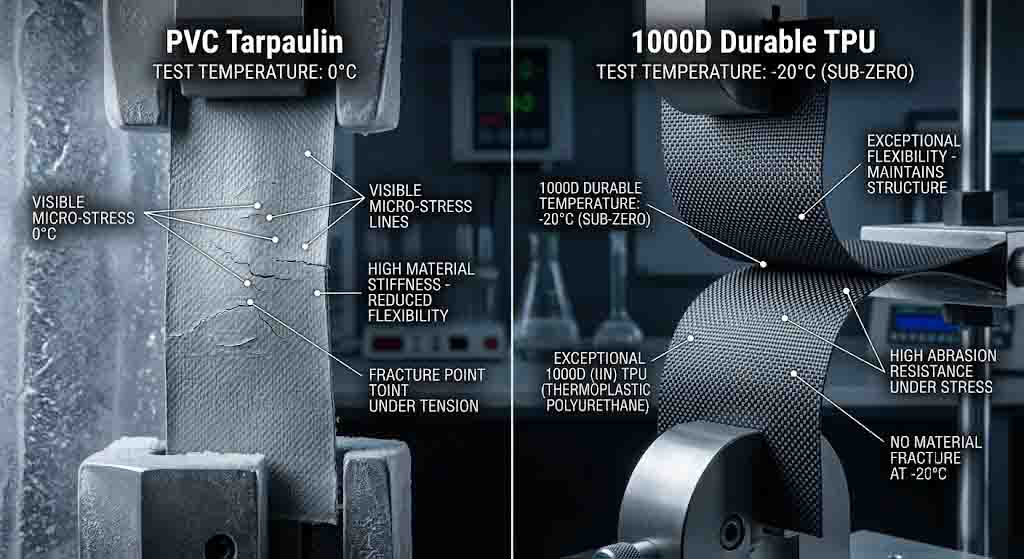
Denier matters too. A 500D fabric is lighter and cheaper; an 840D or 1000D fabric resists tearing and abrasion for rougher use. Tell your manufacturer the environment the bag lives in, and let them spec the denier. For the engineering behind weld-grade materials, see our breakdown of 1000D ballistic TPU construction.
3. The seam is the product
This is the part buyers under-weight. A dry bag fails at its seams long before the fabric fails. There are two broad approaches:
- Sewn + taped: stitched then sealed with tape. Fine for splash and rain; needle holes are a long-term risk under pressure.
- Welded: the layers are fused with no needle penetration. This is what allows a bag to be fully submerged and stay dry.
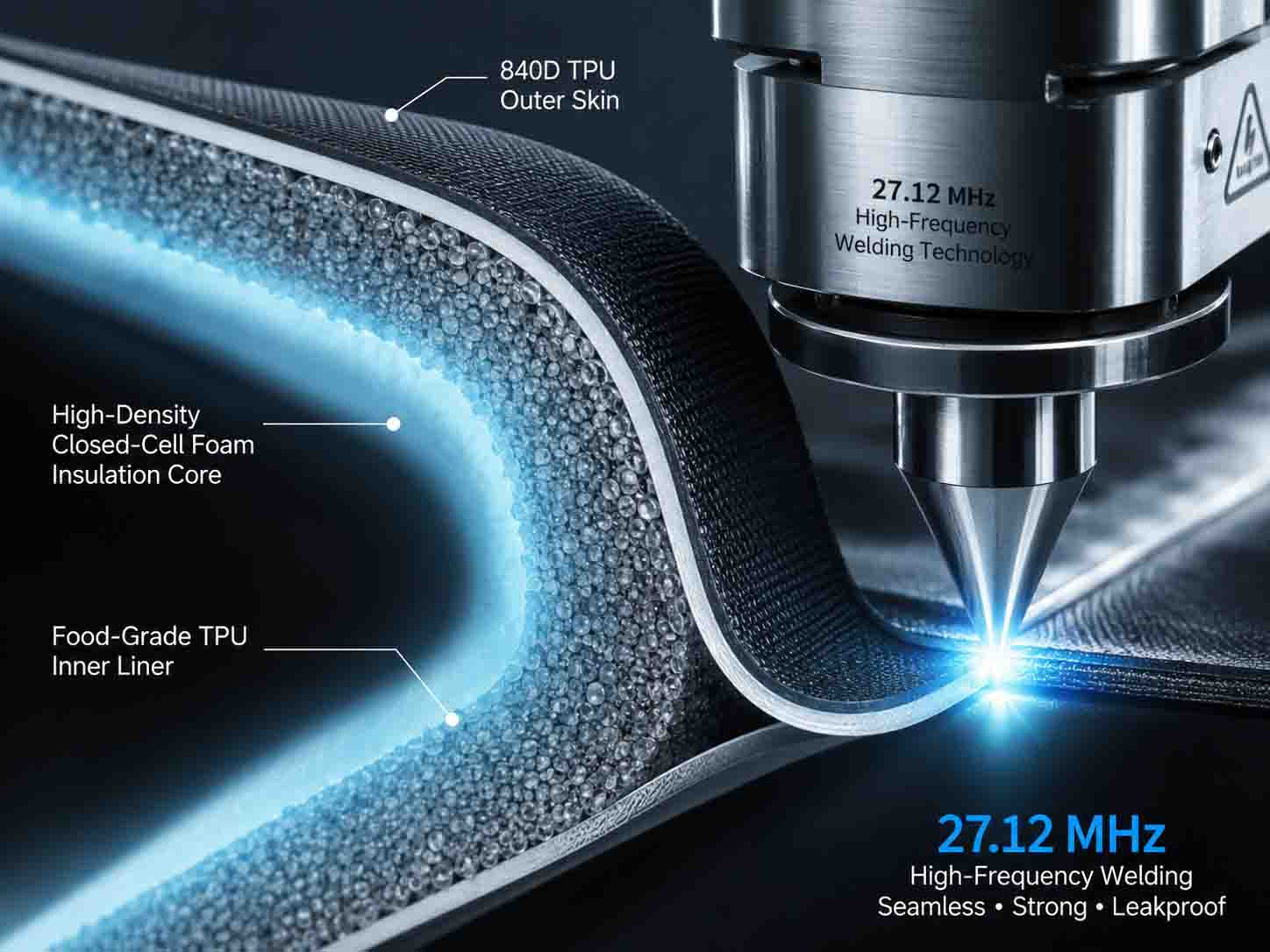
High-frequency welding at 27.12 MHz fuses the material at the molecular level, producing a seam that is effectively part of the fabric. If submersion matters to your customer, welded is not optional. We documented the process in Engineering the Ultimate Dry Bag and the welding standard on our HF welding page.
4. Make the supplier prove "waterproof" in numbers
"100% waterproof" is a marketing phrase, not a spec. Ask which standard the bag is tested to:
- IPX ratings (IEC 60529): IPX4 is splash; IPX7 is brief immersion; IPX8 is continuous immersion to a stated depth.
- Hydrostatic pressure: a 1.0-bar test holds the sealed bag under sustained water pressure — a far tougher bar than a quick dunk.
A serious factory tests in-house and can show you the procedure, not just a certificate. Our own protocol is published as the 1.0-bar testing SOP, and we explain why it has become the new baseline for extreme use in Beyond Splashproof.
5. MOQ, sampling, and lead time
Get these three numbers in writing early; they decide whether a supplier fits your business model at all.
| Stage | What to ask | Typical range* |
|---|---|---|
| Sampling | Cost, and how many days to a first sample | ~7–15 days |
| MOQ | Minimum per color / per SKU, not just per order | From ~100–500 pcs for OEM |
| Production | Days after sample approval & deposit | ~25–40 days |
*Ranges are indicative and vary by complexity, print method, and season. Always confirm against your own spec.
6. Customization: OEM vs ODM
Decide what you are actually buying. OEM means you bring the design and the factory builds it. ODM means you adapt the factory's existing models with your logo, colors, and minor changes — faster and lower-risk for newer brands. A capable partner offers both; see our OEM/ODM services and the dedicated custom-branded supplier page.
For logo work, confirm the method (heat transfer, welded patch, screen print, woven label) and whether it survives the weld and the field. Pantone matching should be confirmed on a physical sample, not a screen.
7. The China + Vietnam tariff question
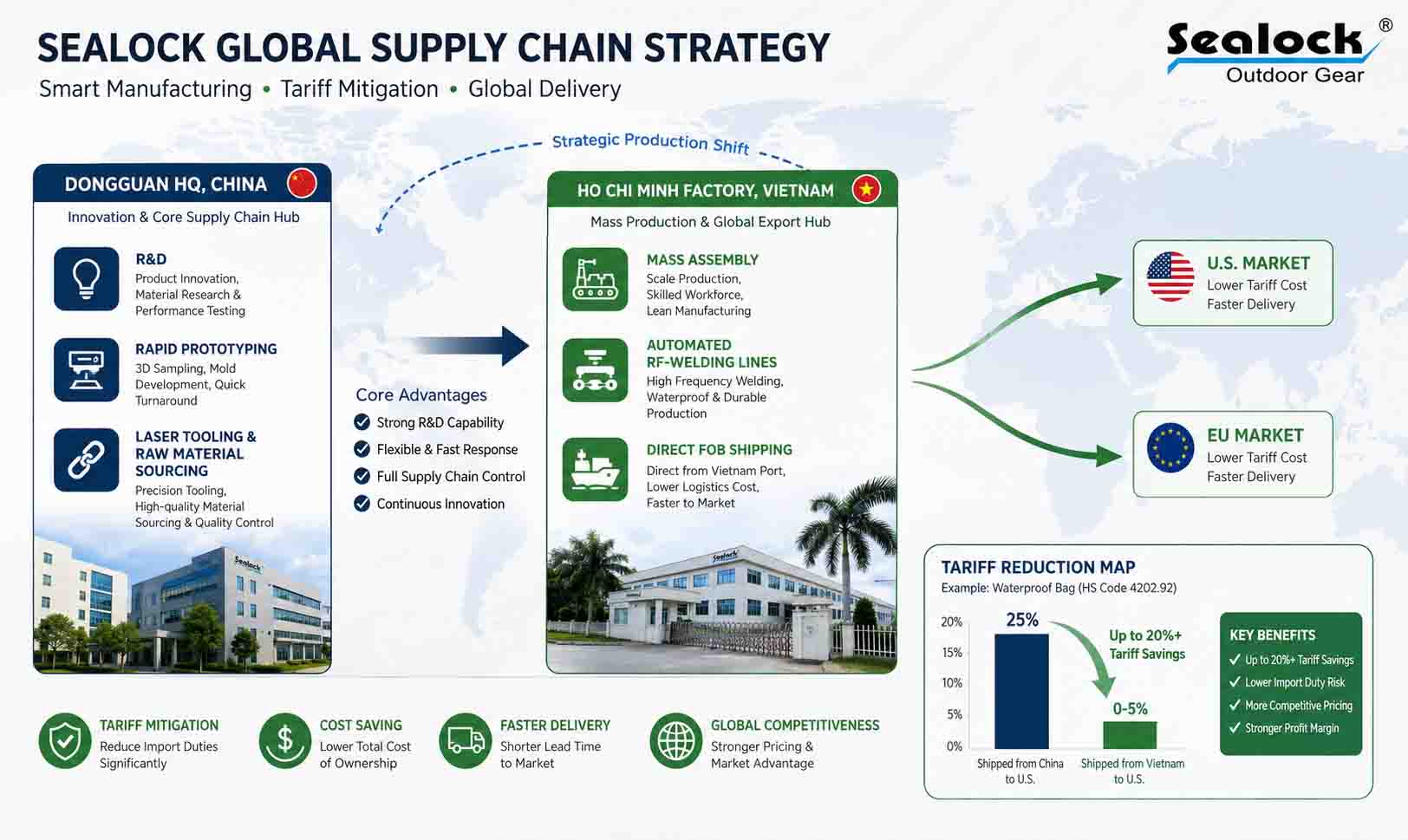
For US and EU importers, country of origin can move landed cost more than unit price does. A manufacturer with both a China R&D base and a Vietnam production option lets you keep development speed while shifting final assembly to a more favorable origin when your tariff schedule calls for it. Ask the supplier to model both origins for your specific destination before assuming China is cheapest delivered.
8. Certifications and audits
For retail and brand programs, compliance is a gate, not a nice-to-have. Expect a credible factory to support quality and social-compliance audits and to provide material declarations (including PFAS status) on request. Our 2026 procurement guide covers PFAS-free compliance in detail.
- Do you weld seams in-house, and at what frequency?
- What test standard (IPX level / bar) is this bag rated to, and can I see the test?
- PVC or TPU, and why for my use case? Denier?
- MOQ per color and per SKU?
- Sample cost and lead time?
- Production lead time after approval?
- Can you produce in Vietnam if my tariffs require it?
- Which audits and material declarations can you provide?
Putting it together
The best dry bag manufacturer for you is not the cheapest quote — it is the one that welds in-house, tests to a number you can verify, states its MOQ and lead time plainly, and can flex its origin to protect your landed cost. Lead your sourcing conversation with the eight questions above and you will separate real factories from resellers within one email exchange.
Representative dry bag products & standard specs
What the standards above look like in shipped product — a cross-section of our range, all 27.12 MHz HF-welded and validated to 1.0 bar:
| Product | Type | Key spec |
|---|---|---|
| Roll-Top Small Dry Bag | Roll-top dry bag | Submersible, welded, D-ring |
| Outdoor Dry Bag | Multi-use roll-top | Welded seams, air valve option |
| Waterproof Duffle Bag | Duffle, foldable | IPX8 waterproof zipper |
| 25L TPU Dry Backpack | Dry backpack | ~300g, 4-division TPU, heavy-rain rated |
Standard B2B terms: MOQ from 300 pcs · OEM/ODM available · PVC tarpaulin (500D/840D) or TPU-coated nylon (210D/420D/840D) · certified SMETA 4-Pillar, BSCI, ISO 9001:2015, GRS, SCAN, HIGG · dual production in Dongguan, China & Ho Chi Minh, Vietnam. More on our company & factory page.
Sourcing dry bags in 2026?
Send us your spec or your target use case — we'll recommend material, weld, and test standard, then quote MOQ and lead time.
Request a Quote →Frequently asked questions
- What is the minimum order quantity (MOQ) for custom dry bags?
- For OEM/ODM dry bags, MOQ commonly starts in the ~100–500 pcs range per color or SKU, depending on material, size, and print method. Confirm the MOQ per color, not just per order.
- How long does it take to produce a dry bag order?
- A first sample typically takes about 7–15 days, and bulk production usually runs about 25–40 days after sample approval and deposit, varying with quantity and complexity.
- Is PVC or TPU better for waterproof dry bags?
- PVC tarpaulin is lower cost and well-suited to value and high-volume retail lines; TPU film is lighter, stays flexible in cold, and is easier to spec PFAS-free, making it the common choice for premium, marine, and technical bags.
- What does the 1.0-bar test mean?
- It is a hydrostatic test that holds a sealed bag under sustained water pressure rather than a brief dunk, verifying the seams and closure stay dry under demanding, fully submerged conditions.
- Can a Chinese manufacturer produce in Vietnam to reduce tariffs?
- Some manufacturers operate a China R&D base alongside Vietnam production, letting buyers keep development speed while shifting final assembly to a more favorable country of origin for their destination market's tariff schedule.
Related reading: Engineering the Ultimate Dry Bag · Dry Bag Size Guide · Roll-Top vs Zipper · OEM Dry Backpack Manufacturer