
- English
- Español
- Português
- русский
- Français
- 日本語
- Deutsch
- tiếng Việt
- Italiano
- Nederlands
- ภาษาไทย
- Polski
- 한국어
- Svenska
- magyar
- Malay
- বাংলা ভাষার
- Dansk
- Suomi
- हिन्दी
- Pilipino
- Türkçe
- Gaeilge
- العربية
- Indonesia
- Norsk
- تمل
- český
- ελληνικά
- український
- Javanese
- فارسی
- தமிழ்
- తెలుగు
- नेपाली
- Burmese
- български
- ລາວ
- Latine
- Қазақша
- Euskal
- Azərbaycan
- Slovenský jazyk
- Македонски
- Lietuvos
- Eesti Keel
- Română
- Slovenski
- मराठी
- Srpski језик

The Science of Cold-Flex Durability: 1000D Ballistic TPU and Seam Integrity in Sub-Zero Scenarios
Specifying a heavy-duty dry bag based on a standard room-temperature specification sheet is a common procurement error. At 25°C, most commercial thermoplastic polyurethane (TPU) films exhibit excellent tensile strength and elasticity. Drop the operational environment to -30°C in a tactical search and rescue (SAR) or open-ocean marine deployment, and the material physics change completely. The flexible barrier becomes a brittle liability.
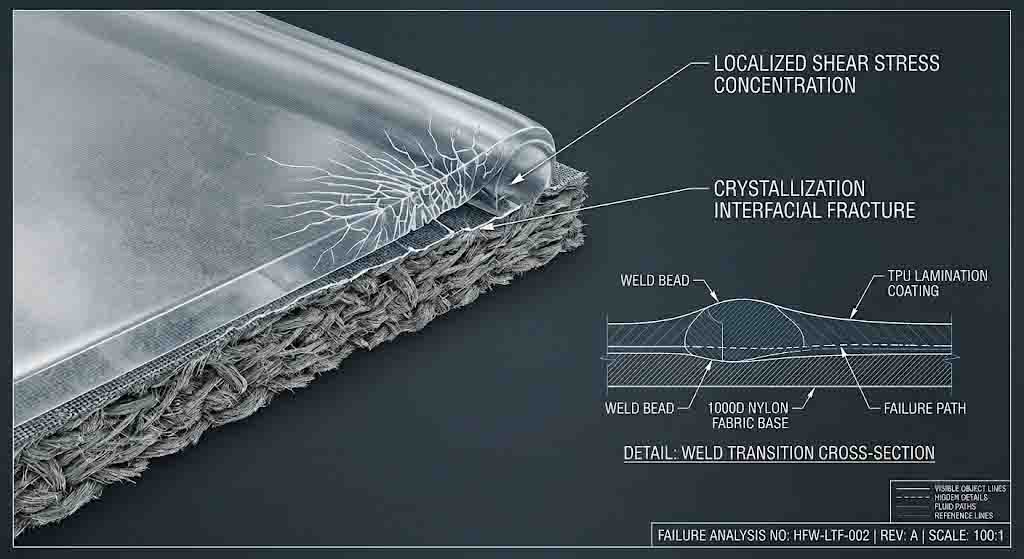
For supply chain managers engineering critical equipment within our submersible dry bags guide (Pillar Roadmap), surviving sub-zero deployment requires understanding low-temperature crystallization. When a loaded bag is dropped onto frozen ground or lashed tightly under wave surges, the failure is rarely a clean fabric tear. It is an interfacial shear fracture along the high-frequency weld line. That is where standard outdoor-grade manufacturing fails.
The Glass Transition Blind Spot: Polyester vs. Polyether TPU
On the factory floor, generic contract shops treat all TPU coatings as equal. They focus heavily on fabric denier, opting for massive 1000D ballistic weaves while completely ignoring the chemical formulation of the polymer matrix laminated to that weave.
Polyester-based TPU coatings perform well in standard mechanical abrasion tests. However, their glass transition temperature—the point where the polymer matrix transitions from a flexible, rubbery state to a rigid, brittle glass structure—is notoriously high, often sitting around -15°C. When exposed to sub-zero alpine or maritime environments, the polyester molecular chains lose their mobility. Under repeated flexing, micro-cracks develop within the coating layer itself, leading to rapid mechanical delamination from the base textile.
Tactical and search-and-rescue operations require specialized Polyether-based TPU formulations. Polyether chemical structures maintain molecular segment mobility down to -40°C or lower. This low-temperature flexibility is non-negotiable for equipment that must endure the brutal physical forces described in our analysis of marine-grade deck dry bags under wave surges. Without this material foundation, the waterproof barrier will crack along flex lines long before the mission is completed.
The Physics of Edge Transition Stress Concentration
The seam interface of an RF-welded dry bag undergoes massive thermodynamic stress during the manufacturing cycle. During 27.12 MHz high-frequency processing, the polar molecules of the TPU are excited, melting the layers from the inside out to form a monolithic molecular structure.
The danger zone is the exact line where the welded section meets the unwelded flexible shell—the edge transition. If the pneumatic pressure distribution across the custom machined brass die shifts by even a fraction of a millimeter, it creates a microscopic thinned step down at this boundary. In sub-zero conditions, when the material undergoes rapid deceleration or impact loading, this micro-step acts as a violent stress concentrator. The brittle polymer matrix cannot dissipate the energy through elastic deformation. It shears instantly at the boundary line, a critical failure mechanism we continuously eliminate through our specialized tactical waterproof gear manufacturing protocols.
The Sub-Zero Shop Floor Kill-Shot: When auditing a contract manufacturer for extreme-condition gear, do not let them show you room-temperature grab test certificates. Demand to see their low-temperature impact and dynamic flex logbooks (such as ASTM D1790 or ISO 4675 testing metrics). Ask their lead engineer: "What is the exact glass transition temperature of your current polymer batch, and how do you compensate for die-edge thinning during winter production?" If they cannot present a real-time testing matrix, your gear will fail on the ice.
Eliminating Delamination via Post-Weld Thermal Stabilization
Releasing pneumatic pressure from an RF welding die the instant the electromagnetic field turns off is a recipe for latent seam failure. When polymer chains are melted under high frequency, they require a specific cooling dwell cycle under sustained compression to properly align and stress-relieve the joint.
Cutting this cooling cycle short by 0.5 seconds increases factory throughput but traps massive residual shear stress inside the weld zone. When that seam encounters extreme cold shock, the internal stresses combine with the external environmental loading, triggering spontaneous cracking without visible external impact. Our vehicle and tactical bag production lines implement automated post-weld thermal stabilization. The brass tooling holds the fused layer under precise compression until the temperature drops below the polymer's recrystallization threshold, ensuring a uniform molecular bond capable of surviving the brutal vibration tolerances demanded by heavy-duty applications like hardcore motorcycle rally luggage engineering.
Validating Low-Temperature Seam Reliability
A factory that cannot prove its quality metrics under simulated field abuse is just guessing. Visual inspection cannot identify internal micro-voids or polymer crystallization brittleness hidden inside a heavy 1000D ballistic weld line.
We validate our extreme-environment builds by extracting material coupons from production runs and exposing them to cyclic low-temperature dynamic flex testing inside specialized environmental chambers. Following cold conditioning, these samples undergo destructive T-peel and hydrostatic burst testing referenced against our internal 1.0 Bar hydrostatic pressure testing standards. The pass criteria are binary: zero micro-cracking under 10,000 continuous flex cycles at -30°C, and absolute zero fluid migration through the seam interface under peak pressurization. This uncompromising validation loop provides global procurement directors with auditable, zero-failure structural security.
About Sealock Outdoor Group: Sub-Zero Engineering Authority
Sealock Outdoor Group is an established B2B OEM contract manufacturer specializing exclusively in heavy-duty, monolithic waterproof equipment designed for zero-failure performance in extreme environments. Operating highly optimized, SCAN and ISO 9001:2015 certified manufacturing facilities in Dongguan, China, and Ho Chi Minh City, Vietnam, we merge advanced polymer material science with rigid process control.
We eliminate cross-border specification drift and parameter variance structurally, delivering elite-tier, tariff-insulated technical bags for tactical, maritime, and extreme outdoor operations worldwide.
Engineering FAQ for Sub-Zero Procurement
Why does a 1000D dry bag fabric feel stiff and crack in extreme cold?
Stiffness and cracking occur when the dry bag utilizes a Polyester-based TPU coating. Polyester TPU has a relatively high glass transition temperature (around -15°C). When temperatures drop below this point, the polymer chains lock into a brittle, glass-like structure. Under repeated bending or impact, the rigid coating fractures and delaminates from the 1000D nylon base weave.
How does post-weld cooling time affect the seam's low-temperature impact resistance?
If the high-frequency welding die is released too quickly before the melted TPU cools below its recrystallization point, residual mechanical stresses are trapped inside the weld zone. When exposed to extreme cold shock, these internal forces cause the polymer matrix to cleave along the edge transitions under minimal external load. Sustained cooling under pressure stress-relieves the joint entirely.
What is the difference between Polyester TPU and Polyether TPU in sub-zero marine applications?
Polyether TPU features an ether-linked molecular backbone that maintains its flexible, rubbery properties at extreme low temperatures (down to -40°C or lower) and is structurally immune to saltwater hydrolysis. Polyester TPU stiffens prematurely in the cold and undergoes progressive chemical breakdown when exposed to continuous moisture and frost cycles, leading to seam failure.