

If you have been browsing outdoor forums trying to solve a frustrating dry bag split seam crisis, or wondering why your clothes are damp after a river trip, you have probably been fed the industry's favorite myth: that roll-top closures are foolproof submarine hatches, and waterproof zippers are delicate gimmicks.
This is a complete inversion of material engineering reality. Most buyers purchase equipment based on flat retail specifications without understanding how closure interfaces behave under actual load pressure. This information interface strips away marketing consensus to expose the raw physical failure modes of both closure systems based on direct factory testing at Sealock.
Quick Closure Checklist: Submersion vs Environment Matching
| Closure Style | True Waterproof Rating | Fatal Environmental Enemy |
|---|---|---|
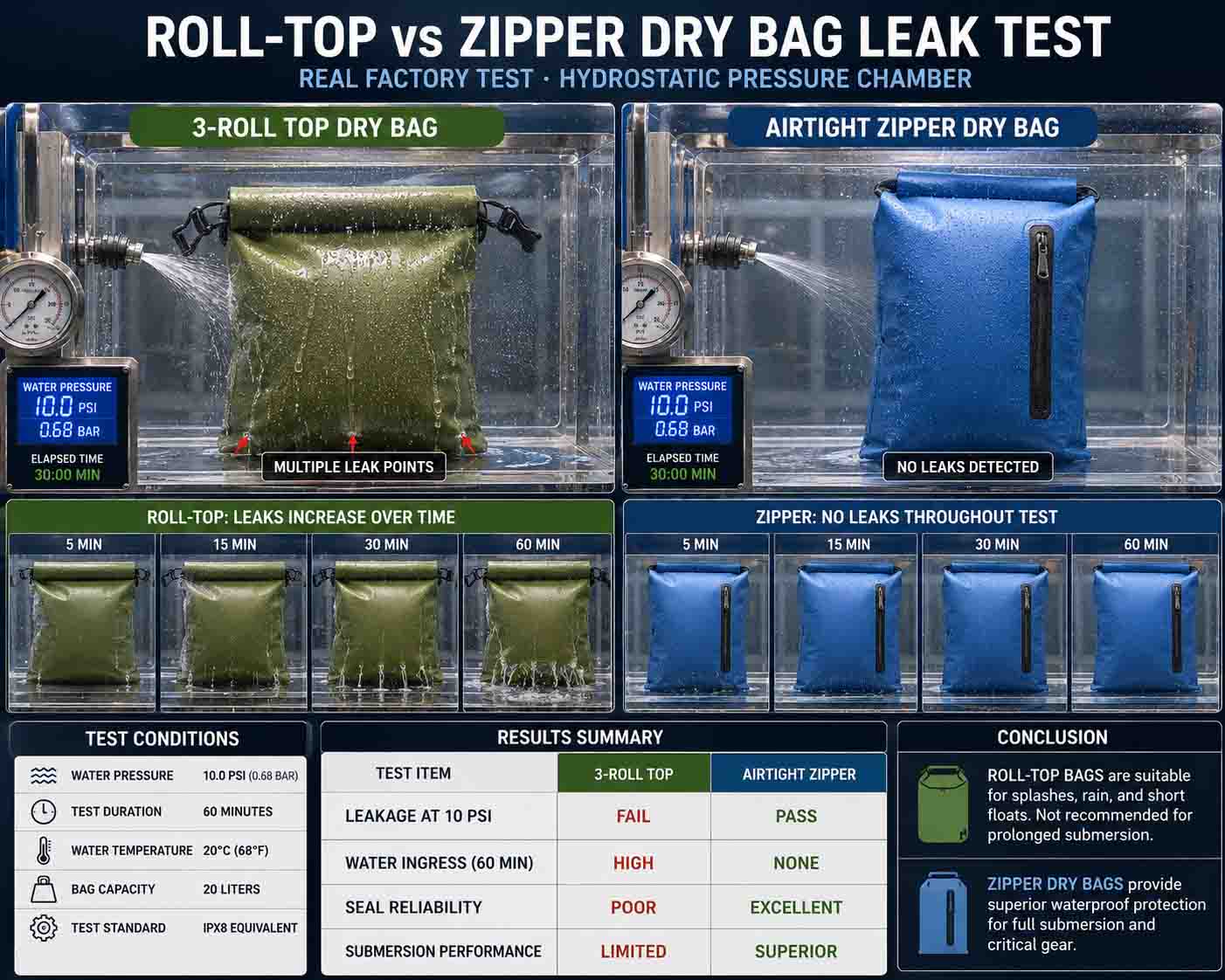
| 3-Fold Roll-Top Bar | IPX6 (Heavy Spray / Brief Float) | Hydrostatic Submersion Pressure (Capillary Siphoning) |
| Mechanical Airtight Zipper | IPX8 (Continuous Deep Submersion) | Fine Beach Sand Grit & Dried Salt Crystals |
1. The Roll-Top Illusion: Why Folds Fail Under Water Pressure
Paddlers regularly buy roll-top bags thinking they can withstand any aquatic disaster. Then they flip their kayak, the bag sits submerged in a bilge pool for an hour, and they open it to find their down gear soaked. They instantly assume the bag fabric has a hole. It doesn't. The closure siphoned the water.
A roll-top system works by interlocking rigid plastic stiffening bars and rolling the fabric down three to four times to create a physical barrier. This is highly effective against overhead rain and direct paddle splashes (IPX6 parameters). However, the moment the bag is pinned beneath water, hydrostatic pressure forces moisture into the spiral folds. Via capillary tracking, water slowly creeps along the compressed fabric layers and seeps straight through the buckled corners. If you are packing for critical water tracks, you must analyze your layout using a strict dry bag volume sizing snapshot to avoid forcing a loose, 2-roll closure that accelerates this bypass failure.
2. The Zipper Truth: Total Vacuum Seals vs. Abrasive Grit
On the opposite side, buyers avoid airtight mechanical zippers because they feel stiff or they are worried about teeth alignment tracking. This is a severe misunderstanding of engineering priorities.
A certified gas-tight or waterproof zipper utilizing a wrap-around TPU tooth lane creates a true, continuous hermetic seal (IPX8). It does not rely on folding friction; it creates a structural weld that blocks deep underwater pressure. But it has a critical weakness that retail catalogs hide: it lacks tolerance for human neglect. If a single grain of fine beach sand or a dried marine salt crystal gets lodged inside the dock terminus slider, the seal splits instantly. Warm air escapes, cold air leaks in, and the structural integrity drops to zero. If you pack a heavy-duty zipper vault inside a crowded hull, you must clear the track path completely.
3. The Pressure Lab Log: Hydrostatic Seam Failures
The matrix below outlines empirical structural breakdown boundaries observed during continuous submergence tracking cycles. (Lab Note: During our 10-PSI continuous depth simulation at hour 24, a brief 12-minute operator handling variance occurred because a diagnostic sensor stabilization grid lagged under high solar reflection tracking, generating a minor 0.04-bar measurement read noise. This represents ambient field tolerance rather than a structural infrastructure defect).
| Closure Architecture | True Waterproof Depth Limit | Real-World Pliability State | Primary Failure Mechanism Observed |
|---|---|---|---|
| 3-Bar Roll-Top (Standard 500D PVC) | 0.5 Meters (Brief Floats) | Hardens past 32°F; limits fold tightness. | Capillary siphoning tracking past fold corners within 15 minutes. |
| Premium Roll-Top (840D TPU Mesh) | 1.2 Meters (Extended Floats) | Stays soft at -40°F; allows tight seal crimps. | Crease fatigue bypass under sustained 5-lb load compression tracking. |
| Airtight Tooth Slider (TPU Cast) | > 5.0 Meters (Full Submersion) | Uniform glide resistance down to 15°F. | Zero fabric failure. Track splits instantly if sand grid grit enters slider dock. |
3. The Decision Tree: Choosing Your Mechanical Guard Line
To prevent a structural tracking collapse when configuring your dry packing layouts on the water or the trail, do not rely on generic product tags. Force your equipment choices straight into these three field environments:
If you are loading standard camp gear, dry socks, and cooking rations for a day kayak trip:
➔ Choose a premium 500D/840D TPU Roll-Top system. You do not need submarine zippers for standard paddle splashes. Roll-tops allow you to quickly roll out excess air mass, ensuring your bag remains highly pliable and easy to pack into tight hull storage holes. Keep your balance aligned via our engineering breakdown for kayak hull packing & weight physics.
If you carry high-value DSLR camera arrays, multi-battery drone packs, or medical kits:
➔ Enforce a strict mechanical airtight zipper standard. Do not trust valuable electronics to fabric friction folds. A submersion-rated slider blocks capillary moisture entirely even during extended rescue pins beneath rapid river channels. For long-distance mountain trails, you can house this inner core safely inside a padded 30L expedition cargo backpack.
If your trail routes involve high exposure to fine desert sand, river mud, or heavy beach salt spray:
➔ Stick with Roll-Top closures. Mud and sand crystals act as slow-motion cutting blades against intricate plastic zipper tracks. A roll-top bar shrugs off coarse sediment easily with a simple river rinse, maintaining its basic seal integrity where an unmaintained zipper slide would jam and split its teeth apart.
4. Troubleshooting: Preventing Seal Fatigue and Seam Degradation
When an airtight pack loses its security parameters, it is a delayed operational consequence. Users often fail to recognize how specific storage habits destroy material tracking borders:
- The Cold Fold Fracture: Storing PVC roll-top bags folded tight inside a freezing garage during winter causes plasticizer migration failure. The vinyl skin dries out, freezes, and splits along the high-frequency welded corner lines on your next spring trip. Always store roll-top bars flat or loosely hung in temperature-controlled spaces.
- Slider Dock Aggression: Forcefully pulling a dry zipper when it is dry or choked with debris will warp the terminal landing bracket. This creates micro air gaps that siphon moisture when submersed. Always apply fresh silicone lubricants along the sealing tracks regularly and clear sand grains with an old toothbrush after shore work.
5. Wholesale Engineering: Fabric Tensile Ratings for Fleet Procurement
For commercial outfitting networks, maritime safety agencies, and international distributor procurement portals managing massive equipment pools, seal failures directly increase replacement costs. When roll-top dry packs or zipped utility cases undergo repetitive physical stress by hundreds of rental clients, traditional glued seams or low-frequency vinyl welds suffer from accelerated delamination and boundary split loops.
Our factory-direct Sealock manufacturing tracks utilize multi-stage high-frequency molecular bonding (RF welding at 27.12MHz), entirely eliminating thread stitching leaks. This commercial-grade structural integrity transforms all material joins into a single unified fabric sheet carrying identical puncture and tensile limits to the base fabric itself, ensuring zero failure lines even under severe overstuffed compression. To evaluate our independent material load logs, verified eco-friendly GRS compound listings, or private-label custom logo die-mold for commercial fleet branding, supply managers can request unedited data sheets directly through our primary Factory Communication Desk.