
- English
- Español
- Português
- русский
- Français
- 日本語
- Deutsch
- tiếng Việt
- Italiano
- Nederlands
- ภาษาไทย
- Polski
- 한국어
- Svenska
- magyar
- Malay
- বাংলা ভাষার
- Dansk
- Suomi
- हिन्दी
- Pilipino
- Türkçe
- Gaeilge
- العربية
- Indonesia
- Norsk
- تمل
- český
- ελληνικά
- український
- Javanese
- فارسی
- தமிழ்
- తెలుగు
- नेपाली
- Burmese
- български
- ລາວ
- Latine
- Қазақша
- Euskal
- Azərbaycan
- Slovenský jazyk
- Македонски
- Lietuvos
- Eesti Keel
- Română
- Slovenski
- मराठी
- Srpski језик

Waterproof Dry Bag Production Equipment & Manufacturing Line
A reliable waterproof dry bag is not created by material alone. It depends on production equipment, manufacturing precision, and process control across every stage of production.
As a professional waterproof dry bag manufacturer, we operate a complete production line designed for OEM and wholesale orders, ensuring consistent quality from raw material to final inspection.
Full Waterproof Dry Bag Manufacturing Line Overview
Our production system covers the entire manufacturing process, from cutting raw materials to final waterproof testing and secure container.
| The Complete 7-Stage Workflow Includes: |
|---|
| Stage 1: Material cutting and preparation (Precision material cutting) |
| Stage 2: Main body sewing |
| Stage 3: High-frequency welding assembly |
| Stage 4: Final bag assembly |
| Stage 5: Quality control inspection |
| Stage 6: Packaging & boxing |
| Stage 7: Inventory management & shipping |
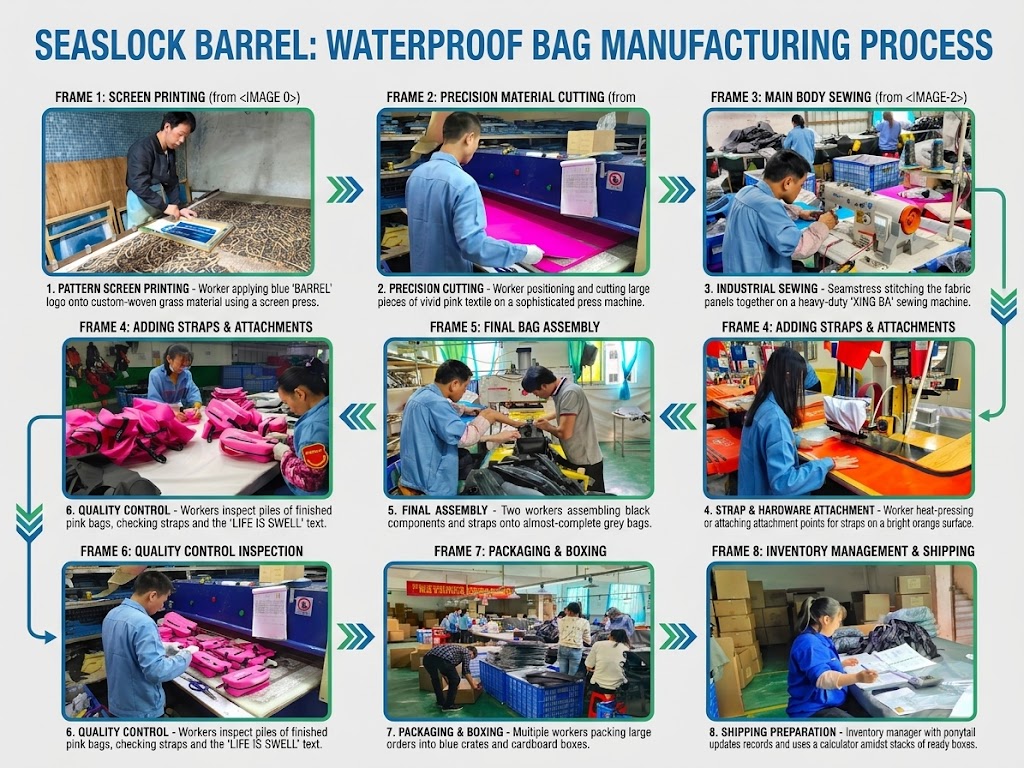
Each stage is controlled under strict production standards to ensure consistency across bulk orders.
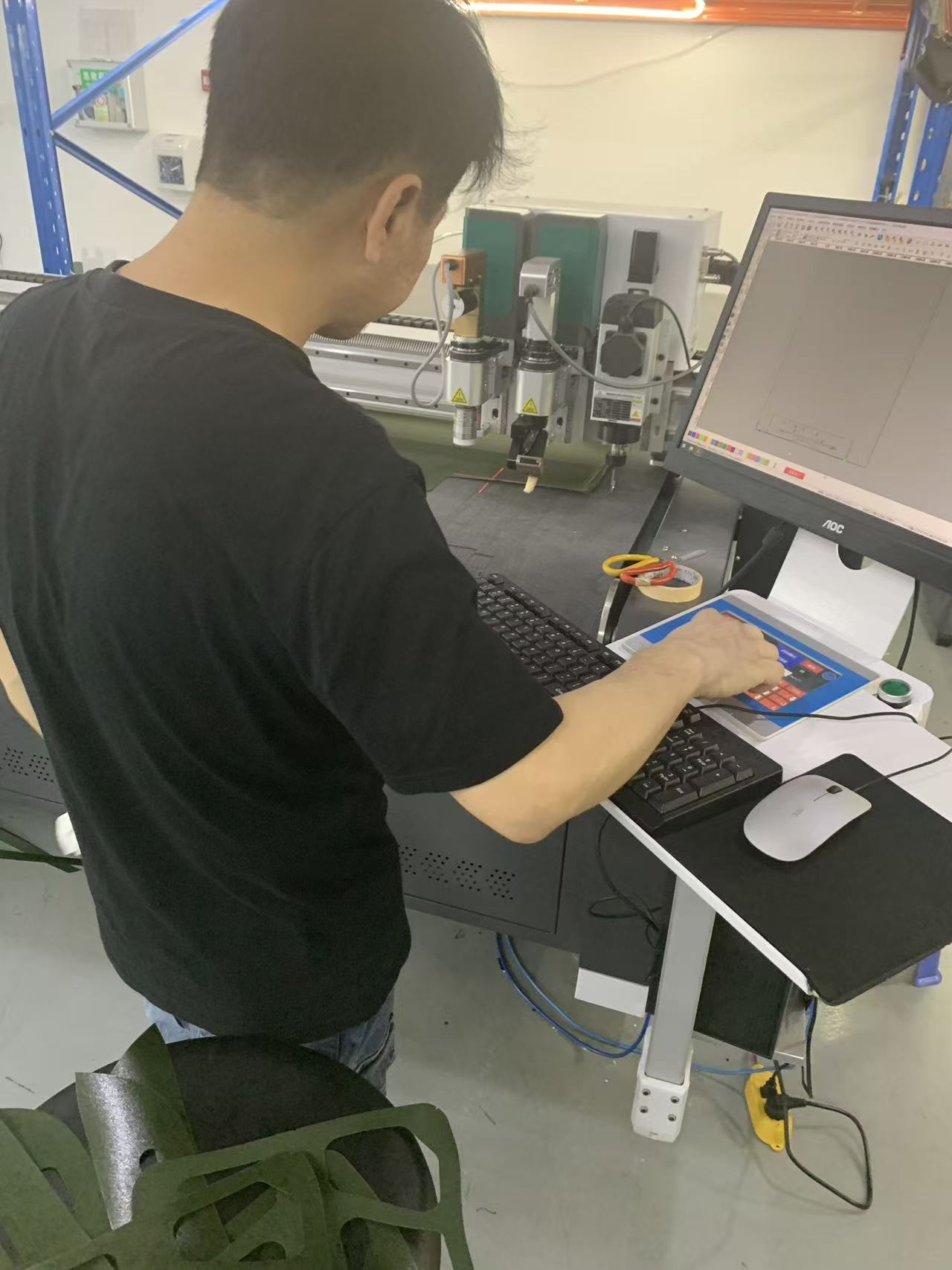
1. Cutting Machines for Precision Material Shaping
Before welding, raw materials must be precisely cut according to product design. We use industrial cutting machines to ensure:
- Accurate pattern shaping
- Consistent size across bulk production
- Reduced material waste
- Stable quality for OEM/ODM customization
Precision cutting is especially important for maintaining uniformity in wholesale production orders.
2. Main Body Sewing & Structural Reinforcement
True heavy-duty dry packs require an optimal blend of tensile structural strength and waterproof integrity. In Stage 2, our facility deploys specialized, high-tension industrial sewing machines to pre-assemble load-bearing elements. This includes stitching ergonomics shoulder strap harnesses, heavy D-ring webbing patches, and external utility pockets straight onto the material panels before final air-tight sealing. Stitched foundations guarantee the bag handles heavy loading points without structural tearing or material distortion under real-world overland stress.
3. High Frequency (HF) Welding Machines
High-frequency welding is the core technology used in waterproof dry bag production. We use industrial HF welding machines designed for TPU and PVC materials. These machines apply electromagnetic energy to fuse materials at the molecular level, creating a strong waterproof seal without stitching.
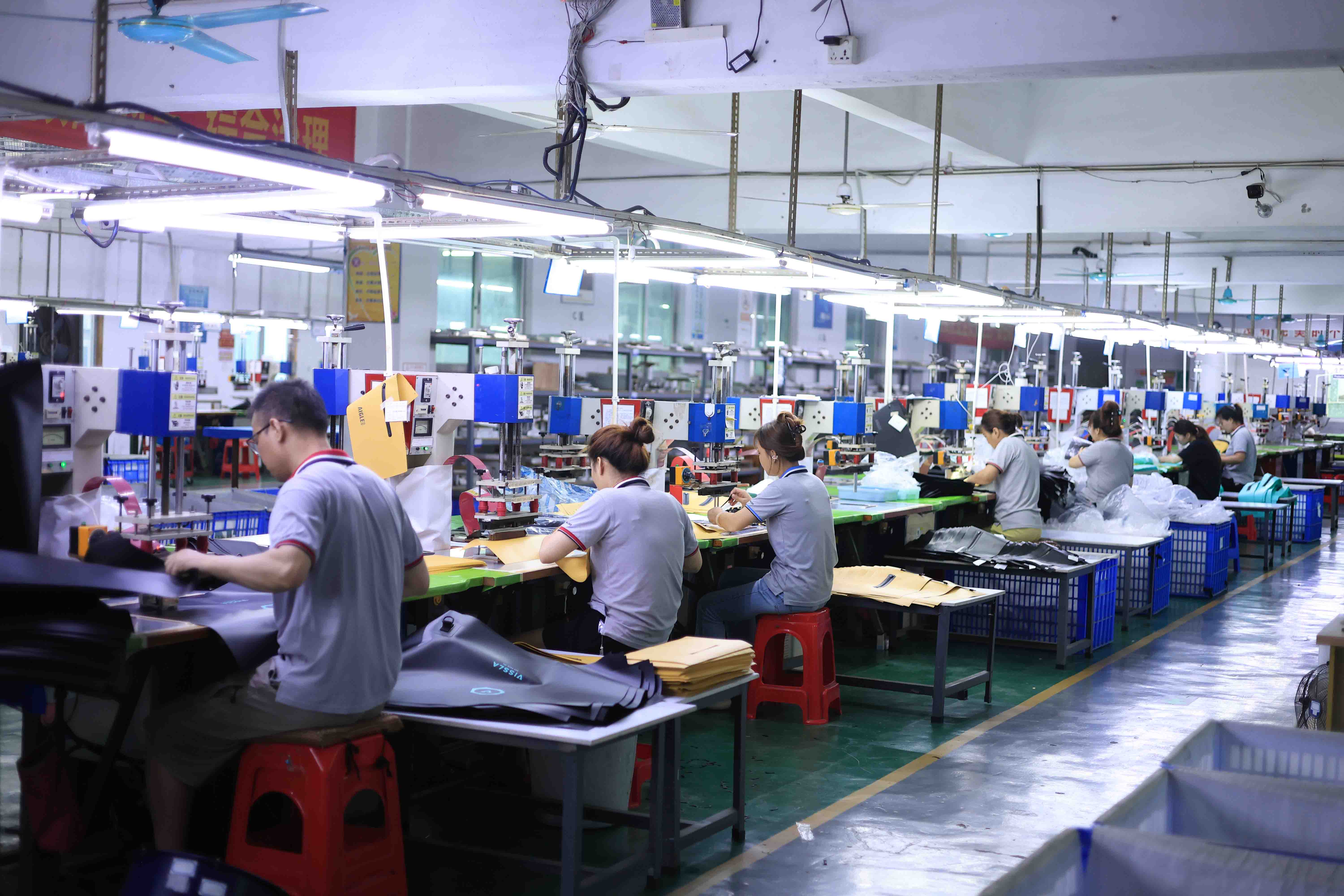
Key advantages of HF welding equipment:
- Seamless waterproof bonding structure
- Higher tensile strength compared to stitching
- Stable performance for mass production
- Suitable for TPU waterproof dry bags and PVC tarpaulin materials
This process significantly improves long-term waterproof reliability, especially for outdoor and marine environments. Learn more about our welding process here: High Frequency Welding Technology Guide.
4. Sealing & Final Bag Assembly Equipment
After welding, dry bag components go through sealing and structural assembly. This includes:
- Roll-top closure alignment and stiffener bar binding
- Strap, heavy-duty buckle, and hardware installation
- Reinforcement sealing at stress points
Sealing equipment ensures that all functional parts are securely fixed and ready for long-term use under outdoor conditions.
5. Quality Control (QC) Equipment & Testing System
Quality control is a critical part of waterproof dry bag manufacturing. Our QC process includes multiple inspection stages using specialized testing equipment:
| Our QC process includes multiple inspection stages using specialized testing equipment: |
|---|
| Air pressure leak testing |
| Water immersion testing |
| Seam strength inspection |
| Load-bearing stress testing |
Each batch is tested to ensure waterproof performance meets export-level standards before shipment.
6 & 7. Packaging, Boxing, Inventory Management & Shipping
The final stages guarantee that your custom volume orders reach your regional warehouses in perfect condition without structural warping or moisture damage:
- Packaging & Boxing: Completed products are folded flat, encased inside thick anti-humidity protective plastic liners, and boxed into heavy multi-layer rigid export cartons with protective edge guards.
- Inventory Management & Shipping: Our digital warehouse tracking controls inventory flow smoothly across our dual production pipeline in Dongguan, China, and Ho Chi Minh City, Vietnam, assuring secure container loading, clear customs clearing, and on-time ocean freight delivery.
Visual Production Flow Chart
Material Cutting & Preparation → Main Body Sewing → HF Welding → Final Bag Assembly → QC Testing → Packaging & Boxing → Inventory Management & Shipping
This structured workflow ensures every product follows the same quality standard, regardless of order size or customization level.
Why Production Equipment Matters in Waterproof Bag Manufacturing
In waterproof dry bag production, equipment quality directly determines product performance. Factories with advanced equipment can achieve:
- More stable waterproof sealing
- Higher production consistency
- Lower defect rates in bulk orders
- Better support for OEM customization
- Faster lead times for wholesale orders
This is why professional buyers often evaluate production equipment before placing large orders.
Support for OEM & Wholesale Orders
Our manufacturing line is designed to support both standard and custom waterproof dry bag production. We provide:
- OEM branding and logo application
- Custom sizes and structures
- Material selection (TPU / PVC / coated fabrics)
- Wholesale bulk production capability
Whether for outdoor brands, marine suppliers, or retail distributors, our production system is built for scalable manufacturing.