- English
- Español
- Português
- русский
- Français
- 日本語
- Deutsch
- tiếng Việt
- Italiano
- Nederlands
- ภาษาไทย
- Polski
- 한국어
- Svenska
- magyar
- Malay
- বাংলা ভাষার
- Dansk
- Suomi
- हिन्दी
- Pilipino
- Türkçe
- Gaeilge
- العربية
- Indonesia
- Norsk
- تمل
- český
- ελληνικά
- український
- Javanese
- فارسی
- தமிழ்
- తెలుగు
- नेपाली
- Burmese
- български
- ລາວ
- Latine
- Қазақша
- Euskal
- Azərbaycan
- Slovenský jazyk
- Македонски
- Lietuvos
- Eesti Keel
- Română
- Slovenski
- मराठी
- Srpski језик

Caving and Canyoning Backpack Manufacturer: IPX8 Welded Packs for Expedition Brands
Listen to this article
Sealock manufactures caving and canyoning backpacks for expedition brands, caving equipment retailers and outdoor clubs, with OEM production from 300 pieces, sealed IPX8 and drain-hole constructions, and factories in Dongguan, China and Ho Chi Minh City, Vietnam. Our SL-J033 caving backpack is a designated supply item for Explore China expedition teams. This article explains how a caving pack differs from every other bag in the outdoor catalogue, the two construction philosophies cavers argue about, and what a brand should specify when developing its own.
A caving pack lives the hardest life of any bag we make. It is dragged through crawls on limestone, hauled up pitches on a rope, pushed ahead through squeezes, dropped down shafts, submerged in streams and sumps, and caked in mud that works into every buckle and seam. Experienced cavers say that zippers fail quickly underground, that ordinary backpack fabric is shredded within a few trips, and that a pack which cannot be dragged on its side is the wrong pack. Designing for this environment is a specialist job, and it is one where a welding factory has a genuine advantage.
Sealed or Drained: Which Caving Pack Construction Is Right?
There are two schools of thought, and both are correct for different caves.
The traditional caving tackle bag is deliberately not waterproof. It is a tough tube of PVC tarpaulin with a drawstring or roll-top closure, shoulder straps and drain holes in the base, so that water entering in a stream or a duck runs straight out again instead of turning the pack into a heavy bucket. Anything that must stay dry, such as food, a first aid kit, a camera or a survey notebook, goes inside a separate dry bag or a hard drum. Established caving brands state plainly that tackle bags are not dry bags, and for long, wet through-trips this approach makes sense.
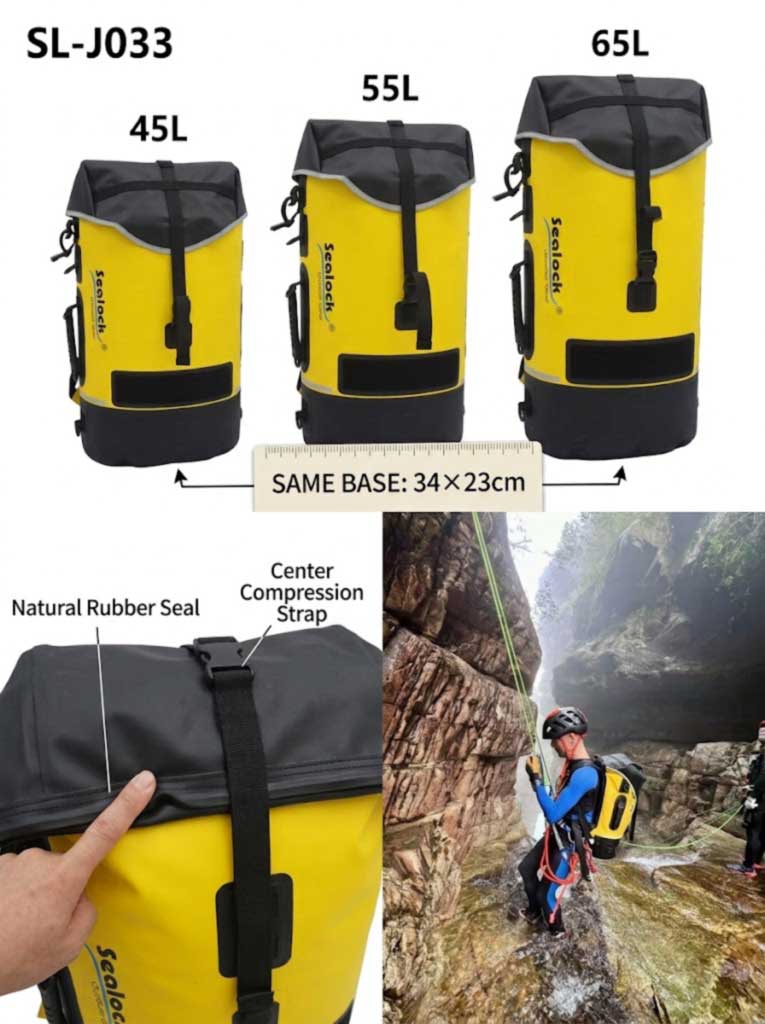
The sealed caving pack takes the opposite approach. The whole pack is the dry bag. Our SL-J033 uses a TPU and 420D nylon body joined with high-frequency welded seams, closed by a fold-over flap with a natural rubber sealing strip and a central compression strap. Folded and clipped, the rubber compresses into a continuous seal rated IPX8 and verified by a full water-immersion test of two hours or more. There is no inner bag to pack and no drum to carry, and the contents stay dry through swims, ducks and stream crawls. Because the sealed pack traps air, it also floats, which helps on swims and in flooded passages.
The trade-off is weight in the wrong direction. A sealed pack that is opened in a wet passage and closed again with water inside will hold that water. Brands therefore sell both, and Sealock builds both. Sealed packs are produced on our high-frequency welding lines, and drain-hole tackle bags in PVC tarpaulin are produced on our industrial sewing lines with reinforced cross-stitched attachment points, in separate rooms on the same production floor. A buyer can develop a sealed pack and a drained tackle bag as a matched range from one factory.
What Makes a Good Caving Pack Shape?
Footprint matters more than capacity. Cave passages are measured by what fits through them, and a pack that is wide at the base will jam in a squeeze no matter how much it holds. The three sizes of the SL-J033, 45, 55 and 65 litres, share the same 34 by 23 centimetre base and differ only in height, at 58, 68 and 78 centimetres. A caver choosing a bigger pack for a camp trip gets more volume without a wider profile, which is the single most important dimension underground.
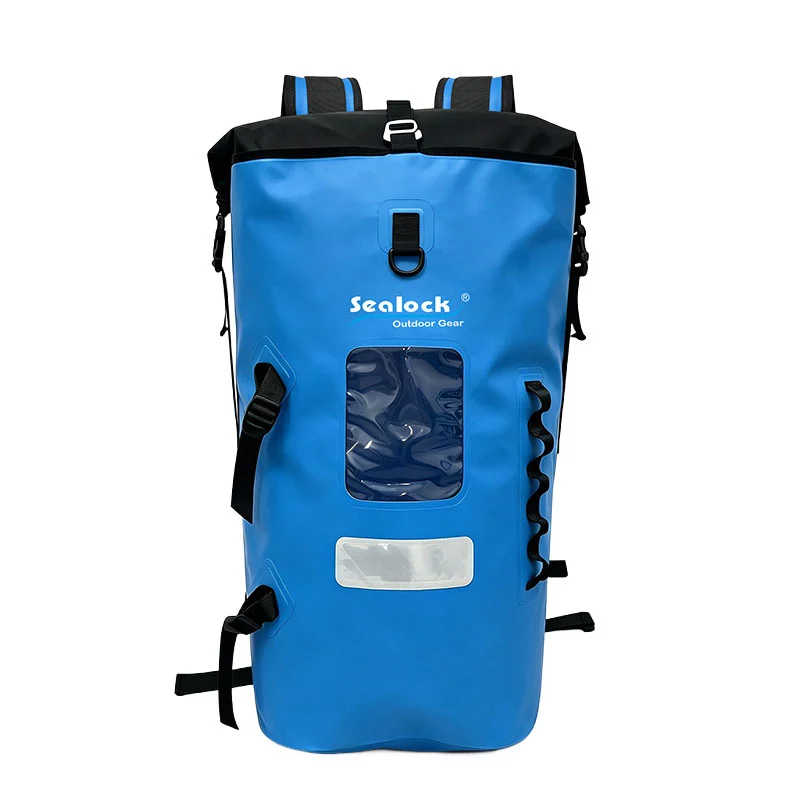
The same logic shapes our SL-E273A, a 45 litre roll-top dry backpack in 500D PVC tarpaulin with a 32 by 25 centimetre footprint, about 63 centimetres tall when closed and 1.1 kilograms in weight. It is rated IPX6 for heavy rain, spray and dripping water rather than for immersion, which makes it a lighter, lower-cost pack for drier caves, approach walks and canyon routes without swims. Its padded harness with chest strap and waist belt, side attachment points, shoulder D-rings and top grab handle suit long carries to the entrance, and the clear front window pocket keeps a survey sheet or map visible without opening the pack. For trips where the pack will go underwater, the sealed SL-J033 remains the right choice.
The top should carry a strong moulded haul handle, because the pack spends much of its life being dragged behind or pushed ahead of the caver, or clipped to a rope and hauled up a pitch. The base must be the toughest part of the bag. On the SL-J033 it is a heavy black abrasion base that takes the wear from being dragged over rock. The straps should be padded enough for the walk in and out, but low-profile enough not to snag, and the waist belt and chest strap should be removable or tuckable for crawls.
Why Closures and Seams Decide a Caving Pack's Life
Mud is the enemy of every mechanism. Grit packs into zipper teeth and sliders, and a zipper that jams in a sump is more than an inconvenience. That is why the standard closure on our caving pack is a fold-over flap with a rubber seal and a single buckle, a system that can be rinsed clean in a stream and still seal. Roll-top closures and airtight zippers are available as OEM options for brands with different priorities, but we advise caving customers on the trade-offs before they choose.
Stitched seams are the other weak point. In a sewn pack, every needle hole is a place where water can enter and where abrasion can start a tear. In a welded pack, the seam is a band of fused material with no holes at all, which is why sealed caving packs are welded rather than sewn. Where the pack does need stitching, for example on straps and webbing anchors, the stitching is kept off the waterproof shell or covered with welded patches.
What Is the MOQ and Price for a Custom Caving Pack?
The standard MOQ is 300 pieces per design, with the three SL-J033 sizes usually able to share one order. Custom colours, including high-visibility two-tone combinations, need their own material run. Changing the closure from rubber seal to roll-top or airtight zipper, adding drain ports or tool loops, or changing the strap system is a modification of an existing pattern. A completely new caving pack with its own welding die takes longer and the die is quoted separately.
On price, a sewn PVC drain-hole tackle bag is the most economical construction. A sealed, welded TPU pack with a rubber seal, abrasion base and full harness costs several times more, because it combines heavier material, more weld steps, moulded parts and immersion testing. We send a firm FOB quote within 24 hours of receiving your design or reference sample, quantity, colours and logo requirements. Caving gear is usually sold in small specialist volumes, so we are used to helping brands plan a 300-piece first run across three sizes, then reorder by size as they sell through.
How Can a Caving Pack Be Branded?
Logos on caving packs have to survive being dragged across rock. A high-frequency welded TPU logo patch is the most durable option, because it is fused into the shell and has no edges to catch. Screen printing in a material-matched ink works on the upper body, away from the base and the drag zones. The SL-J033 also carries a hook-and-loop patch panel, so a club, team or expedition patch can be added and swapped. Reflective trim or reflective printing helps in headlamp light, and coloured webbing gives a range a recognisable look without adding anything to snag.
How Are Caving Packs Tested?
Sealed caving packs are tested with a full water-immersion test of two hours or more on sampled units from every batch, closed exactly as the user instructions describe. Weld peel tests run at the start of every production run. Because caving is about abrasion and load, the base fabric is tested for abrasion resistance, the pack and its haul handle go through more than 1,500 load cycles, and buckles, webbing and D-rings are pull-tested. Fabric is checked for colour fastness and colour difference against the approved sample. Incoming materials, in-line production and finished goods are inspected in turn, with SGS or QIMA inspection available on request.
When buyers inspect shipments themselves, we follow the full leak procedure: unboxing, vacuum extraction, a 24-hour static rest, and then the air-leak determination.
Origin in 2026
Goods of both Chinese and Vietnamese origin have carried the 12.5 percent Section 301 baseline in the United States since 24 July 2026, and Chinese origin additionally carries the existing China-specific Section 301 duties. Every Sealock design can be produced at either factory, so caving packs for the United States market can be quoted with Vietnam origin at the same specification.
Caving and Canyoning Pack Models
The models below are organised by type rather than priority. The SL-J033 is our sealed IPX8 caving pack, and the SL-E273A is our lighter roll-top option for drier caves and approaches. The SL-D002 is listed because many cavers using drain-hole tackle bags carry a roll-top dry bag inside for the gear that must stay dry.
| Image | Model | Size | Dimensions and Weight | Construction and Rating | MOQ |
|---|---|---|---|---|---|

|
SL-J033 45L | 45 litres | 34 by 23 by 58 cm, 1,916 g | Welded TPU and 420D nylon, natural rubber seal flap, IPX8 | 300 pcs |
|
|
SL-J033 55L | 55 litres | 34 by 23 by 68 cm, 1,968 g | Same base footprint, abrasion base, haul handle, IPX8 | 300 pcs |
|
|
SL-J033 65L | 65 litres | 34 by 23 by 78 cm, 2,043 g | Same base footprint, padded harness with waist belt, IPX8 | 300 pcs |
|
SL-E273A | 45 litres | 32 by 25 by 63 cm closed, about 1.1 kg | 500D PVC tarpaulin, roll-top with side buckles, clear window pocket, IPX6 for rain and spray | 300 pcs |
|
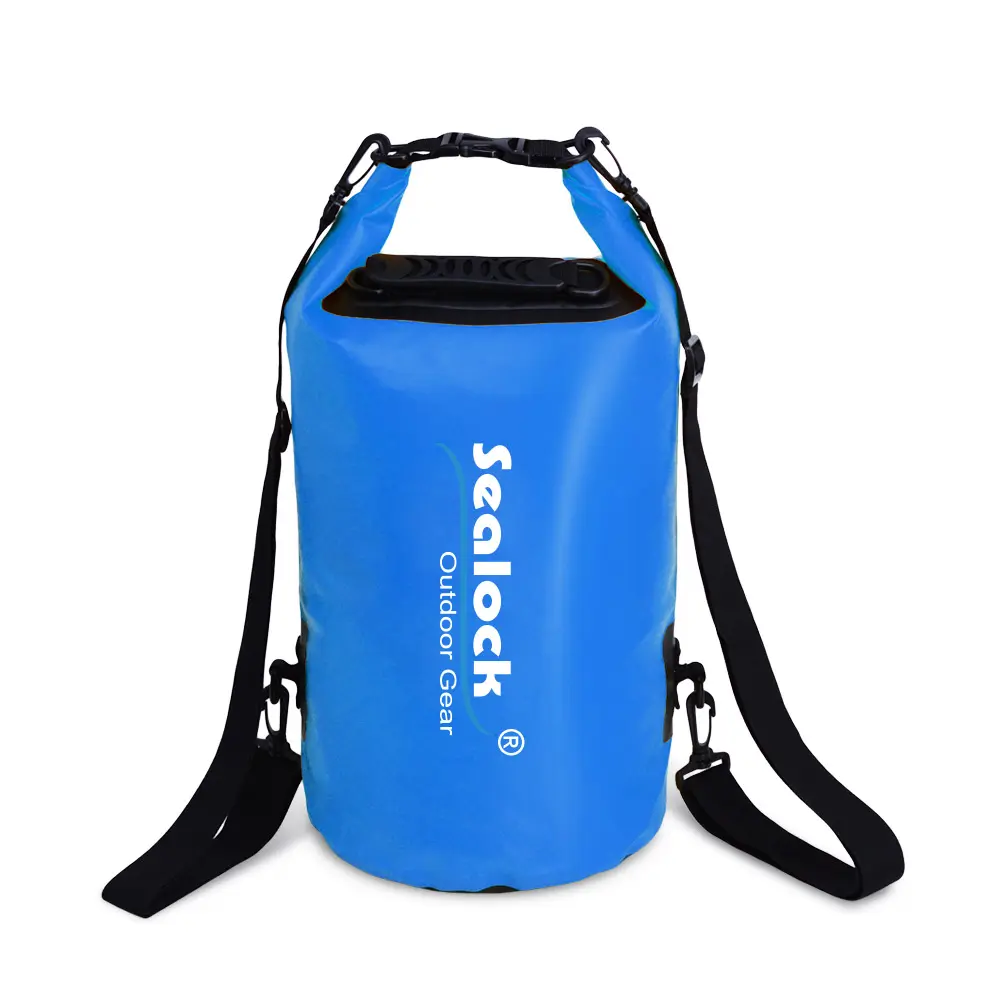
SL-D002 | 5 to 63 litres | 5 litre stands 22 cm, 63 litre stands 68 cm | 500D PVC tarpaulin roll-top, IPX7, inner liner for drain-hole tackle bags | 300 pcs |
Standard Terms
Samples take 7 to 15 days, and bulk production takes 30 to 45 days after sample approval. Prices are quoted FOB Guangdong for China origin, with Vietnam origin quoted on request. Sealock has over 20 years of manufacturing experience in welded and sewn waterproof bags. For related water-focused designs, see our articles on floating dry bags and buoyancy design and how to close and use a roll-top dry bag.
Frequently Asked Questions
Should a caving pack be waterproof or have drain holes?
It depends on the cave. A sealed pack keeps everything dry and floats on swims. A drain-hole tackle bag sheds water and stays light on long wet trips, with a dry bag inside for critical gear. We make both.
Why not use a zipper?
Mud and grit jam zippers underground. A fold-over rubber seal or a roll-top can be rinsed clean in a stream and keeps working. Airtight zippers are available as an option, but we explain the trade-off first.
Will the pack fit through tight passages?
The SL-J033 keeps a narrow 34 by 23 centimetre base in all three sizes, so choosing more capacity adds height, not width.
Can it be hauled on a rope?
Yes. The moulded top haul handle and welded anchors are built for dragging and hauling, and load-tested in production.
Is it suitable for canyoning?
Yes, for canyons with swims and wades where gear must stay dry. For canyons where the pack will be repeatedly filled with water, a drain-hole version is usually the better choice.
Can you make it in our colours?
Yes. Custom Pantone and two-tone colour combinations are available, together with welded logo patches and reflective details.
Request a Quote for Caving and Canyoning Packs
Send us your design brief or reference sample, the sizes, quantity, colours and logo, and tell us whether you need a sealed or drained construction. We will reply within 24 hours with an FOB price and a sample timeline. Contact Sealock about your caving pack project, or email info@sealock.com.hk.