
- English
- Español
- Português
- русский
- Français
- 日本語
- Deutsch
- tiếng Việt
- Italiano
- Nederlands
- ภาษาไทย
- Polski
- 한국어
- Svenska
- magyar
- Malay
- বাংলা ভাষার
- Dansk
- Suomi
- हिन्दी
- Pilipino
- Türkçe
- Gaeilge
- العربية
- Indonesia
- Norsk
- تمل
- český
- ελληνικά
- український
- Javanese
- فارسی
- தமிழ்
- తెలుగు
- नेपाली
- Burmese
- български
- ລາວ
- Latine
- Қазақша
- Euskal
- Azərbaycan
- Slovenský jazyk
- Македонски
- Lietuvos
- Eesti Keel
- Română
- Slovenski
- मराठी
- Srpski језик

Fly Fishing Bag Manufacturer with Custom Branding
Sealock manufactures fly fishing bags for outdoor brands, fly shops, guide services, and OEM programmes from factories in China and Vietnam, with both welded and stitched construction in house and custom branding across the range. Fly packs are not general daypacks with extra D-rings. Their geometry, ride height, closure, and attachment layout derive from two constraints nothing else in outdoor gear shares — the angler is standing in moving water, and there is a fly line in the air — and delivering them takes two different manufacturing disciplines rather than one.
1. Company and Terms
Sealock (YiFuLong Outdoor Gear Co., Ltd.) has built waterproof bags for over 20 years, producing for international outdoor and fly fishing brands including ORVIS, SIMMS, West Marine, and PENN.
- Facilities: Dongguan, China | Ho Chi Minh City, Vietnam — either origin available on any model
- Production: 27.12 MHz high-frequency welding and industrial sewing, each in its own dedicated workshop on the same production floor
- MOQ: 300 pcs on most models; 500 pcs on the 15L and 12L slings and the 20L shoulder bag
- Samples: 7–15 days | Bulk: 30 days for 1–500 pcs on the sling line | Capacity: 15,000 pcs/month
- Certifications: BSCI, ISO 9001, Sedex, plus HIGG, GRS, SCAN | Warranty: one year on most fishing models
2. Two Production Lines on One Floor
Buyers approaching a welded-bag specialist often assume welding is all it does. That assumption costs them options, because a fly pack in particular cannot be built by welding alone.
Sealock runs high-frequency welding and industrial sewing as two separate workshops on the same production floor — deliberately separated, because the two processes need different equipment, different operator skills, and different environments, but adjacent, so a single bag can move between them within one facility rather than being subcontracted out. Welding delivers the sealed, needle-hole-free body that keeps water out. Sewing delivers everything a fly angler judges a pack on: pocket density, mesh organisation, padded straps and back panels, tool docks, tippet bars, net slots, fly patches, and reinforced load-bearing anchors.
Most fly packs in the range use both. A typical construction welds the waterproof shell, then adds stitched organisation and carry components — with load-bearing stitching completed on flat panels before the waterproof seal exists, so no needle ever passes through the finished membrane, and anything mounted afterwards welded onto reinforcement patches instead. The choice is not welded or stitched; it is which process does which job on which part of the bag.

3. The Constraint Set That Defines a Fly Pack
A fly angler works small tools — tippet spools, nippers, hemostats, thin fly boxes — with cold, wet hands, often with the waterline somewhere between mid-thigh and sternum, while an 8- or 9-foot rod loads line into a back-cast directly behind the shoulder. Three requirements follow:
- Keep contents above the water. Ride height is a specification, not a styling choice.
- Present tools to the hand without removing the pack. An angler standing in current cannot take a bag off to find nippers.
- Stay out of the casting arc. Bulk in the wrong place fouls the back-cast, and anything dangling catches line.
4. Wade Depth Decides the Construction
| Use | Requirement | Construction |
|---|---|---|
| Chest-deep wading, skiff and boat work where immersion is plausible | Fully submersible | Welded body with a sealed airtight closure — the IPX8 slings, sealed to 20 m — with stitched components kept off the sealed shell |
| Knee to mid-thigh wading, general stream work | Splash-proof with full organisation | Hybrid: welded waterproof shell with sewn pockets, docks, and carry system |
| Hip and waist carry at any depth | Submersible preferred | Hip packs ride lowest of all formats and will get wet when wading deep, so waterproofing matters more here, not less |
Slings sit slightly higher than backpacks or hip packs, which is part of why they have taken over walk-and-wade fishing over the last decade. Material trade-offs are set out in the TPU material guide.
5. Resolving the Waterproofing-Versus-Organisation Trade-off
Fully welded waterproof bags are often criticised for thin organisation, and the criticism is fair when welding is the only process available — every stitched pocket on a sealed body is a potential leak path, so a welding-only factory has to leave them off.
Having a sewing workshop alongside the welding line is what resolves it. The practical layout on a fly pack:
- Welded sealed core — the main compartment, with a welded seamless liner that wipes out dry and an airtight or sealed zipper.
- Sewn organisation inside — mesh zip pockets, fly box dividers, and a tippet spool bar, built as sub-assemblies on flat panels before the shell is sealed.
- Sewn carry and comfort — padded shoulder straps with mesh facing, ventilated back panels, waist belts and stabiliser straps, all attached at welded reinforcement patches so load never runs through the membrane.
- Sewn or welded external attachment — tool docks, zinger ports, net slots, lash webbing, and patch panels, positioned where they do not compromise the seal.
That combination gives an angler the pocket density they expect without putting a needle through the waterproof shell — the reason both disciplines matter for this category specifically.
6. Snag-Free Design Is a Fly-Specific Requirement
No other fishing discipline cares about this, and fly anglers care intensely: loose fly line wrapping around a pack, hemostats, or a tippet spool is one of the most cited frustrations in the sport, and it happens exactly when the fishing is good. The responses mature fly brands have converged on:
- Docked tools rather than dangling ones. Anchor the zinger inside a pocket or strap so nippers retract to a fixed position, and provide a sheath that locks forceps jaws rather than leaving them hanging.
- Closed-foot zipper pulls. A pull with a fused arch rather than a folded tab removes the gap that fly line hooks into — a small hardware decision with a disproportionate field effect.
- Clean external geometry. Attachment points recessed or low-profile, with nothing protruding into the line's path.
7. Fly Organisation Is Not Tackle Organisation
A lure or bass bag is dimensioned around rigid utility trays. A fly pack carries flat fly boxes and a set of small tools, which changes the interior entirely — and almost all of it is sewing work:
- Fly box compartments sized for thin flat boxes, in a layout that keeps them ordered rather than stacked loose.
- Tippet spool management — a dedicated bar or holder keeping several spools organised and tangle-free.
- Tool docks and zinger ports for nippers, hemostats, and floatant, positioned for one-handed access while wading.
- Net attachment — a dedicated slot, sleeve, or loop for a net handle, since a retractor alone bounces and tangles.
- Fly patches, built-in or removable, for drying flies between changes.
- Sealed valuables pocket for licence, phone, and keys.
Realistic capacity guidance helps size a range: a minimal session needs one or two boxes, tippet, nippers and forceps, and a licence; a day trip needs two to four boxes, leaders and tippet, indicators and shot, a light layer, and a water bottle. Guide packs go further, carrying spare flies and tippet for clients on top of the guide's own kit.
8. Format Ladder
Fly anglers select format by session length and wade depth rather than capacity alone — chest and lanyard setups for minimalist technical streams, slings for walk-and-wade, hip packs for long balanced days on foot, shoulder bags for simple fast access, and backpacks for hike-in and multi-day. A range covering a sling, a hip or waist pack, and a backpack reaches most of the market. Wholesale architecture is covered in the guide to OEM fishing bags for wholesale buyers.
9. Custom Branding for Fly Shops, Guides, and Lodges
Fly fishing has an unusual buyer profile: alongside brands, there is a large population of fly shops, guide services, lodges, clubs, and outfitters wanting branded gear in modest quantities. Options across the range:
- Welded and rubber patches — a premium tactile mark with no printed layer to abrade off, and the best fit for coated TPU bodies.
- Embroidery — traditional in this market and run on the sewing line, applied to a panel or patch rather than through a waterproof shell.
- Silkscreen and heat transfer — bold marks and finer detail respectively, applied with pre-treatment and correctly formulated ink so adhesion holds on a coated surface.
- Hook-and-loop patch panels — particularly suited to guide services and lodges, since one stock bag carries interchangeable patches for different guides, teams, or seasons.
- Colourways — muted, natural palettes matched to a Pantone standard; stock colours include heather grey, dark green, black, orange, blue, and grey.
Branding is confirmed at the sample stage on the actual production material rather than a similar swatch, since adhesion behaves differently on a different coating batch. Colour-fastness and colour-difference testing against a signed reference runs on every batch so a lodge's repeat order matches its first.
10. Fly Fishing Range
Models organized by type rather than priority:
| Image | Model | Capacity | Material | Key specification | MOQ | Product Page |
|---|---|---|---|---|---|---|
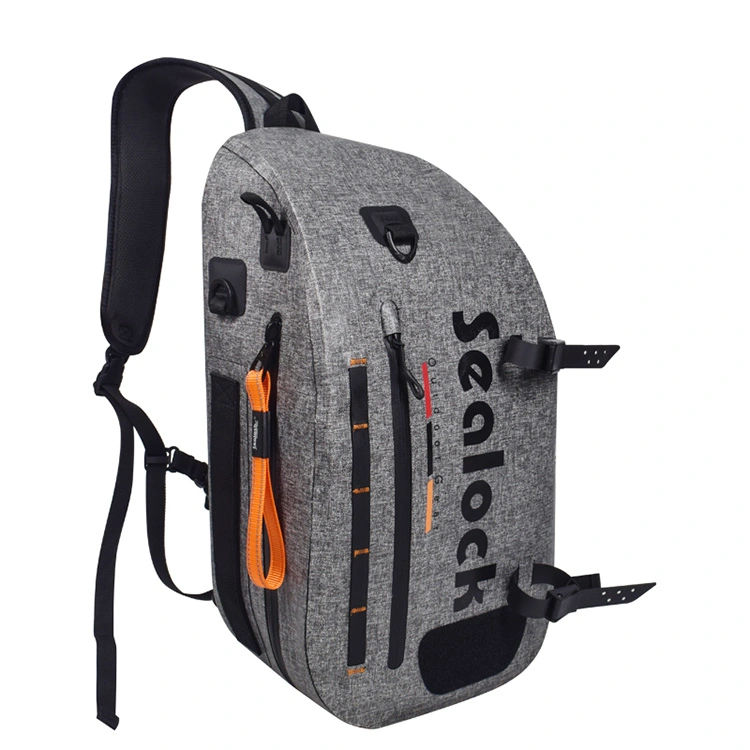
|
SL-E589 | 15L | 840D double-coated TPU | IPX8 to 20 m · waist belt for wading · moulded zipper end cap · 868 g | 500 | View |
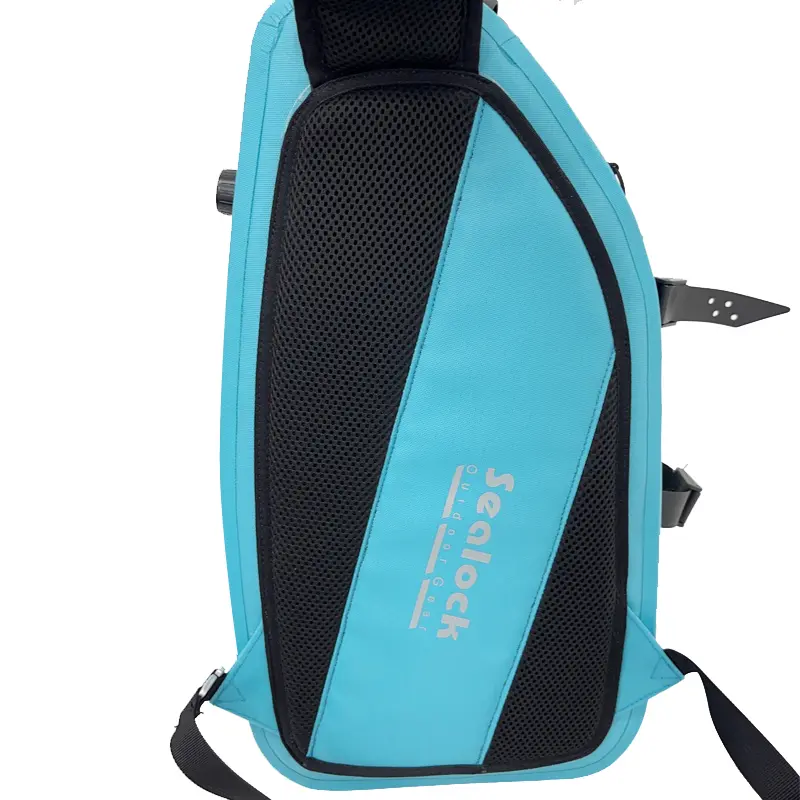
|
SL-E868A | 12L | 840D double-coated TPU | IPX8 to 20 m · welded one-piece liner · internal mesh zip pocket · 800 g | 500 | View |
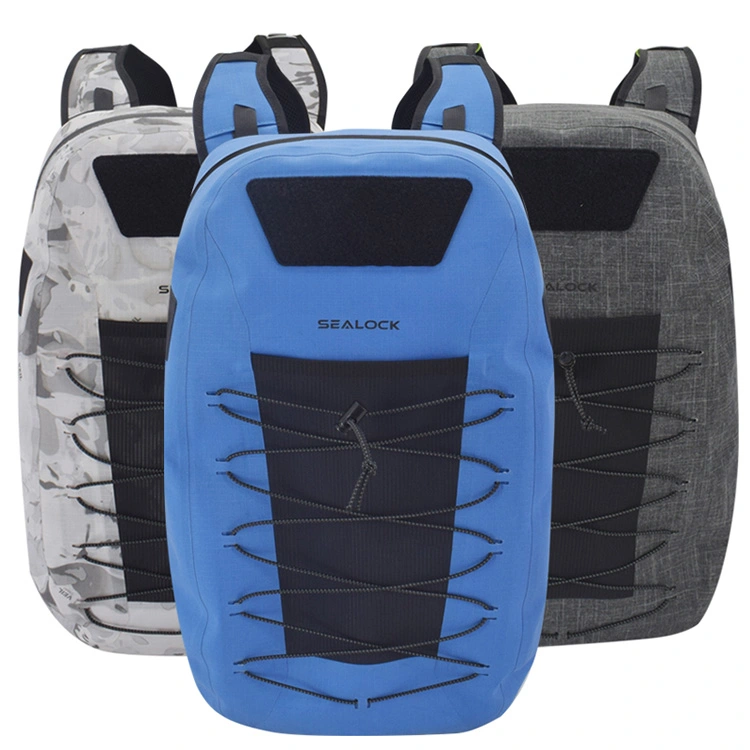
|
SL-E717 | 20L | 840D / 600D TPU | Cross chest pack · bottle holder · blue, grey, green | 300 | View |
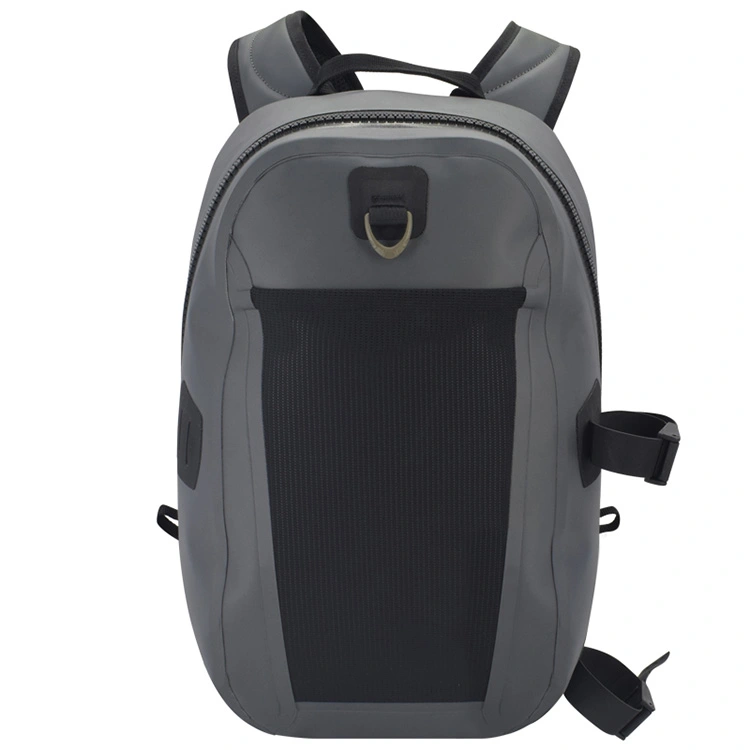
|
SL-E718 | 15L | 600D TPU on nylon | Two-layer construction · one-year warranty | 300 | View |
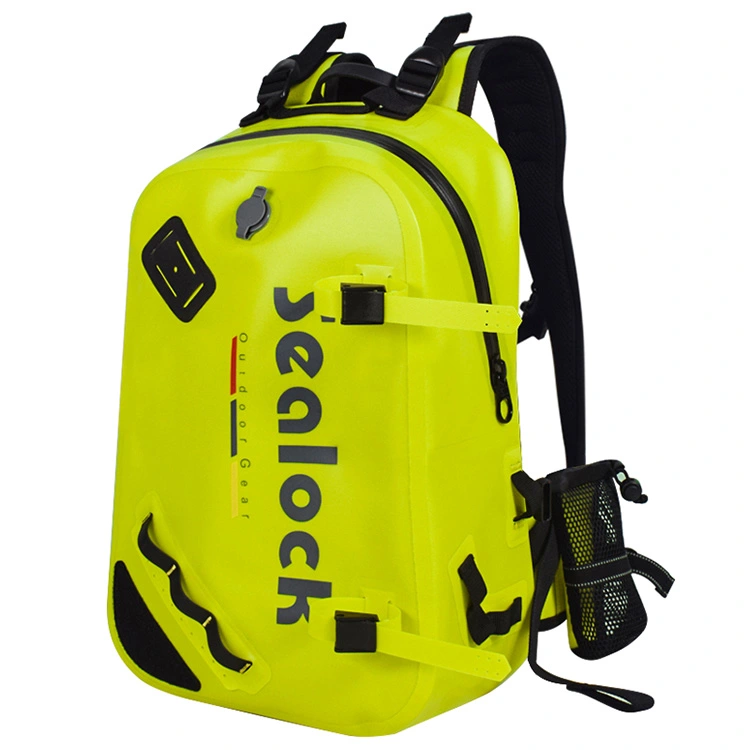
|
SL-E217B | 20L | 840D TPU | 0.7 kg · single-layer · green, dark grey | 500 | View |
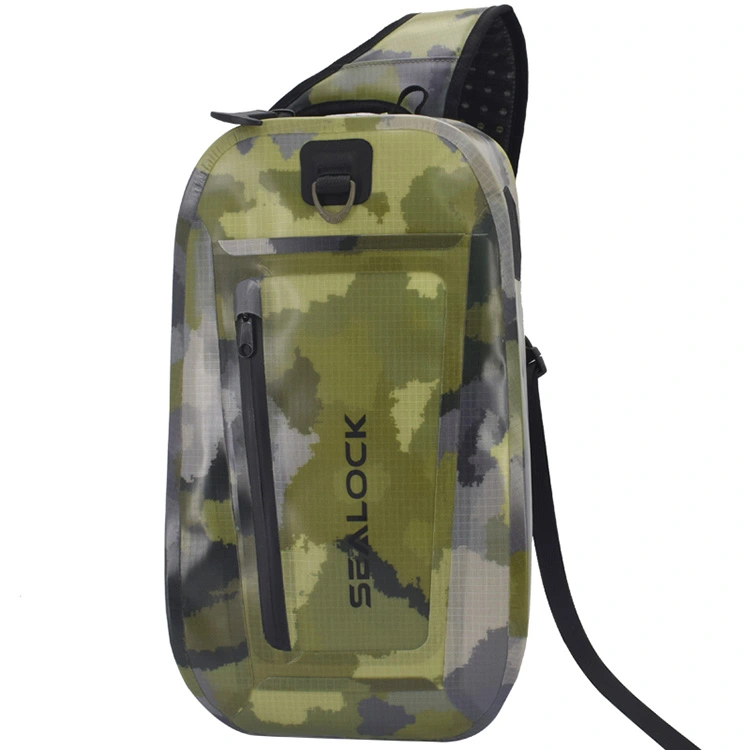
|
SL-E825 | 10L | 600D TPU on nylon | Two-layer · lightweight shoulder carry | 300 | View |
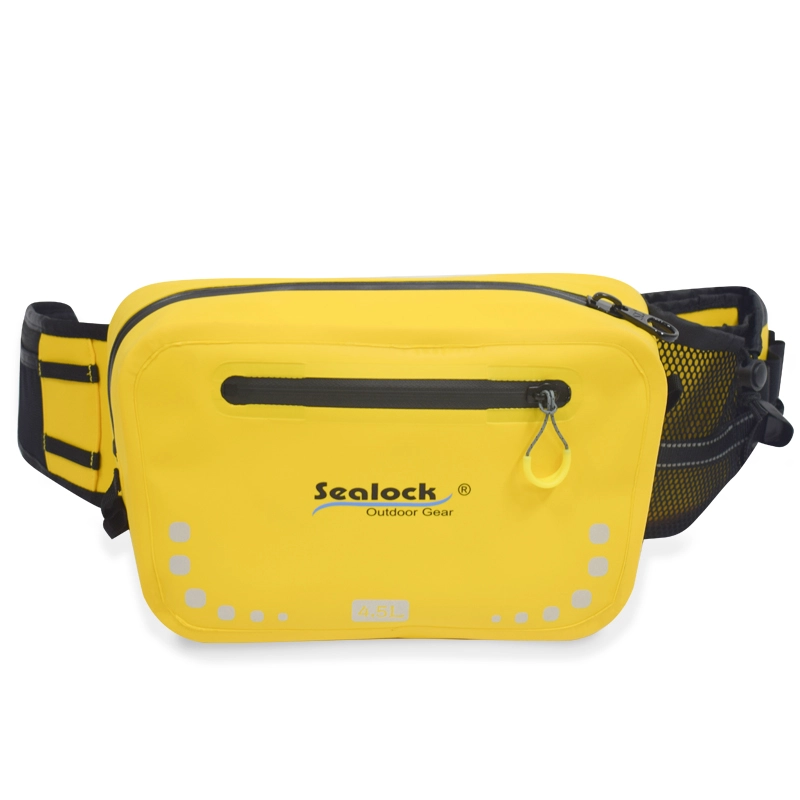
|
Creek Hip Pack | 4.5L | Coated waterproof fabric | Hip carry for wading · adjustable waist strap · multiple compartments | 300 | View |
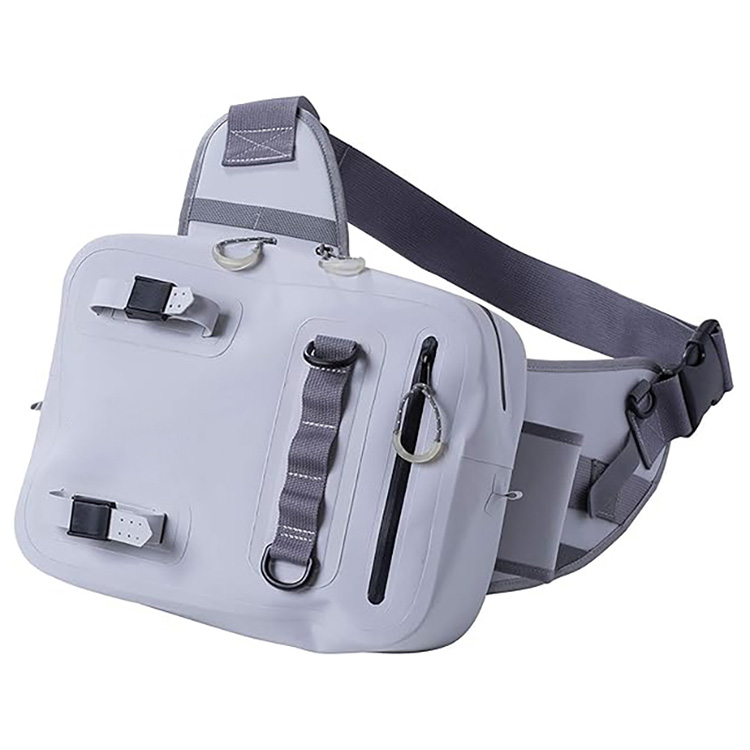
|
Airtight Zipper Waist Bag | 2.3L | Welded waterproof | IPX8 airtight zipper · waist / shoulder / chest carry · rod straps | 300 | View |
Full categories sit under waterproof bags, dry backpacks, and dry bags. Category engineering is covered in the guide for fishing bag manufacturing, and supplier verification in the fishing bag supplier selection guide.
11. OEM Scope
Beyond logo and colour, a fly programme can specify construction method across welded, stitched, and hybrid builds; capacity and ride height; waterproof level from splash-rated to IPX8 submersible; fabric and denier in TPU or PVC; closure and zipper grade including pull geometry; carry configuration across sling, hip, shoulder, chest, and backpack; fly box compartment layout; tippet spool holder; tool docks and zinger ports; net attachment; fly patch; sealed valuables pocket; external attachment matrix; reflective trim; patch panel; and packaging. Ground-up development from a sketch, sample, or target spec is supported, with tooling and lead time scheduled against a launch date.
12. Quality Control
Fabric inspection, weld seam inspection, airtight zipper testing, colour consistency against the signed sample, appearance, and carton inspection run at 100%, with full water immersion of two hours or more by batch sampling and strap, buckle, handle, lash strap, and D-ring pull testing by random sampling. Three-stage control applies — IQC on incoming fabric, zippers, and hardware; IPQC on welds, stitching, and zipper installation in process, including peel tests on sample welds at run start and stitch density and tension checks on the sewing line; and OQC with AQL sampling and gold-sample comparison. Salt spray covers hardware for saltwater programmes. The full customer inspection procedure — unboxing, vacuum extraction, a 24-hour static rest, and air-leak determination — can be witnessed end to end, with SGS or QIMA inspection available. Standards are set out in the quality control standards for waterproof production.
13. FAQ
Q: Do you only make welded bags?
A: No. High-frequency welding and industrial sewing run as separate workshops on the same production floor, both in house. Welding builds the sealed body; sewing builds the pockets, tool docks, tippet bars, padded harnesses, and reinforced anchors. Most fly packs use both, and a fully stitched construction is equally available where the specification calls for it.
Q: Doesn't a waterproof bag mean sacrificing pockets and organisation?
A: Only at a factory that can weld and nothing else. With a sewing line alongside, organisation is built as sub-assemblies on flat panels before the shell is sealed, and carry components attach at welded reinforcement patches — so the pack gets the pocket density fly anglers expect without a needle through the membrane.
Q: Can a general outdoor daypack be adapted into a fly pack?
A: Not credibly. Ride height, closure rating, snag-free geometry, and the attachment matrix all derive from wading depth and casting mechanics. A daypack with D-rings added fails on tool access while standing in current and fouls fly line — the two things fly anglers judge a pack on.
Q: How do we decide the waterproof rating?
A: By wade depth. Chest-deep wading and skiff work need a fully submersible welded build with a sealed closure; knee to mid-thigh work is served by a hybrid welded shell with sewn organisation. Hip packs ride lowest and get wet first, so specify them submersible rather than assuming their small size makes them safe.
Q: What is snag-free design and why does it matter so much?
A: Loose fly line catching on tools or hardware is among the most cited frustrations in the sport. Dock the zinger inside a pocket or strap so nippers retract to a fixed point, sheath forceps rather than leaving them hanging, and specify closed-foot zipper pulls whose fused arch has no gap for line to hook into.
Q: We are a fly shop or guide service, not a large brand. Can you do a small branded run?
A: MOQ is 300 pcs on most models and 500 on two slings and one shoulder bag. Embroidery is run in house on the sewing line, and hook-and-loop patch panels let one stock bag carry interchangeable patches for different guides, teams, or seasons — often a better fit than a permanent printed mark.
Request a Fly Fishing Proposal
For pack architecture, construction method, branding options, samples, or a full OEM proposal, submit an inquiry. Sealock responds to procurement enquiries within 24 hours, with production from Dongguan, China or Ho Chi Minh City, Vietnam.