
- English
- Español
- Português
- русский
- Français
- 日本語
- Deutsch
- tiếng Việt
- Italiano
- Nederlands
- ภาษาไทย
- Polski
- 한국어
- Svenska
- magyar
- Malay
- বাংলা ভাষার
- Dansk
- Suomi
- हिन्दी
- Pilipino
- Türkçe
- Gaeilge
- العربية
- Indonesia
- Norsk
- تمل
- český
- ελληνικά
- український
- Javanese
- فارسی
- தமிழ்
- తెలుగు
- नेपाली
- Burmese
- български
- ລາວ
- Latine
- Қазақша
- Euskal
- Azərbaycan
- Slovenský jazyk
- Македонски
- Lietuvos
- Eesti Keel
- Română
- Slovenski
- मराठी
- Srpski језик

Waterproof Dry Bag Manufacturer: Factory Capabilities and Production Process
Sealock is a waterproof dry bag manufacturer supplying OEM and wholesale production from vertically integrated factories in China and Vietnam. When a brand is choosing a factory rather than a product, the questions change: not "what does this bag cost" but "what can this plant actually make, at what volume, to what standard, and how." This is a look inside the equipment, the production line, and the step-by-step process that turns a roll of coated fabric into a shippable, audit-ready order.
1. What "Factory Capability" Actually Means
The dry-bag supply base ranges from trading offices that subcontract everything to vertically integrated plants that cut, weld, assemble, and test under one roof. The difference decides lead time, consistency, and whether a seam problem can be solved at source or gets bounced between vendors. Real factory capability comes down to five things a brand can verify: in-house welding equipment, production-line structure, monthly capacity, R&D and sampling, and compliance. Sealock has built welded waterproof bags for over 20 years across dry bags, dry backpacks, duffels, and motorcycle luggage on the same integrated lines.
2. Manufacturing Footprint and Capacity
Scale and origin flexibility are the first capability checks for a wholesale program:
- Dual-country production: facilities in Dongguan, China and Ho Chi Minh City, Vietnam, so a brand can shift country of origin to ease its market's tariff exposure — an option pure-China suppliers cannot offer.
- Welding line count: multiple high-frequency welding lines running in parallel, which is what allows volume without queuing a single machine.
- Monthly capacity: production measured in tens of thousands of units per month per category, with the motorcycle line alone rated up to 30,000 pcs/month, so a brand's forecast is matched to real throughput rather than a best-case number.
- MOQ and lead time: a stated MOQ of 300 pcs, samples in 7–15 days, and bulk in 30–45 days.
3. Core Equipment on the Line
The machines are what a factory audit should look at, because they set the ceiling on quality and volume:
- High-frequency (RF) welders at 27.12 MHz: the core technology of waterproof bag production, generating heat inside the thermoplastic to fuse layers at a molecular level into an airtight seam. Bar-electrode welders run straight continuous seams; rotary and automated welders handle high-volume cycle flow.
- Custom-machined copper electrodes (dies): each bag geometry is translated into a precise 2D weld pattern, and a custom die is machined for it — the in-house tooling capability that lets a factory build a new shape rather than only refill existing molds.
- Automated cutting press: stamps bag panels from raw rolls to uniform dimensions, which is what keeps a bulk run consistent.
- High-tension industrial sewing machines: pre-assemble load-bearing elements — harnesses, D-ring webbing patches, pockets — before final sealing.
- Pressure/immersion test rigs: at the QC station for 100% or sampled leak auditing.

4. The Production Process, Stage by Stage
Sealock organizes the line in a strict linear flow to prevent cross-contamination and keep seams consistent. A dry bag moves through the plant in this sequence:
- Stage 1 — Material staging and cutting: raw PVC or TPU rolls are staged, and an automated cutting press stamps out panels to the exact design dimensions. Precision here is what keeps a wholesale run uniform.
- Stage 2 — Main-body sewing / pre-assembly: high-tension sewing pre-attaches load-bearing elements — shoulder harnesses, D-ring webbing patches, external pockets — onto the panels before sealing, so high-stress points do not tear under load.
- Stage 3 — Die setup: the custom copper electrode for that geometry is set on the die table and the weld pattern aligned.
- Stage 4 — HF welding: panels enter the welding station, where 27.12 MHz energy fuses the seams into one continuous waterproof skin with no needle penetration.
- Stage 5 — Cooling: hot seams pass into a dedicated cooling zone so the bond sets without distortion.
- Stage 6 — Trimming and final assembly: the bag is trimmed, and closures, buckles, straps, and valves are fitted.
- Stage 7 — QC testing and packing: a pressurized leak or immersion test is run at the QC station, and passing bags move to packing and boxing.
The order of Stages 2 and 4 is deliberate: load-bearing parts are sewn on before the airtight weld, so stitching never pierces the finished waterproof membrane — hardware that must not leak is welded onto reinforcement patches instead.

5. R&D and Sampling Capability
The ability to develop a new design — not just refill an existing mold — is what separates an ODM factory from an assembler. Sampling is the clearest test: a capable factory turns a brief, sketch, or reference sample into a working sample and helps refine it before bulk. That depends on an in-house design team, a tooling workshop that can machine new copper dies and cut custom nylon or CNC-aluminum backing plates for rack mounts, and a sample turnaround measured in days. Ground-up development runs longer than modifying an existing model, so a brand should plan its timeline against a launch date.
6. Quality Control Built Into the Line
Sealock applies a three-stage control rather than relying on final inspection alone. The laboratory test suite covers a load test of over 1,500 cycles, 3,000 sealed-zipper cycles for zippered models, tensile strength, bonding strength, salt spray, friction resistance, color fastness, and color difference, plus a full water immersion test to confirm the interior stays dry. Inspection runs as IQC on incoming rolls, zippers, and hardware; IPQC on welds and processes in line, including peel tests on sample welds at run start; and OQC with AQL sampling, batch immersion testing, and signed gold-sample comparison, with optional SGS/QIMA third-party inspection before shipment. Quality control is a system built across stages, not a single test at the end.
7. Production Range: One Factory Across Categories
The same integrated lines run the full waterproof range, so a brand can build a matching program under one logo and ship it in a single run. Representative categories and models, organized by type rather than priority:
| Image | Category | Representative model | Material | Product Page |
|---|---|---|---|---|
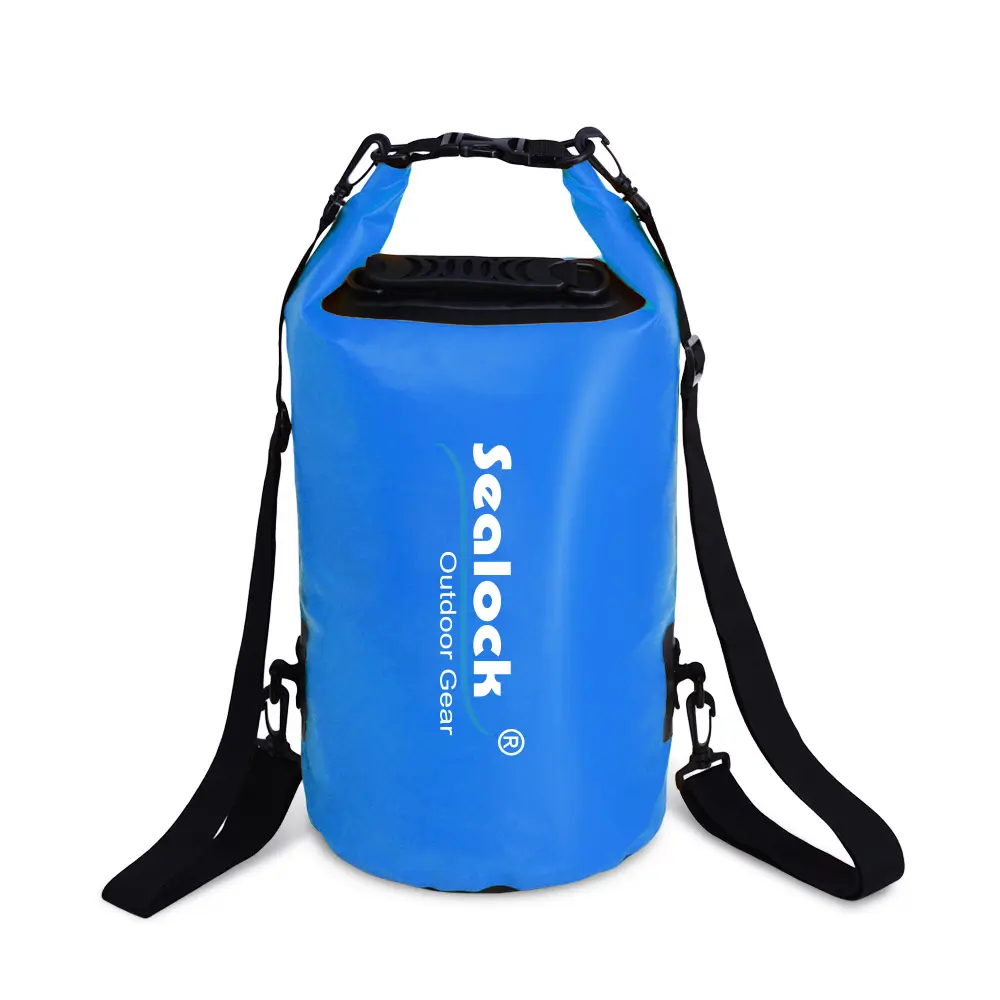
|
Roll-top dry bag | 500D PVC UTX Buckle Dry Bag (SL-D002), 5–63L | 500D PVC | View |
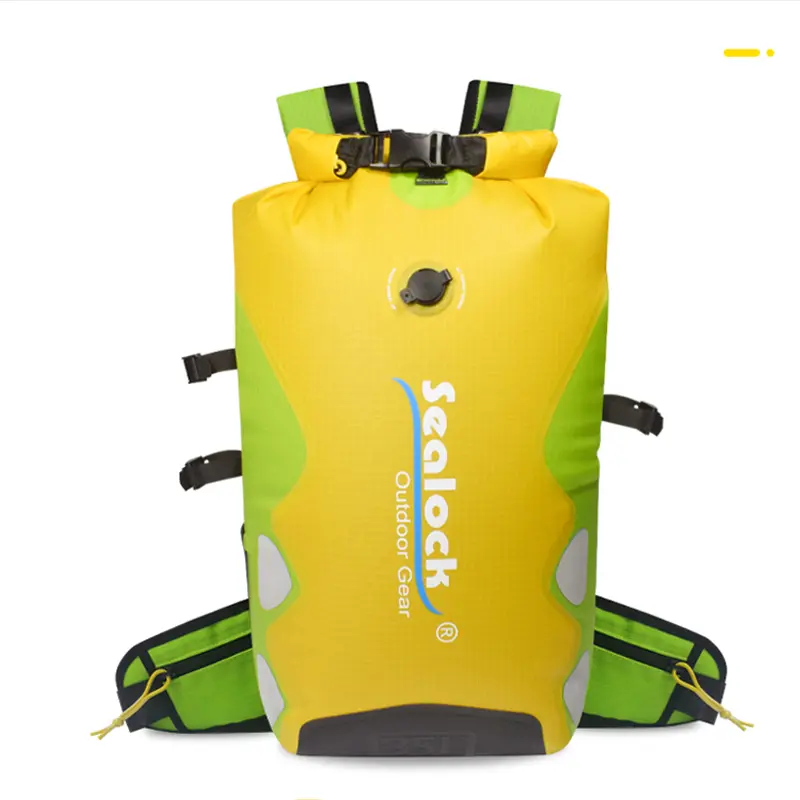
|
Dry backpack | 35L Roll-Top Backpack (SL-E801) | 420D TPU | View |
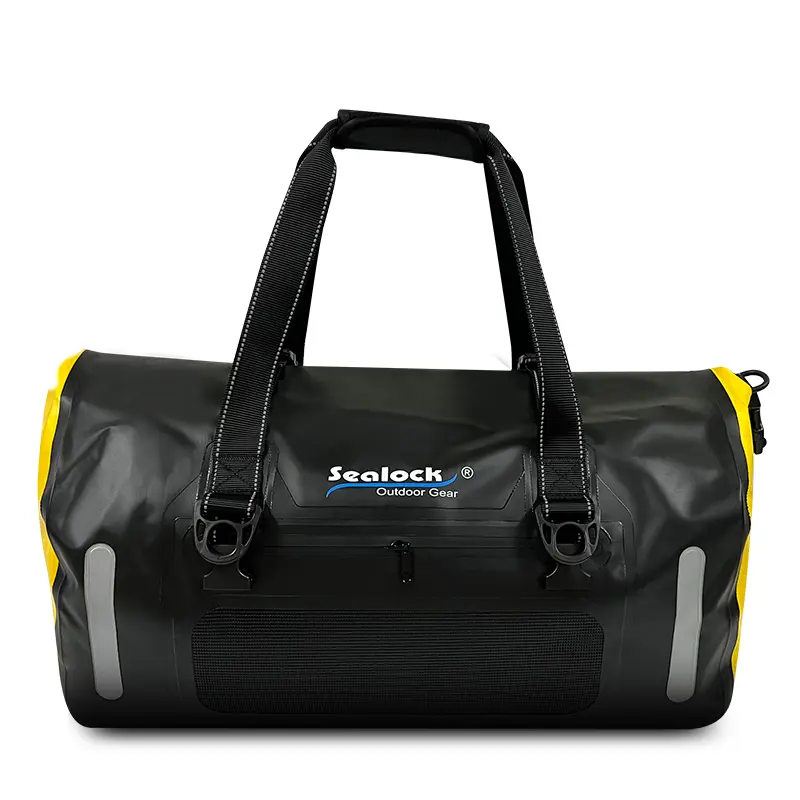
|
Waterproof duffel | 40L / 60L Roll-Top Duffel (SL-K099) | 840D TPU | View |
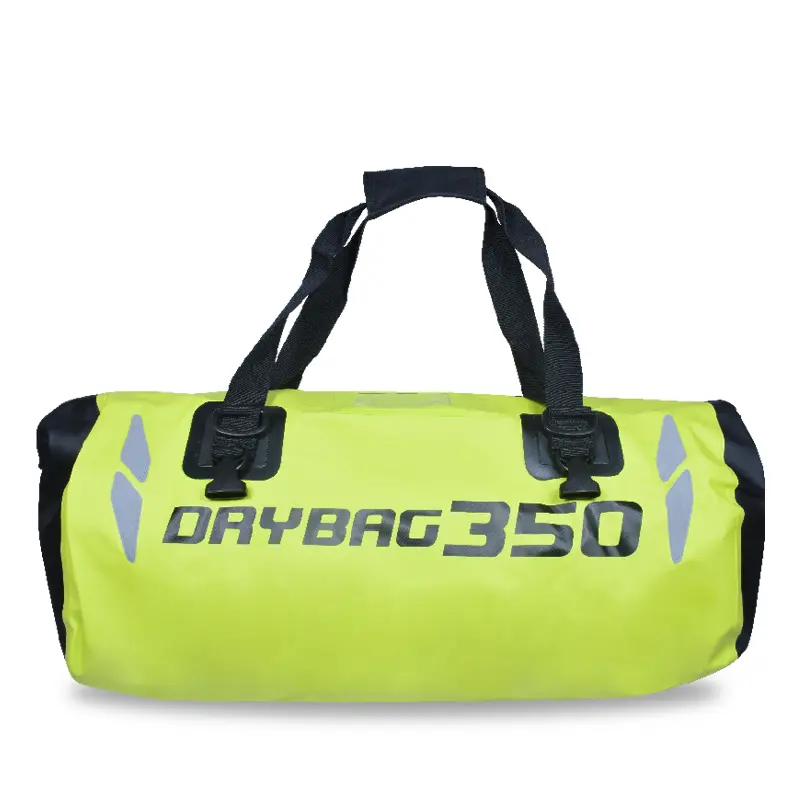
|
Motorcycle luggage | 50L Motorcycle Luggage Bag (SL-C619), 35/50L | 500D PVC | View |
|
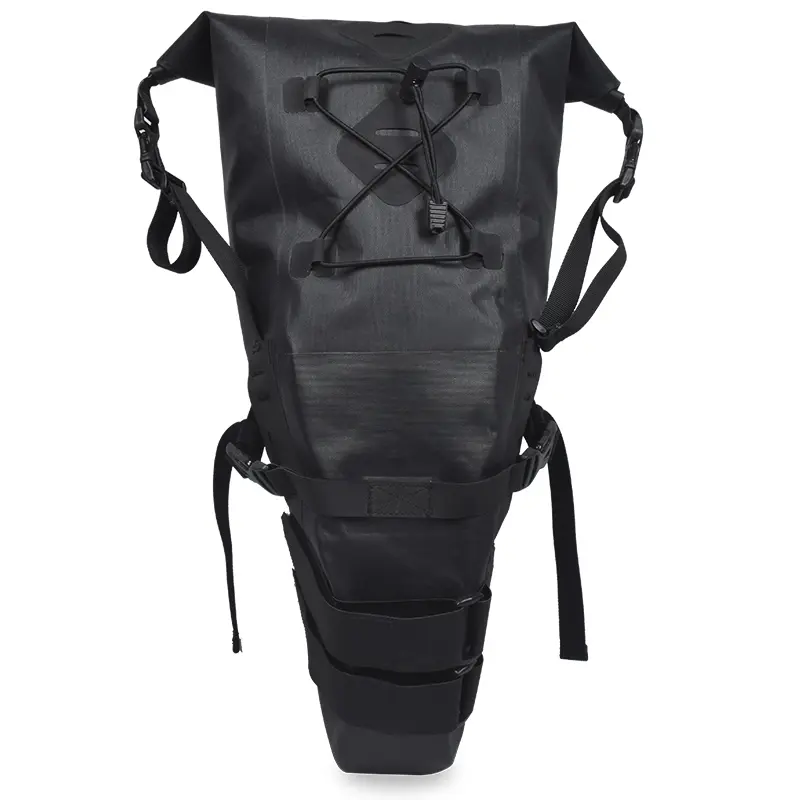
Bikepacking / cycling | Bikepacking Saddle Bag (SL-K022), 10–14L | 420D/600D TPU | View |
|
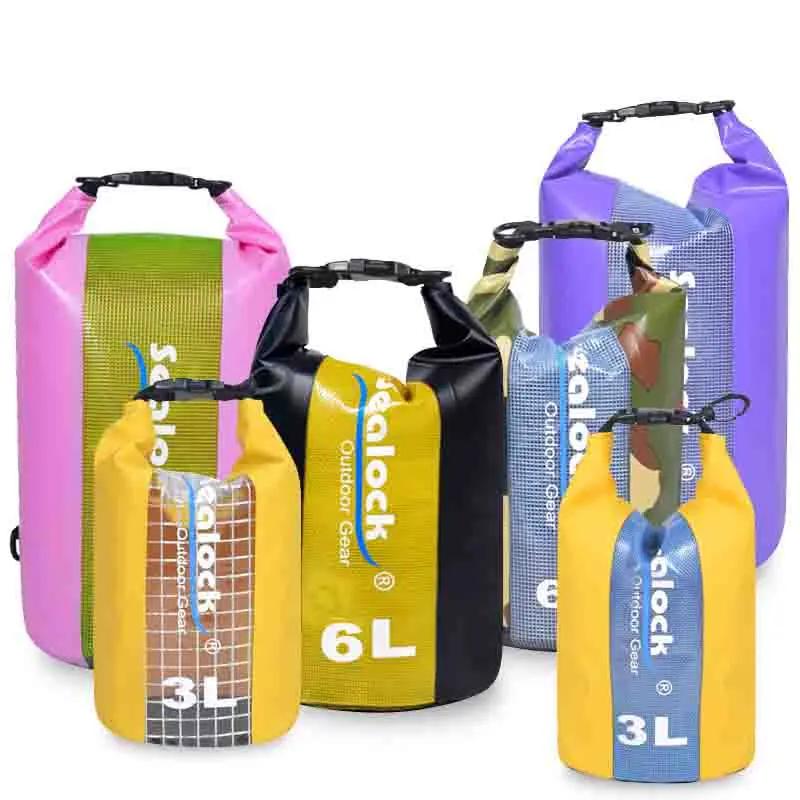
Window / phone-view dry bag | Clear Window Dry Bag, 3–10L | PVC | View |
8. FAQ
Q: How can a brand tell a real dry bag factory from a trading company?
A: A factory can name its welding equipment and frequency, show the production line, state monthly capacity, and provide close-up images or video of welded seams, corners, and attachment points. A trading office subcontracts and cannot answer process questions in depth — the gap usually shows within one email exchange.
Q: Why does the welding equipment matter so much?
A: High-frequency welding at 27.12 MHz is what fuses the fabric into an airtight seam with no needle holes; stitched-and-taped seams leak once the tape lifts, often within days of immersion. A factory without in-house RF welding cannot control the single most important part of the bag.
Q: What monthly capacity should a brand confirm before a large order?
A: Ask for capacity per category, not a single headline number. Sealock runs multiple welding lines with category capacity in the tens of thousands per month, so a forecast is matched to real throughput rather than a best-case figure — important when a promotion or retail launch has fixed dates.
Q: Can the factory develop a new design, or only copy existing molds?
A: A full-capability factory machines custom copper dies for new geometries and cuts custom backing plates for mounts, then proves the design through sampling before bulk. Ask to run a sample from your own sketch — an assembler that only refills existing molds cannot.
Q: How is quality kept consistent across a large bulk run?
A: Through in-line control, not just final inspection: precise automated cutting for uniform panels, peel tests on sample welds at run start, and three-stage IQC/IPQC/OQC with immersion testing and a signed gold-sample reference so late batches match the first.
Request a Factory Proposal
For a capability profile, capacity confirmation, samples, or a full OEM/ODM proposal, submit an inquiry. Sealock responds to procurement enquiries within 24 hours and can route production through China or Vietnam to suit a brand's tariff position.