
- English
- Español
- Português
- русский
- Français
- 日本語
- Deutsch
- tiếng Việt
- Italiano
- Nederlands
- ภาษาไทย
- Polski
- 한국어
- Svenska
- magyar
- Malay
- বাংলা ভাষার
- Dansk
- Suomi
- हिन्दी
- Pilipino
- Türkçe
- Gaeilge
- العربية
- Indonesia
- Norsk
- تمل
- český
- ελληνικά
- український
- Javanese
- فارسی
- தமிழ்
- తెలుగు
- नेपाली
- Burmese
- български
- ລາວ
- Latine
- Қазақша
- Euskal
- Azərbaycan
- Slovenský jazyk
- Македонски
- Lietuvos
- Eesti Keel
- Română
- Slovenski
- मराठी
- Srpski језик

Engineering Marine-Grade Deck Bags: Saltwater Hydrolysis and Dynamic Shear Loads
Strapping a dry bag to a kayak or SUP deck looks simple. Sourcing an OEM partner capable of manufacturing a deck bag that survives a season of saltwater exposure and Class IV wave surges is a material engineering problem. Most commercial dry bags do not leak from the main closure. They fail at the anchor points, or the material itself disintegrates under UV radiation.
For marine and tactical gear sourcing directors, specifying a deck bag means planning for dynamic impact, not just static waterproofing. A deck-mounted bag is a structural component of the vessel absorbing wave energy. If your manufacturing partner treats it like a generic backpack, the failure rate in the field will be catastrophic.
The Delamination Reality: Saltwater and ASTM G154
The marine environment is hostile to flexible polymers. UV radiation accelerates plasticizer breakdown. Saltwater drives hydrolysis. This combination destroys generic PVC and standard Polyester TPU.
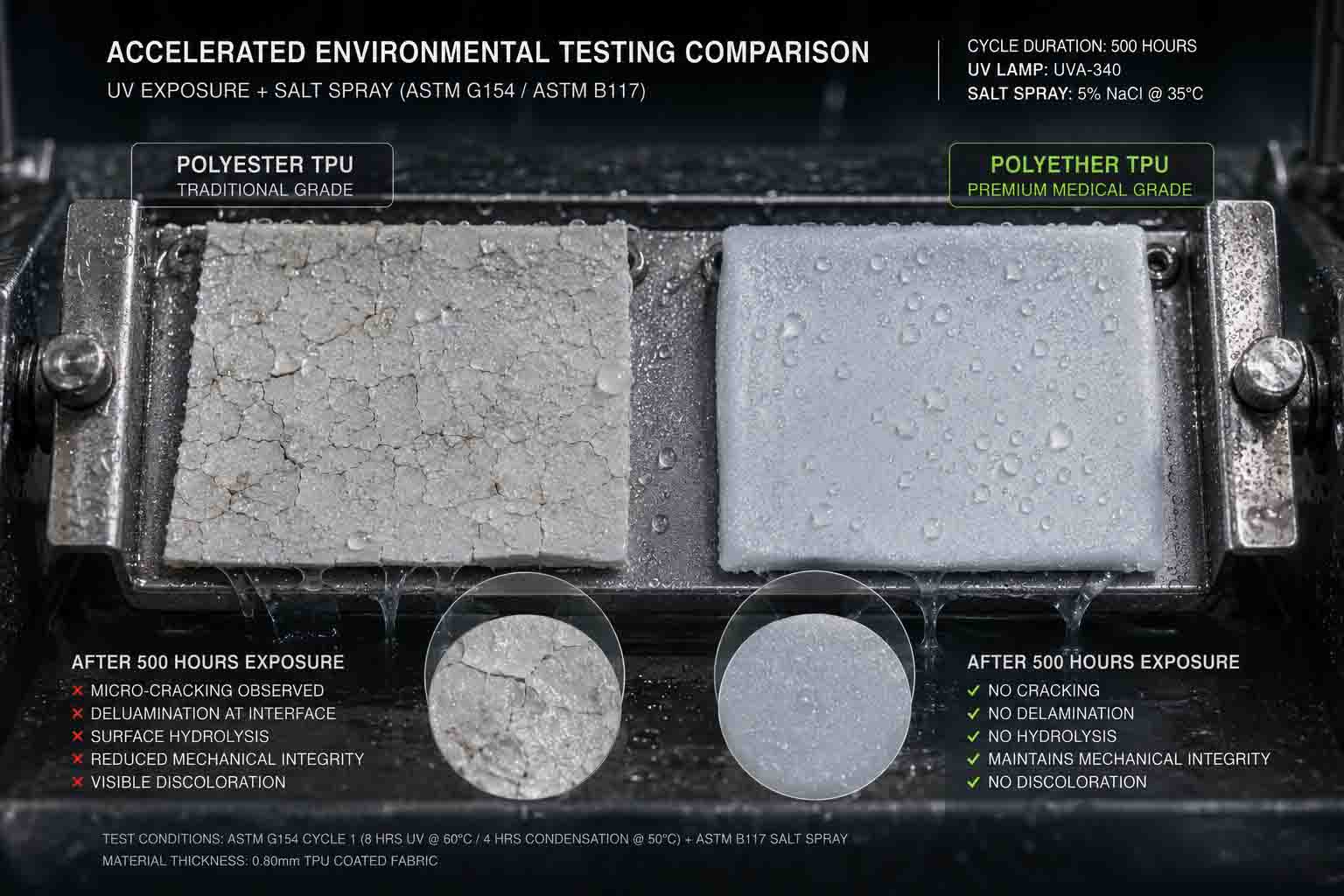
In consumer-grade dry bags, the material feels robust on the showroom floor. Under continuous sun exposure and salt spray, Polyester TPU embrittles. Micro-cracks form along the flex points. Within 90 days of heavy marine use, the waterproof barrier delaminates from the base textile. The bag doesn't just leak; it sheds its coating.
Marine-grade production mandates Polyether-based TPU. But specifying the polymer family isn't enough. The material must be validated against ASTM G154 (Standard Practice for Operating Fluorescent Ultraviolet Lamp Apparatus for Exposure of Nonmetallic Materials). If the factory cannot provide accelerated weathering data proving the TPU retains its tensile strength after 500 hours of cyclic UV and condensation exposure, you are buying a disposable product.
The Anchor Point Vulnerability: Dynamic Shear Loads
When a Class IV rapid or heavy ocean surf crashes over a kayak deck, a 20L loaded bag creates massive dynamic shear force. This force transfers directly to the D-rings or RF-welded lash tabs securing the bag to the deck rigging.
This is where commercial tactical and outdoor gear manufacturing fails. A factory will optimize their High-Frequency (HF) welding parameters for straight seams. But welding a thick, multi-layer lash tab to the bag's exterior requires an entirely different tooling setup and dwell time profile.
If the HF welding dwell time on a lash tab is off by 0.3 seconds, the weld appears solid to visual QA inspectors. In the field, when a 50 lb wave impacts the bag, the dynamic load peels the patch right off the base fabric, exposing the bare textile underneath. The integrity of the main seam is irrelevant if the anchor points rip a hole in the side of the bag.
Beyond Static Testing: Instantaneous Pressure Spikes
Static submersion tests are deceptive. Gently lowering a bag into a 1.0 Bar pressure tank proves the seams hold air. It does not replicate a kayak rolling in heavy surf.
A wave crashing directly onto the closure system generates instantaneous hydrostatic pressure spikes that far exceed static depth ratings. The closure system—whether it is a precisely engineered roll-top with stiffeners or an airtight zipper used in extreme motorcycle rally gear—must be engineered to deflect impact pressure. Water forced into a fold under high velocity behaves differently than water resting against a seam. Impact deflection requires structural rigidity at the closure point, not just airtight material.
The Sourcing Audit Kill-Shot
Evaluating an OEM for marine-grade deck bags requires cutting through the marketing brochures. When you walk the factory floor, visual inspection of the seams is a waste of time. Ask the engineering lead these specific questions:
- Show me the Universal Testing Machine (UTM) peel-strength data for your RF-welded D-ring patches. What is the peak load failure in Newtons?
- How do you adjust your HF welding tooling temperature and pressure when bonding a 3mm rigid lash tab to a 0.6mm TPU shell?
- Provide the ASTM G154 UV and saltwater degradation logs for this specific batch of Polyether TPU.
If the factory responds by pointing to a generic 1.0 Bar static water tank, they manufacture pool toys. They do not manufacture marine-grade survival gear.
About Sealock Outdoor Group: Extreme Waterproof Manufacturing
Sealock Outdoor Group is a dedicated B2B OEM/ODM manufacturer focused exclusively on heavy-duty, monolithic waterproof structures. We engineer marine, tactical, and extreme-environment dry bags designed to survive dynamic shear loads, saltwater hydrolysis, and instantaneous hydrostatic impact.
We do not guess on anchor point strength. Our Dongguan R&D laboratory dictates rigid ASTM testing protocols, transferring precise, locked-in HF welding parameters to our high-volume production facility in Ho Chi Minh City, Vietnam. We provide global procurement directors with absolute technical transparency and zero-defect manufacturing execution.
For sourcing teams requiring uncompromising marine-grade gear, contact our engineering division for a technical review of your project requirements.
Engineering FAQ for Marine Procurement
Why do welded D-ring patches fail on commercial dry bags?
D-ring patches fail because factories use the same HF welding parameters for the patch as they do for the main seams. Bonding a rigid, thick lash tab to a flexible TPU shell requires a specifically calibrated die, increased pressure, and modified dwell time to ensure a monolithic bond. Incorrect parameters create a weak surface bond that tears off under the dynamic shear force of a wave impact.
What makes Polyether TPU mandatory for kayak and SUP deck bags?
Polyester-based TPU degrades rapidly in wet environments through a process called hydrolysis, which is accelerated by UV exposure. For deck bags constantly exposed to sun and saltwater, Polyether-based TPU is mandatory because its polymer structure resists hydrolytic breakdown and microbial attack, ensuring the material remains flexible and waterproof over a multi-year lifespan.
Is a 1.0 Bar static rating sufficient for deck-mounted gear?
A 1.0 Bar static rating is a baseline, not a guarantee of survival. Deck gear is subjected to dynamic impact—waves crashing at high velocity. This creates instantaneous pressure spikes that can force water through closures that easily pass static tank tests. The engineering focus must be on impact deflection and the shear strength of the anchor points, not just static depth resistance.