

Recreational dry bags and tactical dry bags look nearly identical on a product page. The same basic shape, the same black colorway, and often the same waterproof claims. The engineering requirements behind those claims—and what happens when they're not met—are where the comparison ends.
When the payload is a $15,000 encrypted radio, a team's trauma kit, or the only satellite communicator a rescue unit is carrying into the backcountry, a seam failure or a compromised closure isn't a warranty claim. It's an operational failure with consequences that don't have a return process. Procurement officers sourcing for these applications are working against a different risk standard than commercial outdoor buyers, and the construction specifications need to reflect that.
This whitepaper covers three scenarios where standard commercial dry bag construction produces predictable failures in tactical and SAR conditions—and the engineering specifications that prevent them.
Scenario 1: Maritime Amphibious Insertion — The Closure System as a Tactical Vulnerability
During a RHIB insertion in heavy surf, a communications specialist is carrying an encrypted radio in a roll-top PVC bag sourced through a standard commercial channel. The bag meets the unit's basic waterproof specification. On approach, a wave impact shifts the roll-top collar. The seal breaks. Saltwater reaches the electronics. The team loses communications at the point of insertion.
The failure isn't operator error in any meaningful sense. Roll-top closures perform reliably when the operator has two hands free, a moment to execute the fold sequence correctly, and the fine motor control to apply even tension across the collar before buckling. A surf insertion in full kit, in darkness, under time pressure, eliminates all three of those conditions simultaneously. The closure design assumes an operational context that doesn't exist at the moment the bag actually needs to seal.
This is the distinction that matters for tactical procurement: a closure that works under controlled conditions but degrades under stress is a liability, not a specification. PVC as a shell material creates a secondary problem in marine environments. Extended saltwater exposure, UV loading, and repeated mechanical flex degrade the plasticizers that give PVC its flexibility. The material that performed adequately at the start of a deployment cycle behaves differently after three months of field use. For equipment carrying irreplaceable electronics, that degradation window is not acceptable.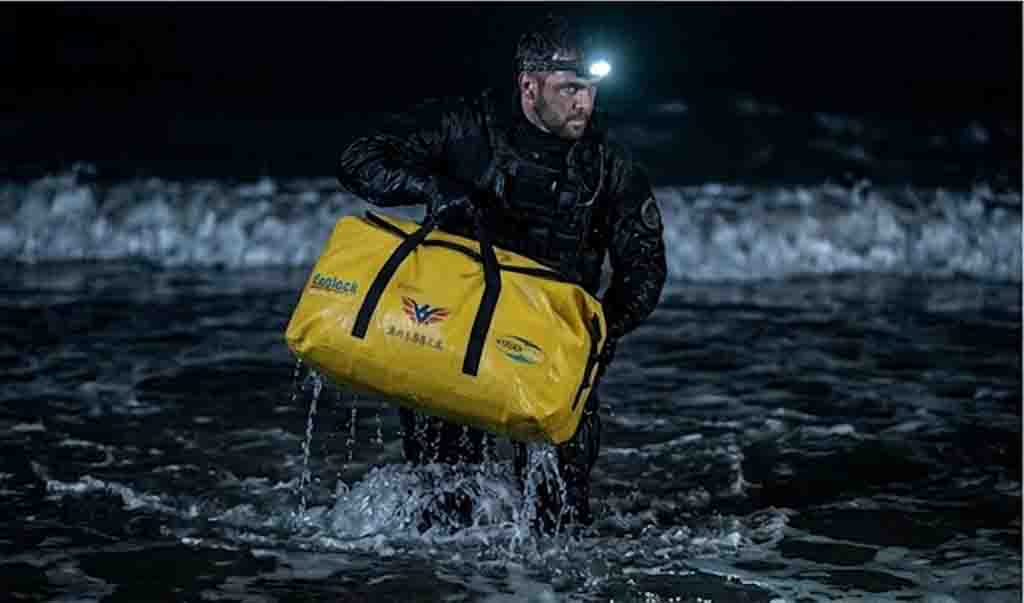
Construction Standard: Mechanical Airtight Closure and 1.0 Bar Validation
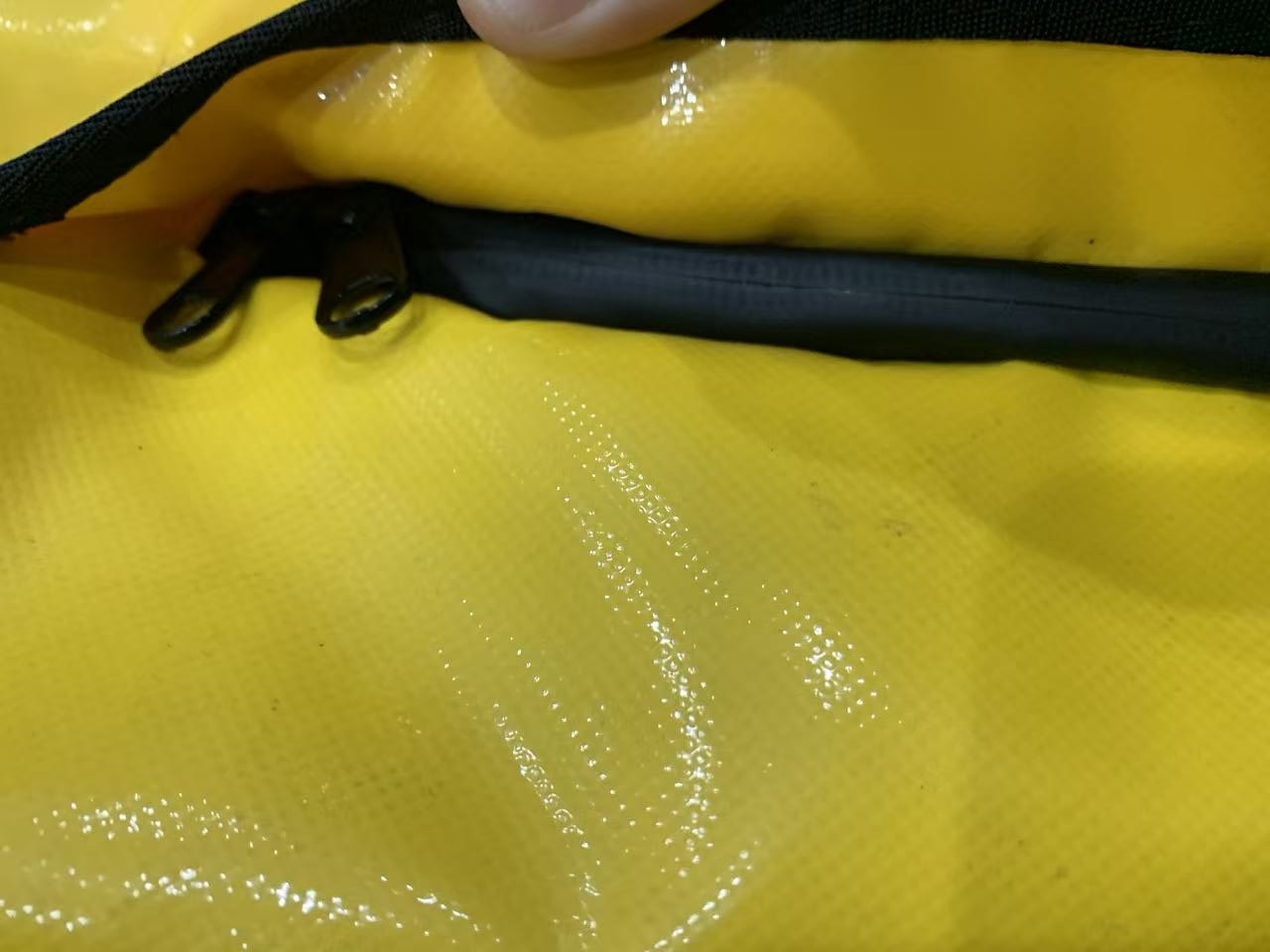
Airtight zipper systems eliminate the operator execution variable. These closures—using extruded polymer tracks that interlock mechanically when engaged—create a hermetic seal as a function of the closure design rather than the quality of the operator's technique. There is no partially-sealed state. The zipper is either engaged and airtight, or it isn't closed. Under surf impact, wave pressure, or uncontrolled submersion, the seal doesn't shift because it isn't held in place by folded fabric tension.
Combined with 27.12 MHz RF-welded seams throughout the bag body, this architecture holds 1.0 Bar of internal hydrostatic pressure without micro-bubble emission at any point. One Bar is the pressure equivalent of a 10-meter water column—well above the dynamic loads of surf impact and adequate for deliberate submersion at operational depths. The same construction that survives submersion also survives use as an emergency flotation device: the molecularly fused weld zones don't blow out under internal pressure because there's no structural discontinuity to initiate failure.
Zipper units for these applications should be individually pressure-tested as incoming components before production begins. Two batches of zippers from the same supplier can look identical and perform differently under pressure; the variation only appears under test conditions, not visual inspection. Per-unit incoming testing is the only reliable gate.
Scenario 2: Alpine SAR Extraction — PVC Failure in Sub-Zero Operating Conditions
An alpine SAR team is working a casualty extraction in blizzard conditions at -20°C. The medic needs the trauma kit from a PVC dry bag. The bag has been in the cold for hours. The PVC that was flexible at the staging area is now rigid. When the medic applies force to open the bag, the outer shell fractures along a fold line. The trauma kit is exposed to the blizzard. The bag is no longer functional.
PVC cold cracking isn't a product defect or a quality control failure—it's a predictable material behavior that PVC specification sheets acknowledge. The plasticizers that give PVC flexibility at ambient temperatures migrate out of the polymer matrix gradually, a process accelerated by UV exposure and repeated thermal cycling. Below approximately -10°C, PVC stiffness increases significantly. Below -20°C, the material can fracture under the kind of flex stress that field handling produces routinely. Alpine SAR operations work at these temperatures as a matter of course, not as an extreme condition.
The access problem operates in parallel. At -20°C in blizzard conditions, a medic is wearing expedition gloves or thick insulated mitts. Fine motor control is substantially reduced. A roll-top closure requires even folding across the full collar width, consistent buckle tension, and two free hands to operate correctly. Under those conditions, a closure that takes fifteen seconds becomes one that takes sixty—or fails to seal reliably on re-close after the kit is extracted. For emergency medical access, that gap in time and reliability matters.
Construction Standard: Cold-Weather TPU and Gloved-Hand Access
840-Denier TPU-coated nylon maintains full flexibility to -30°C because its elastomeric properties are structural rather than plasticizer-dependent. The material doesn't change behavior meaningfully across the temperature range of alpine SAR operations. Fold lines that flex without cracking in summer perform identically in blizzard conditions. Hardware attachment points that hold under load in warm weather hold under the same load at -20°C.
The 840D denier count addresses the abrasion conditions of alpine SAR work specifically. Granite surfaces, ice-coated rock faces, crampon edges, and rappel hardware all produce contact stresses that lower-denier fabrics don't survive intact. An alpine team carries a single set of equipment into terrain where replacement isn't available; the material specification needs to handle the full range of contact conditions without requiring intervention.
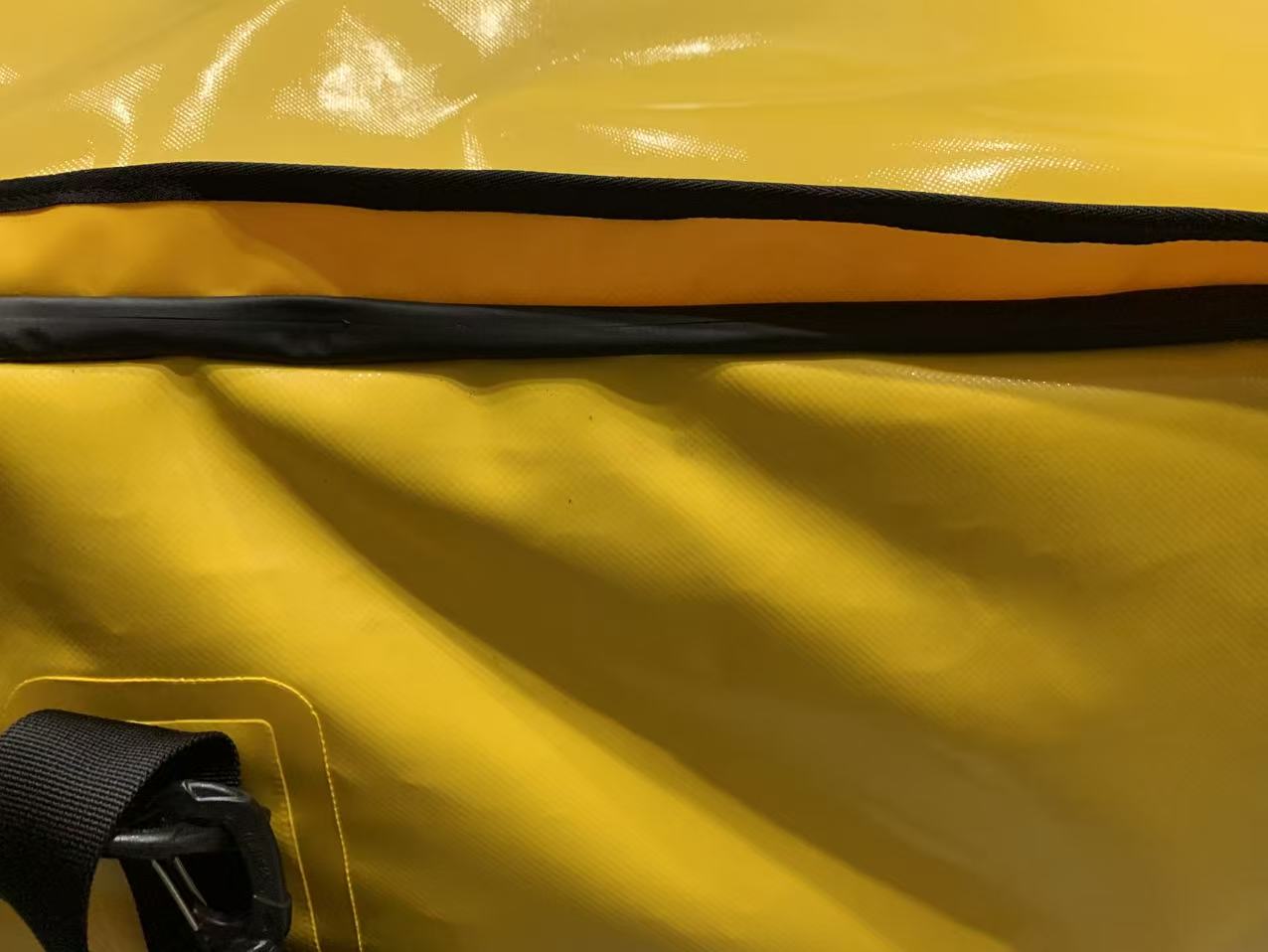
Wide-mouth airtight zipper access with a T-bar pull handle resolves the gloved-hand operation problem directly. The T-bar provides grip surface adequate for thick insulated gloves in a single-handed pull. The zipper opens and seals in one motion per direction—no fold sequence, no tension adjustment, no two-hand requirement. Medical access takes seconds. Re-seal after extraction takes seconds. The hermetic seal is maintained regardless of how quickly or forcefully the closure is operated.
Scenario 3: Night Operations — Hardware Signature and Load-Bearing Failure
A military contractor delivers a production run of tactical dry bags to specification. The specification called for black, and the bags are black. During a pre-deployment kit review under NVGs, the procurement officer discovers that the D-ring hardware is polished steel, the buckle surfaces are semi-gloss polymer, and the pull tabs have a low-gloss coating that still produces detectable reflectance under infrared illumination. The bags fail operational acceptance.
This failure pattern is common enough that it has a consistent cause: the procurement specification was written by people who had never operated under night vision, so the NVG-compatibility requirements that are second nature to operators never made it into the written spec. Commercial outdoor hardware is specified for durability and cost-effectiveness. Polished stainless D-rings and semi-gloss polymer buckles are excellent choices for those criteria. They are incompatible with tactical night operations, and no factory will deviate from standard commercial hardware unless the specification explicitly requires non-reflective alternatives.
The load-bearing failure is a separate and independent problem. Standard commercial dry bag construction sews shoulder straps and carry handles directly through the waterproof shell membrane. This creates two simultaneous problems: needle perforations through the waterproof layer at the attachment point, and stress concentration on a small number of stitch points when load is applied. Under the weight of loaded tactical kit—ammunition, batteries, communications equipment, and water—these attachment points are the first structural failure location. The strap separates from the bag body under load, typically at a moment when the operator has no opportunity to address it.
Construction Standard: Non-Reflective Hardware and RF-Welded Anchor Points
Non-reflective hardware specification for tactical applications means matte-anodized aluminum or chemically blacked steel D-rings, flat-dark polymer buckles from suppliers like ITW Nexus, and no specular surfaces anywhere on the assembled product. Where branding or identification markings are required, IR-absorbing inks or blind emboss replace reflective thread or standard print. These specifications need to appear explicitly in the product brief and need to be verified on production samples under NVG-equivalent inspection—a daytime visual check of a matte-finish product does not confirm IR compliance.
RF-welded TPU anchor patches replace all stitched hardware attachment on load-bearing points. The process: a reinforcement patch of TPU-coated nylon, sized to distribute the expected load across adequate surface area, is RF-welded to the exterior of the bag at each hardware attachment location. D-rings, handle loops, and MOLLE anchor points attach to the patch. The primary shell membrane is never perforated. Under destructive load testing, the hardware or the webbing fails before the patch-to-shell weld bond—the attachment point is not the structural weak link.
MOLLE webbing integration follows the same logic: RF-welded channels on the exterior surface rather than stitched attachment that creates leak pathways through the shell. The bag accepts standard MILSPEC accessories without acquiring the membrane perforations that stitched MOLLE attachment requires.
What Tactical Procurement Actually Requires From an OEM Partner
The three scenarios above share a common procurement failure mode: a specification that was adequate for commercial outdoor applications was applied to a tactical or SAR context where different failure modes matter. The construction worked well enough to pass the written spec and failed in field use because the written spec didn't capture what the operational environment actually demanded.
Preventing this requires procurement specifications that are built from the operational scenarios rather than from commercial product catalogs. The engineering specifications that address these three scenarios—1.0 Bar hydrostatic validation with mechanical airtight closures, 840D TPU with documented cold-temperature flex testing, RF-welded load-bearing anchor patches, and NVG-verified non-reflective hardware—are all specific, testable, and documentable. They belong in the purchase order, not in an after-action report.
When evaluating OEM partners for tactical or SAR dry bags, the differentiating questions are: Are zipper units pressure-tested individually or by batch sampling? What temperature is the TPU flex specification validated to, and how is that validated on incoming material batches rather than assumed from the supplier datasheet? Can they produce pull-force test data for RF-welded anchor patches from production samples? Do they stock non-reflective tactical hardware as a standard catalog item, or is it a special-order component with lead time implications? A manufacturer with genuine capability in this category has direct operational answers to all of these.
Frequently Asked Questions
Q: Why are airtight zippers preferred over roll-top closures for tactical dry bags?
A: While roll-tops are effective for general use, they are prone to human error—if not rolled tightly and symmetrically, they can leak when fully submerged. Airtight zippers provide a foolproof, absolute mechanical seal required for protecting high-value electronics during amphibious insertions.
Q: Can TPU dry bags withstand freezing temperatures without cracking?
A: Yes, premium Thermoplastic Polyurethane (TPU) maintains its elastomeric flexibility in extreme cold-weather environments, unlike PVC, which becomes brittle and is prone to shattering or cracking when manipulated in sub-zero temperatures.
Q: How does RF welding improve the load-bearing capacity of a military backpack?
A: Instead of stitching heavy straps directly through the waterproof fabric (which creates perforations and weak points), RF welding fuses thick TPU anchor plates to the bag's exterior. This distributes the weight of heavy ammunition or batteries across a wider area without ever piercing the waterproof membrane.