
- English
- Español
- Português
- русский
- Français
- 日本語
- Deutsch
- tiếng Việt
- Italiano
- Nederlands
- ภาษาไทย
- Polski
- 한국어
- Svenska
- magyar
- Malay
- বাংলা ভাষার
- Dansk
- Suomi
- हिन्दी
- Pilipino
- Türkçe
- Gaeilge
- العربية
- Indonesia
- Norsk
- تمل
- český
- ελληνικά
- український
- Javanese
- فارسی
- தமிழ்
- తెలుగు
- नेपाली
- Burmese
- български
- ລາວ
- Latine
- Қазақша
- Euskal
- Azərbaycan
- Slovenský jazyk
- Македонски
- Lietuvos
- Eesti Keel
- Română
- Slovenski
- मराठी
- Srpski језик

Can Dry Bags Be Submerged? Professional Guide to Waterproof Limits
| Rating Type | Performance Expectation |
|---|---|
| Water-Resistant | Light rain, surface splashes, damp ground contact. Suitable for casual outdoor use, but not for immersion or sustained water pressure. |
| Waterproof (Standard) | Designed for heavy rain, wet deck exposure, and brief accidental dunking above water surface level. Not engineered for prolonged underwater pressure. |
| Fully Submersible (IPX7+) | Built for continuous immersion scenarios, including capsized kayaks, river submersion, and short-duration underwater exposure with pressure-tested sealing systems. |
When you're out on the water, the difference between a dry set of clothes and a ruined gear load comes down to one thing: your dry bag’s ability to handle actual submersion. Many people assume any "roll-top" bag is ready for a river capsize, but real-world conditions often prove otherwise,it is a sudden, violent, and often unpredictable event.
A kayak flips unexpectedly in fast-moving water. A canoe tips while crossing a windy channel. A raft collides with submerged rocks in turbulent current. In all of these situations, your gear does not gently get wet—it is forced underwater instantly under dynamic pressure.
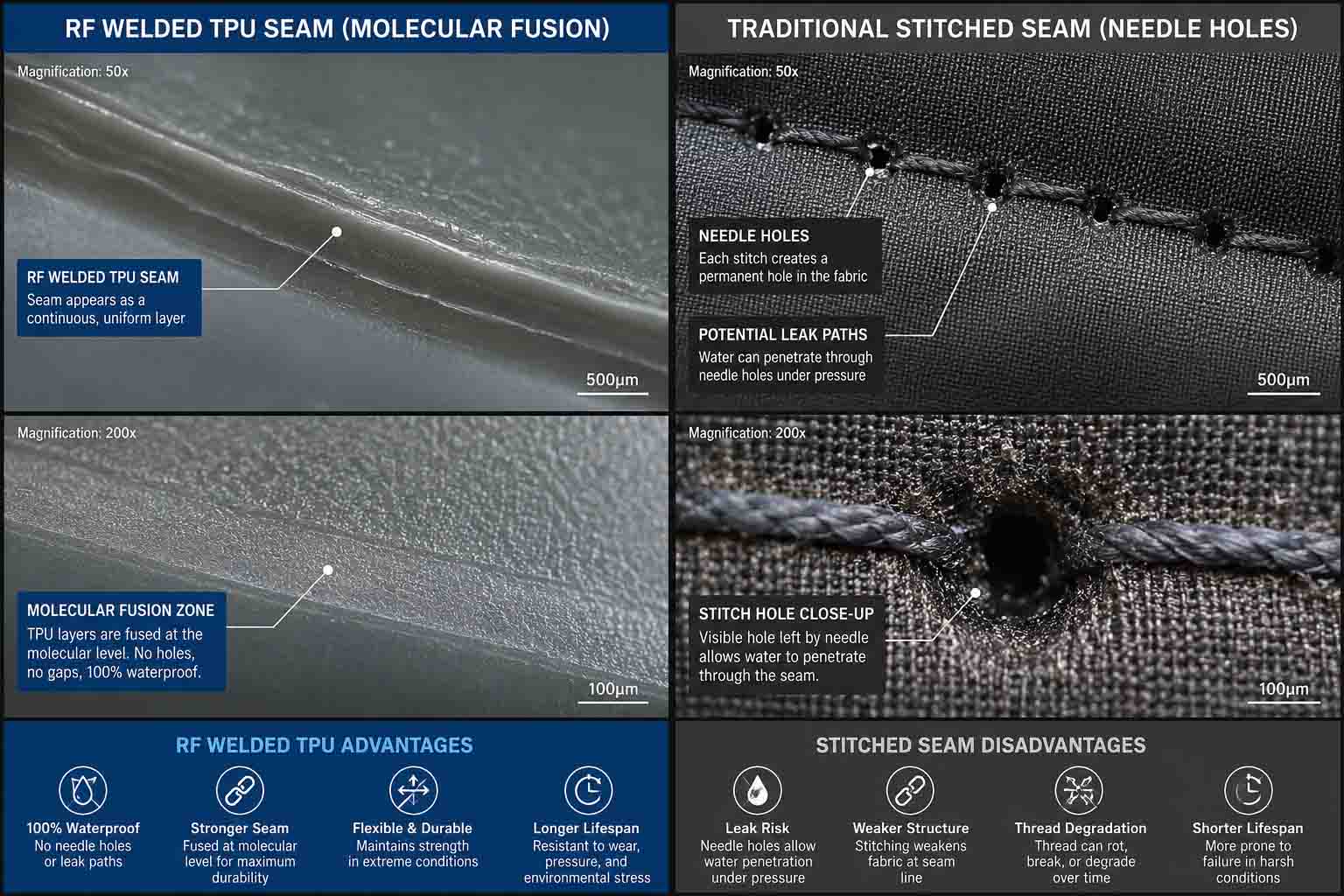
The Engineering Reality of Seams
If your bag fails, it's rarely the fabric's fault. It’s almost always the seams. Traditional stitched seams—even those with tape—create thousands of needle holes. Under the pressure of submersion, water finds these microscopic entry points. To truly keep gear dry underwater, you need RF welded seams. This process uses radio-frequency energy to fuse TPU layers into a single, monolithic wall. There are no stitches, no holes, and no paths for water to seep through.
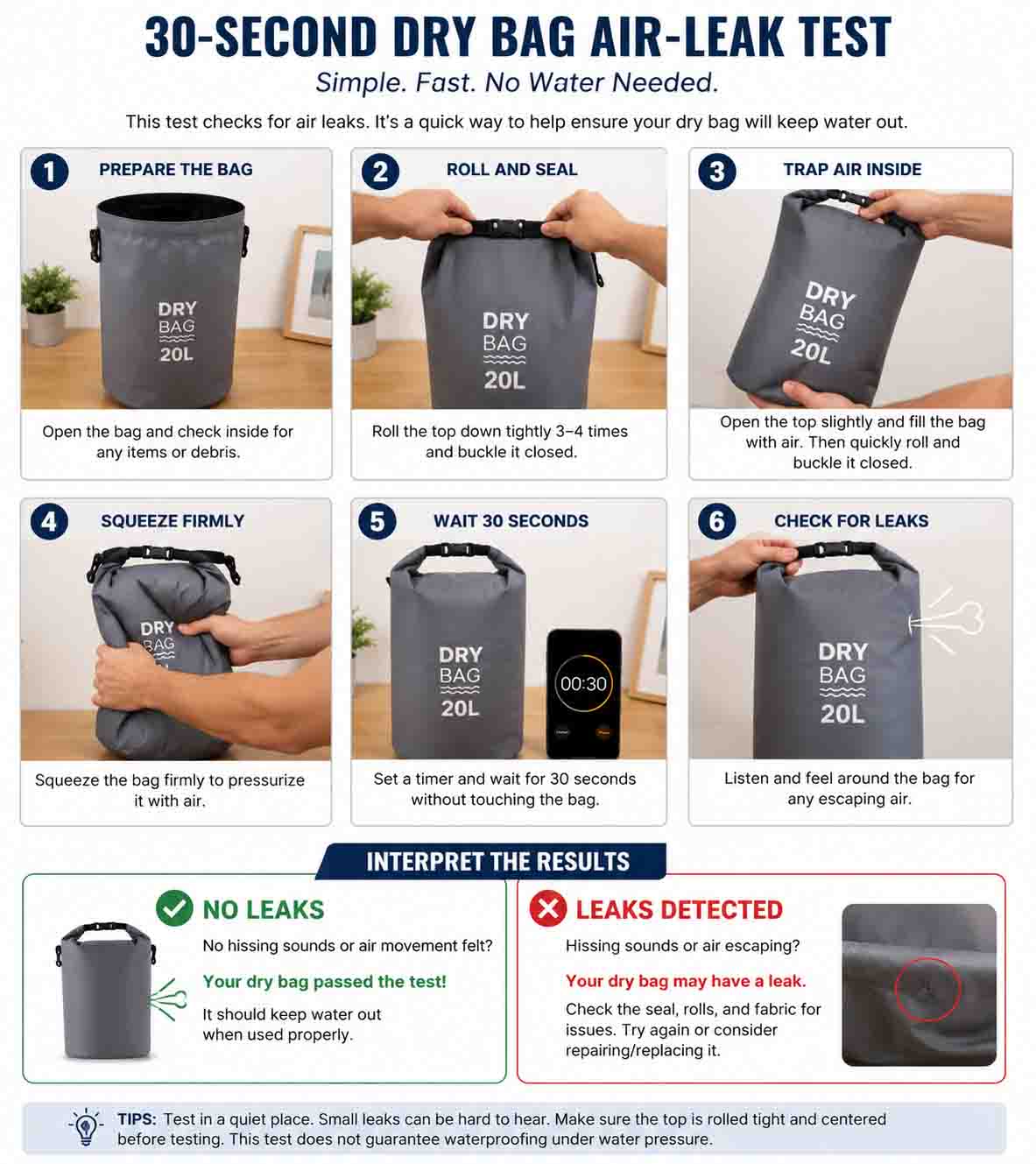
The 30-Second "Home Air Test"
You don't need a lab to know if your bag is still up to the job. If you suspect your bag might be losing its integrity after a season of rubbing against rocks and mud, perform this simple check:
- Step 1: Trap as much air as possible inside the bag, then roll it tight (at least 3-4 rolls) and secure the buckle.
- Step 2: Submerge the bag in a bathtub or a large basin of water, or place it on the floor and apply firm, steady pressure with your body weight.
- Step 3: Watch for bubbles (if submerged) or listen for a hissing sound (if pressing).
If you see a steady stream of bubbles, your bag is compromised. A perfectly sealed bag will hold the air pressure without leaking. If it loses firmness quickly, it’s time to retire the bag for serious water activities.
Decision Framework: Is Your Bag Ready?
If you hear a hiss during the test: The seams or the valve are compromised. Do not trust it for electronics.
If you see no bubbles: Your bag is airtight and ready for heavy-duty use.
Need a reliable replacement? Explore our heavy-duty waterproof gear collection.
Maintenance Tip: The "Gravel Factor"
Even the best TPU composites aren't indestructible. Avoid dragging your bag over sharp gravel or jagged riverbeds. That kind of abrasive wear thins the TPU coating over time, making it prone to pinholes. A quick rinse with fresh water after a trip is the best way to extend the lifespan of your gear.
Best Practice for Longevity
To extend the functional lifespan of your dry bag:
- Avoid dragging it across rocky surfaces
- Rinse with fresh water after river or saltwater exposure
- Store in dry, shaded environments away from UV exposure
- Avoid long-term compression storage in tightly rolled states
These simple habits significantly delay material fatigue and maintain waterproof integrity over multiple seasons of use.
About Sealock Outdoor Gear Co., Ltd.
We are a direct manufacturer specializing in RF welded waterproof gear. With our headquarters in Dongguan, China, and our Phase II production facility in Ho Chi Minh City, Vietnam, we provide strategic supply chain solutions to navigate international tariffs. Our facilities are audited for SMETA P4, HIGG, SCAN, GRS, BSCI, and ISO9001 standards.
For B2B inquiries, please visit our contact page.