

The honest answer is "yes — but." Dry bags do keep water out, yet plenty of people have opened one to find damp gear inside. Here's why that happens, why the word "waterproof" on the label means less than you'd hope, and how to tell a genuinely waterproof bag from a hopeful one.
Ask "are dry bags waterproof?" and you'll get confident yeses from sellers and frustrated nos from a few reviewers who got wet gear. Both are right, and the gap between them is the whole story. A dry bag absolutely can keep water out — that is the entire point of its design. But "waterproof" is doing a lot of quiet work in that sentence, and unpacking it tells you exactly which bags to trust.
Yes — when it's built and used right
Start with the genuine yes. A dry bag keeps water out through three parts working together: a waterproof-coated fabric, seams with no holes, and a closure that seals when shut. When all three are done properly — a welded seam instead of a stitched one, a roll-top folded over enough times — the bag holds out water reliably, including brief submersion. (We break down the mechanism in What Is a Dry Bag & How Does It Work?.)
So if the design works, why do some people still end up with a wet phone? Because "waterproof" only holds when none of those three parts is the weak link — and in practice, one usually is. Here are the three reasons a dry bag lets you down.
Why dry bags leak (it's usually not the bag)
Reason 1: The closure wasn't sealed correctly
This is the most common cause by far, and it has nothing to do with build quality. A roll-top only seals if you fold the opening over on itself at least three times before clipping — the rolled layers pressing together are what create the seal. Roll it once or twice "to save time" and you've left a gap. A perfectly good bag will leak every time if the top isn't rolled down enough, which is why "the dry bag leaked" is so often really "the closure was rushed."
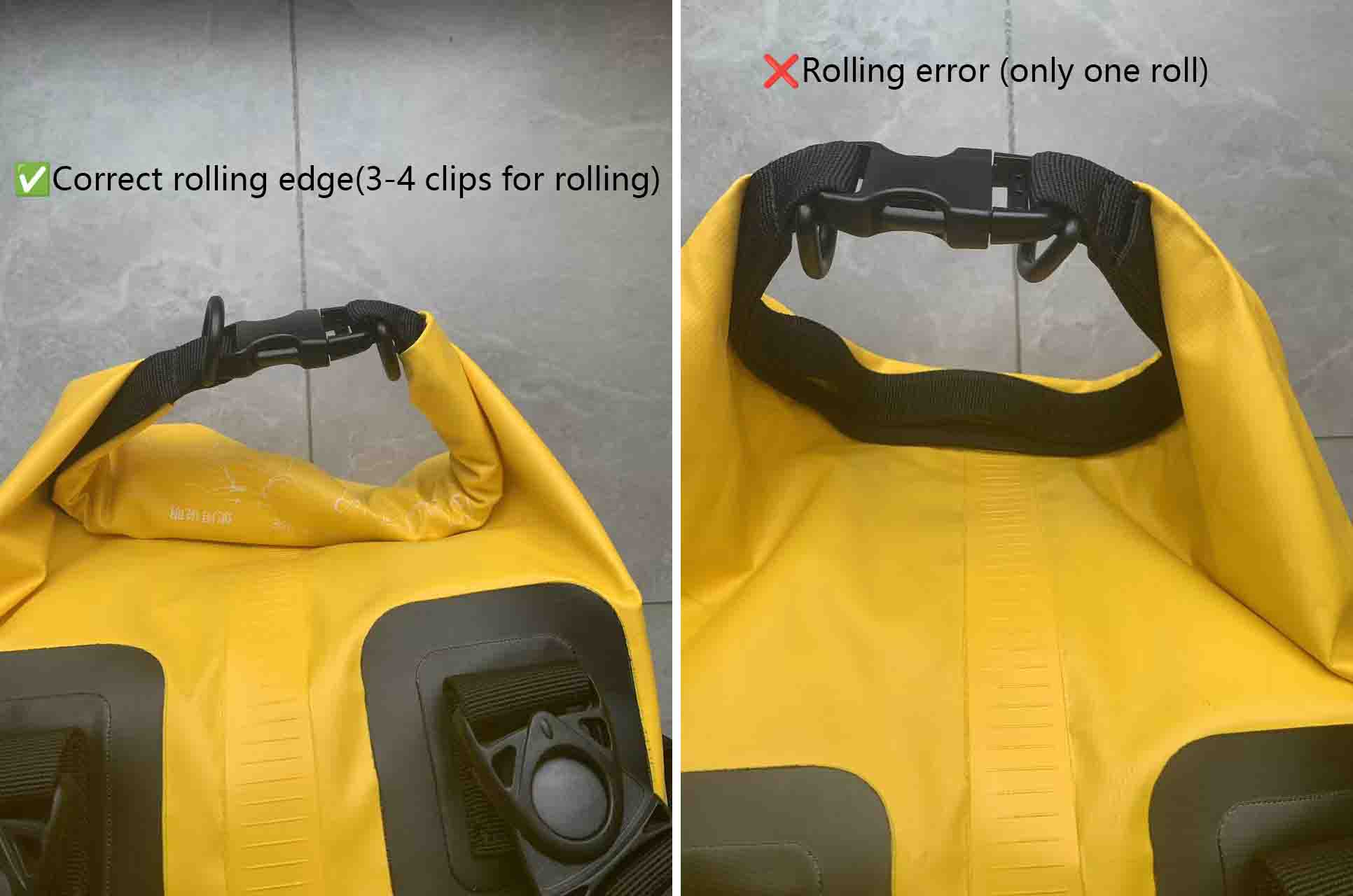
Reason 2: The seams were stitched, not welded
If the closure was done right and water still got in, look at the seams. A seam that is sewn and then taped has a row of needle holes under that tape. For rain and splash that's fine; under sustained pressure, or after the tape ages and lifts, those holes become the leak. A welded seam has no needle holes at all because the layers are fused into one. This is the difference between a bag that survives real immersion and one that only ever resisted rain — and it's invisible from a product photo, which is part of why buyers get caught out. Our seams are fused by high-frequency welding for exactly this reason.
A quick note on material, since people often blame it: both PVC and TPU coatings are genuinely waterproof — the difference between them is flexibility, cold resistance, and cost, not whether they keep water out. If you're choosing between the two, see TPU vs PVC Dry Bags>. The leak almost always traces to the seam or closure, not the coating.
Reason 3: A splash-rated bag was asked to do an immersion job
The third reason is a mismatch, not a defect. A light, water-resistant bag built for rain will leak if you submerge it in a river — but that's the user expecting an immersion bag from a splash bag, not the bag breaking. This is the trap the label sets, which brings us to the real problem with the word "waterproof."
The catch: "waterproof" is an unregulated word
Here's what most buyers never hear: there is no single legal standard a product must meet to be called "waterproof" on a bag. One brand uses it for a bag that shrugs off rain; another uses the same word for a bag tested to stay sealed underwater. Both are technically allowed. That's why two bags with identical "100% waterproof" tags can perform completely differently — and why the word on the label is the least reliable thing about it.
What is reliable is a measurable standard. Instead of the word, look for a stated test:
| If the bag claims… | What it likely means | Trust it for… |
|---|---|---|
| "Water-resistant" | Sheds rain and splash | Wet weather, not dunking |
| "Waterproof" (no test stated) | Could mean anything | Verify before trusting |
| An IPX rating, or a bar/hydrostatic figure | Tested to a defined condition | What the rating actually states |
If a bag does state an IPX rating, here's the quick read on what each level actually withstands — higher isn't always necessary, just defined:
| IP rating | Withstands | Realistic use |
|---|---|---|
| IPX4 | Splashing from any direction | Light rain, spray |
| IPX6 | Powerful water jets / heavy spray | Driven rain, deck spray |
| IPX7 | Temporary immersion (approx. 1 m, 30 min) | Accidental dunk, brief submersion |
| IPX8 | Continuous immersion beyond IPX7 | Sustained underwater use to a stated depth |
A figure you can check beats an adjective you can't. We validate our submersible builds to 1.0 bar of hydrostatic pressure — a sustained-pressure test — precisely because "waterproof" on its own proves nothing. If you want the boundary of how far submersion can be trusted, we set it out in Can Dry Bags Be Submerged?
How to tell if a dry bag is genuinely waterproof
You don't need a lab. Working from the three failure reasons above, here is how to judge a bag before and after you buy it:
The 4-point waterproof check
- Find a stated test, not just the word. An IPX level or a bar/hydrostatic figure beats "100% waterproof" every time.
- Check the seams. Welded (continuous, no stitches) outperforms sewn-and-taped for anything beyond rain.
- Test it yourself at home. Fill the sealed bag with air, hold it under water in a sink or tub, and watch for escaping bubbles — that's where water would get in.
- Match the bag to the job. A splash bag for rain, a welded immersion bag for kayaking, a pressure-validated bag for repeated submersion.
What waterproof level does your activity need?
That last point — matching the bag to the job — is where most buyers go wrong, so here it is as a direct guide. Over-buying wastes money; under-buying soaks your gear. Match the column, not the marketing word:
| Activity | Minimum you want | Why |
|---|---|---|
| Hiking / commuting in rain | Water-resistant (≈ IPX4) | Gear meets rain and spray, never submersion |
| Fishing / beach / paddling | Waterproof, welded seams (≈ IPX6–7) | Splash is constant; the occasional dunk happens |
| Kayaking / rafting | Submersible, welded (≈ IPX7–8) | A capsize means full, if brief, immersion |
| Boating / diving support | Pressure-validated (e.g. 1.0 bar) | Sustained water pressure, repeated exposure |
The pattern is simple: the more likely full immersion is, the further down this table you should buy. When in doubt, go one row down — the cost difference is small next to the price of ruined gear.
Do those four and the question stops being "are dry bags waterproof?" and becomes "is this dry bag waterproof enough for what I'll do with it?" — which is the question that actually protects your gear.
Frequently asked questions
- Are dry bags 100% waterproof?
- A well-built dry bag — welded seams, sealed roll-top — keeps water out reliably, including brief submersion, when used correctly. But "waterproof" is an unregulated term, so the claim is only as good as the bag's build and any stated test rating behind it.
- Why did my dry bag leak?
- Usually one of three reasons: the roll-top wasn't folded over enough times before clipping, the seams were stitched-and-taped rather than welded, or a splash-rated bag was used for full immersion. The first cause is by far the most common and is a usage issue, not a defect.
- How can I test if my dry bag is waterproof?
- Seal the bag with air trapped inside, hold it underwater in a sink or bathtub, and look for escaping bubbles. Bubbles mark the spots where water could get in — typically a seam or the closure.
- Is a "water-resistant" bag the same as "waterproof"?
- No. Water-resistant means it sheds rain and splash but isn't built for submersion. Waterproof should mean it keeps water out under immersion — but since the word isn't regulated, look for a stated IPX or pressure rating to be sure.
- Can a dry bag lose its waterproofing over time?
- Yes. On stitched-and-taped bags the seam tape can age and lift; coatings can wear at high-abrasion points. Welded seams have no tape to fail, which is one reason they hold up longer.
Not sure which waterproof level you need? Tell us where you'll use it and we'll match the build and rating to the job.