
- English
- Español
- Português
- русский
- Français
- 日本語
- Deutsch
- tiếng Việt
- Italiano
- Nederlands
- ภาษาไทย
- Polski
- 한국어
- Svenska
- magyar
- Malay
- বাংলা ভাষার
- Dansk
- Suomi
- हिन्दी
- Pilipino
- Türkçe
- Gaeilge
- العربية
- Indonesia
- Norsk
- تمل
- český
- ελληνικά
- український
- Javanese
- فارسی
- தமிழ்
- తెలుగు
- नेपाली
- Burmese
- български
- ລາວ
- Latine
- Қазақша
- Euskal
- Azərbaycan
- Slovenský jazyk
- Македонски
- Lietuvos
- Eesti Keel
- Română
- Slovenski
- मराठी
- Srpski језик

Waterproof Duffel Bag for Kayaking Protecting Equipment on the Water
1. Company Overview
Sealock (YiFuLong Outdoor Gear Co., Ltd.) has designed and produced welded waterproof bags for over 20 years, operating two facilities in Dongguan, China and Ho Chi Minh City, Vietnam, and produces for international outdoor and marine brands including OSPREY, Musto, West Marine, and Helly Hansen. Production is held to international compliance and social-audit standards.
- Established: 2003 (20+ years in waterproof bag manufacturing)
- Facilities: Dongguan, China | Ho Chi Minh City, Vietnam
- Certifications: ISO9001, BSCI, SMETA, HIGG, GRS, SCAN, CSR
- Services: OEM / ODM, custom logo, color, and capacity
2. What Actually Damages Gear on the Water
Kayaking equipment fails for reasons that go well beyond "it got wet." The causes below are the real, specific ones behind failure in paddling gear, and most stay invisible until a bag has already been in service for a season or two. Each one maps to a construction decision on a properly built kayaking duffel bag.
2.1 UV Exposure (the Most Overlooked Cause)
Sun damage, not water, is usually the first thing to age a bag. Sustained UV exposure degrades TPU over time, stiffens PVC, fades nylon, breaks down waterproof coatings, cracks zipper tape, and strips the adhesion from hook-and-loop closures. Open water — lakes, reservoirs, and the sea — reflects UV more intensely than land, so a bag left on a deck or a roof rack takes a harder dose than one used inland. A season or two of regular sun is enough for an ordinary waterproof bag to start flaking or stiffening at the seams.
2.2 Saltwater Corrosion
Seawater is not simply water. It carries chloride, microorganisms, and fine sand, all of which attack hardware rather than fabric: D-rings rust, zippers seize, buckles wear, stitching corrodes, and metal springs fail. Waterproof is not the same as saltwater-resistant, and a bag rated only for fresh water can still corrode at every metal point after a season on the coast. This is why genuinely marine-rated gear specifies marine-grade materials and corrosion-resistant hardware rather than generic waterproof components.
2.3 Sand in the Zipper
Beach launches and dragging a boat across sand work grit directly into airtight and YKK-style waterproof zippers. Once inside, the sand grinds against the seal on every open-close cycle, and the zipper gets progressively stiffer until it jams or tears. Most makers of sealed-zipper gear specify rinsing the zipper track after every beach session for exactly this reason.
2.4 Abrasion Against Rock and Concrete
Landing, dragging a boat up a bank, and a capsize all put the bag directly against rock, concrete boat ramps, branches, and shells. This is the most common physical wear a kayaking bag sees, and it is why genuine kayak dry bags specify heavier fabrics — 840D TPU or 1000D PVC — and a reinforced bottom panel rather than the lighter deniers used on packs that never touch the ground.
2.5 Capsize Impact and Submersion
A capsize itself is rarely the problem; the sudden combination of water pressure, impact, and current is. A roll-top folded fewer than three to four turns will fail exactly when it matters, letting water into the whole bag the moment it goes under. A rated waterproof zipper avoids that by sealing fully regardless of orientation. This is the practical line between a bag rated water-resistant and one rated submersible — and submersible is the standard a kayaking bag has to meet, not merely shedding rain.
2.6 Extended Immersion
Many bags handle rain without issue but were never built for continuous immersion. On a rafting trip or during a wade, a bag can float in the water for hours rather than seconds, and that duration is what exposes weak points: stitching seeps, zippers begin to leak, and TPU laminate can delaminate from its backing if the bond quality is poor.
2.7 Temperature Swings
A bag left on a sun-heated deck can reach 60°C or more, then goes into water closer to 15°C within moments of launch. That rapid thermal cycle stresses welded seams, fatigues TPU over repeated cycles, and can deform PVC at the fold lines — a slow, cumulative failure that has nothing to do with water exposure itself.
2.8 Internal Condensation
The water that ruins electronics is often not external. Wet clothing, a damp towel, or food packed alongside a phone or camera raises humidity inside a sealed bag, and condensation forms on the inside of the shell. This is why sealed dry bags are commonly used with a secondary zip-lock or dry pouch for electronics, rather than relying on the outer bag alone.
2.9 Repeated Strap and Line Tension
A bag lashed to deck bungees or deck lines for a full trip takes constant small shocks from every wave and stroke. Over time that repeated tension tears out D-rings, opens stitching at the handles, and delaminates the bond on shoulder straps — failures that appear at the attachment points long before the fabric itself gives out.
2.10 Compression During Transport
Bags stored under a kayak hull or crushed on a roof rack take sustained compressive load rather than impact. Over repeated trips this can damage a pressure-release valve, deform a welded seam, or warp a zipper track — damage that has nothing to do with paddling and everything to do with how the gear is carried between put-ins.
2.11 Punctures from Reeds, Hooks, and Shells
Reed beds, low branches, fishing hooks, and oyster or mussel shells are a routine hazard on many paddling waters, and standard 420D fabric punctures easily against any of them. This is a straightforward argument for higher-denier fabric on bags intended for shallow, vegetated, or shell-lined waters.
2.12 Chemical Exposure
Sunscreen, insect repellent, marine cleaning products, and fuel — gasoline or diesel near a launch ramp — all attack the surface of TPU over time, leaving it tacky, discolored, or eventually cracked. Chemical contact is rarely counted as a damage cause, but it is a common one on gear that lives near boats and fuel docks.
2.13 Fatigue from Repeated Folding
A roll-top folded three times a day accumulates thousands of fold cycles over a season. Each fold stresses the same crease line, producing visible TPU creasing, PVC fatigue, and hairline cracks in the coating — which is why makers of frequently-used roll-tops specify high flex resistance for the fabric at the fold zone specifically.
2.14 Biological Fouling
Freshwater exposure tends to grow mold and algae on a bag left damp; saltwater environments invite shell growth from barnacles or mussels on gear left in the water. Both produce the same downstream effects — odor, fabric discoloration, and accelerated breakdown of the waterproof coating underneath.
2.15 Misuse (the Most Common Cause of All)
A large share of "product failures" reported in the field are not manufacturing defects but handling errors: launching with a roll-top folded fewer than three turns, treating a splash-resistant bag as if it were fully submersible, exceeding the rated load and overstressing a handle or strap, forcing a waterproof zipper closed over trapped sand, or leaving gear in direct sun on a deck or roof rack for long periods. The right construction solves the manufacturing side of durability; the field-use side depends on the buyer's care instructions reaching the end user.
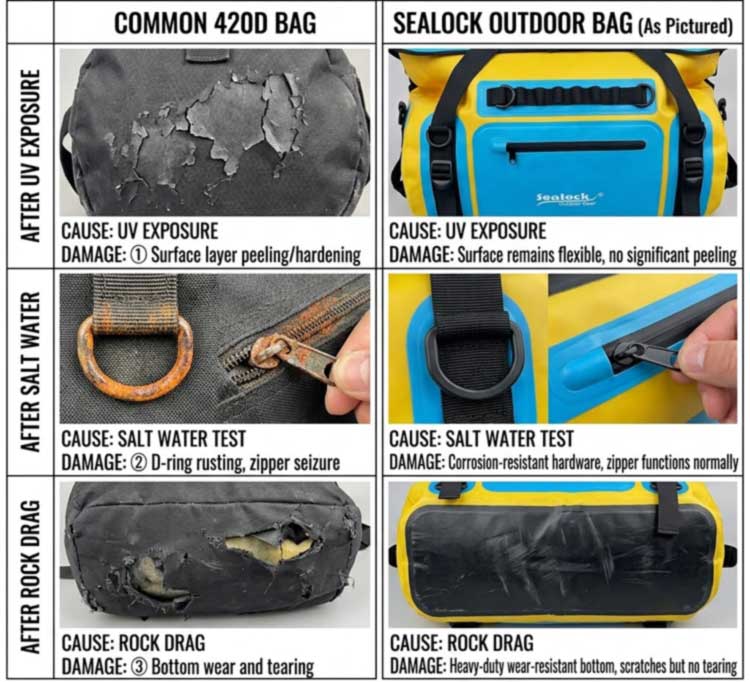
3. How the Sealock Kayaking Duffel Answers Them
Each failure mode above maps to a specific build decision on the Sealock kayaking duffel:
- IPX8 waterproof zipper — rated for continuous submersion, not just splash, so the seal holds through a full capsize regardless of how the bag lands.
- HF-welded, needle-hole-free seams — bonded by high-frequency welding instead of stitching, removing the seep path that stitched-and-taped seams develop under extended immersion.
- Durable TPU composite shell — resists abrasion against hull, rock, and ramp, and can be specified in higher denier for shell-lined or vegetated waters.
- Corrosion-resistant hardware — marine-grade fittings that survive salt where plain metal rusts and seizes.
- Soft, foldable body — compresses to fit odd-shaped bow and stern hatches and folds flat when empty.
For electronics, pairing the duffel with a small secondary dry pouch remains the recommended practice, since no outer bag prevents condensation from wet gear packed inside.
4. Built to Fold Into a Kayak
Kayak storage is oddly shaped, and a rigid bag wastes it. The soft, fully foldable construction lets the duffel compress once or twice and the handles cinch together, so it packs into a bow or stern hatch rather than fighting the curve of the hull. Empty, it folds flat for the paddle back — useful on multi-day trips where the bag needs to disappear into the boat on the way out and hold more on the way home.
5. Sealock Range for Water Sports
The range below leads with the IPX8 kayaking duffel and covers related Sealock models suited to paddling and water sports, with verified specifications and product pages.
| Image | Model / Series | Capacity | Material | Closure | Best for | Product Page |
|---|---|---|---|---|---|---|

|
Waterproof Duffle Bag for Kayaking | Multiple | TPU composite | IPX8 waterproof zipper | Kayaking, canoeing, rafting, SUP | View |

|
Duffle Bag Waterproof Backpack (convertible) | Multiple | TPU (HF welded) | Roll-top / zipper | Put-in and shuttle carry | View |
|
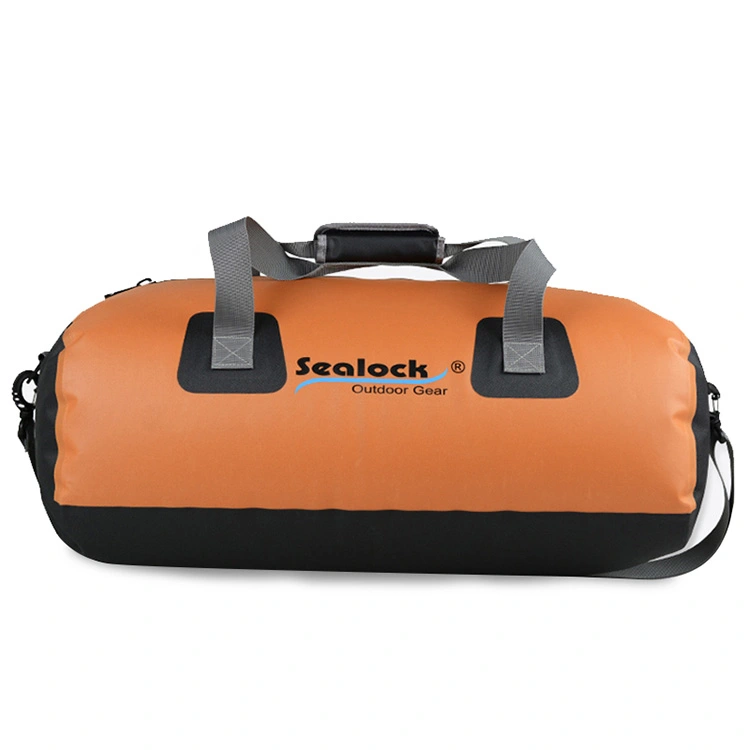
Camouflage Waterproof Duffel Bag 40L | 40L | 420D TPU | Roll-top | Multi-day paddling, hunting access | View |
|
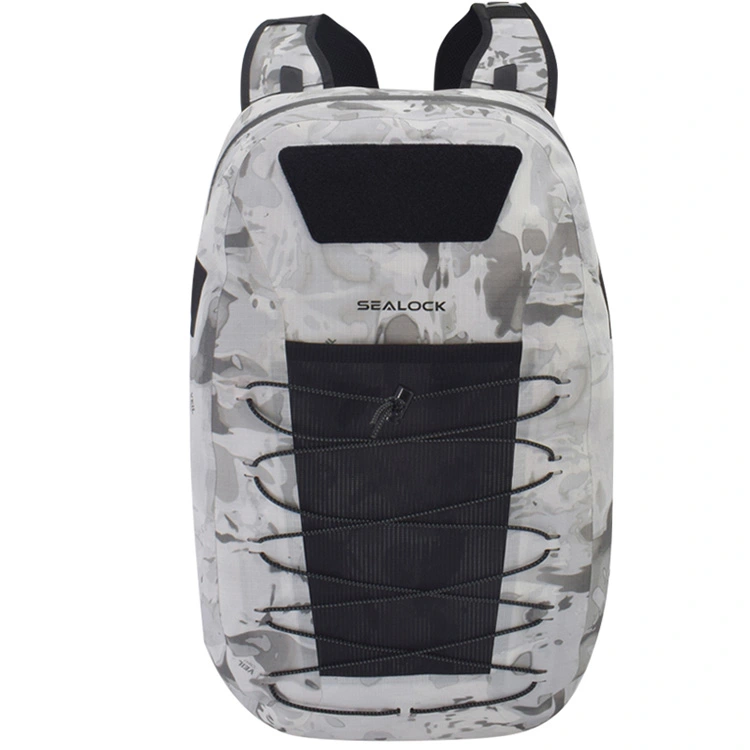
Large Capacity Waterproof Fly Fishing Backpack 20L | 20L | Waterproof composite | Zipper | Angling from a kayak | View |
6. Quality Control
Sealock applies a three-stage control to every batch before shipment. The laboratory test suite includes 3,000 sealed-zipper cycles specific to zippered models, a load test of over 1,500 cycles, tensile strength, bonding strength, salt spray, friction resistance, color fastness, and color difference, plus a full water immersion test with the zipper closed to confirm the interior stays dry. Inspection runs in three stages: IQC checks incoming fabric and the zipper assembly, IPQC samples welds and zipper seating in line, and OQC performs AQL sampling, batch immersion testing, and signed gold-sample comparison, with optional SGS/QIMA third-party inspection on request.
7. OEM / ODM Customization and Cooperation
Sealock supports full customization for brand and distributor orders, from logo and color through to ground-up development of an original kayaking duffel against a buyer's sketch or sample. Standard terms:
- MOQ: 300 pcs per model
- Customization: capacity, zipper rating and placement, fabric and denier (TPU / PVC), fold pattern, color (standard high-visibility red, green, orange, plus camo), and logo
- Sampling: 7–10 working days
- Bulk lead time: confirmed at quotation, based on order quantity
- Trade terms: FOB Guangdong; other terms negotiable
Workflow: (1) inquiry and specification confirmation; (2) quotation and trade terms; (3) sampling and approval; (4) bulk production under the three-stage QC; (5) final inspection and shipment. Ground-up development takes longer than modifying an existing model, so allow extra lead time against a launch date. See the OEM / ODM services page.
8. FAQ
Q: Will gear stay dry if the kayak capsizes?
A: Yes. The IPX8 zipper is rated for continuous submersion and the body is HF-welded with no stitching, so the interior stays dry through a full capsize, not just a splash.
Q: What damages a kayaking bag fastest — is it the water?
A: Usually not. UV exposure, saltwater corrosion of the hardware, and abrasion against rock and ramps age a bag faster than immersion does, which is why fabric denier, marine-grade fittings, and a reinforced base matter as much as the seal.
Q: Does the duffel fit inside a kayak hatch?
A: It is built to. The soft, foldable construction compresses to fit odd-shaped bow and stern compartments and folds flat when empty.
Q: Is it suitable for other paddle sports besides kayaking?
A: Yes — the same construction suits canoeing, rafting, and paddleboarding, anywhere gear needs to survive submersion and pack into a confined hull space.
Q: What is the minimum order quantity and sampling time?
A: MOQ is 300 pcs per model, with samples produced in 7–10 working days. Bulk lead time is confirmed at quotation based on quantity and customization scope.
Request a Quotation
For specifications, samples, or pricing on the kayaking duffel or any model in the range, submit an inquiry. Sealock responds to procurement enquiries within 24 hours.