

Introduction: The Urgent Evolution of Last-Mile Thermal Logistics
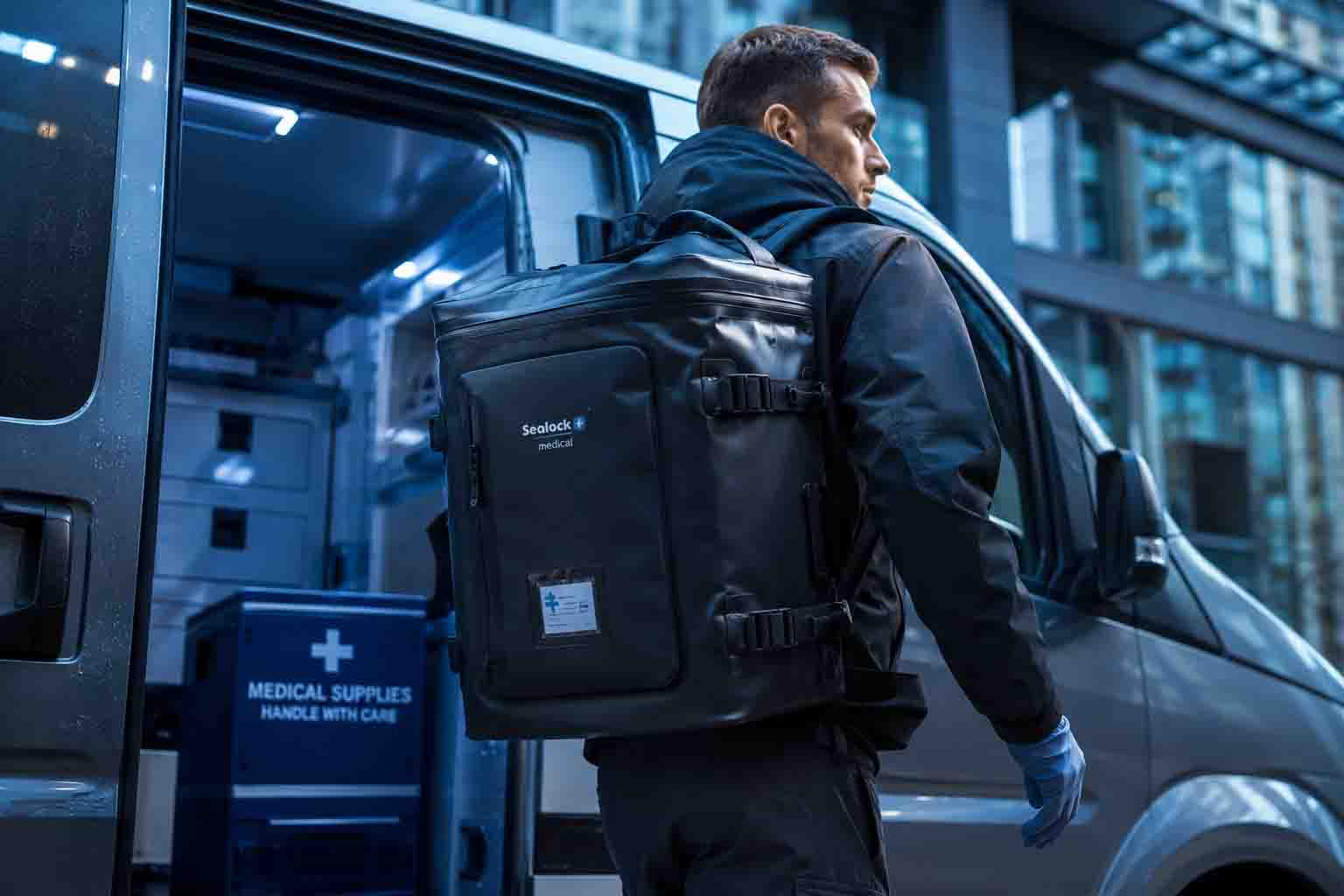
Global logistics in 2026 looks nothing like it did a decade ago, and nowhere is that more apparent than in the final leg of temperature-controlled delivery. The payloads moving through last-mile cold chains today are genuinely irreplaceable: mRNA vaccines, biologics with narrow stability windows, live blood samples, organ transport media. A single temperature excursion doesn't just degrade product — it can end someone's treatment cycle or make a scheduled transplant impossible.
For years, the industry leaned on rotomolded hard coolers as the default solution. Durable, yes. But heavy, bulky, and badly suited to the realities of urban courier routes, motorbike delivery, or any scenario where a courier needs to move fast through a hospital corridor or climb three flights of stairs. The weight alone disqualifies them from a growing share of actual use cases.
The shift toward soft cooler bags seemed like the obvious answer. Lighter, more portable, easier to store flat when empty. The problem was that the bags being produced didn't actually solve the core engineering challenges — they just moved them around. Sewn seams leaked. Open-cell foam turned into a moisture sponge the moment condensation started forming inside. Interior liners that looked clean accumulated contamination in ways that weren't visible until the damage was already done.
At the Sealock Dongguan R&D Center, we stopped treating this as a bag-making problem fairly early on. The real challenge is applied thermodynamics and fluid mechanics — understanding precisely how heat moves, how moisture behaves, and where biological contamination actually originates. This whitepaper walks through the engineering decisions behind our medical-grade soft cooler backpacks: the materials, the welding process, the insulation architecture, and the manufacturing infrastructure that lets us scale these specifications into OEM production without degrading what was achieved in the lab.
Chapter 1: The Biology of Temperature Excursions and Microbial Contamination
Good thermal engineering starts with understanding failure modes. Before designing anything, we spent considerable time mapping exactly how and why conventional soft coolers break down in medical and high-end commercial cold chain environments — not in theory, but in the specific physical mechanisms that cause payloads to be destroyed.
The Capillary Action Failure
Every time a needle passes through fabric during conventional sewing, it leaves a hole. In a typical sewn soft cooler, that adds up to thousands of micro-penetrations running through the seam lines. Under normal dry conditions, these holes are small enough that they don't seem significant. But once ice packs or gel packs start melting inside the cooler, water doesn't just pool at the bottom — it gets drawn upward through those holes via capillary action. The physics are straightforward and unavoidable. The needle holes behave exactly like micro-capillaries, and water climbs them.
Once moisture gets through the interior liner and into the insulation cavity, the second failure begins.
The Biohazard Amplification
Standard open-cell foam and cheap PE/EVA blends absorb moisture readily. Once saturated, that insulation core becomes dark, damp, and thermally stable — conditions that support aggressive mold, mildew, and bacterial growth. The irony is that the cooler's own insulating properties help incubate whatever biological contamination takes hold inside it.
For a brand supplying medical couriers, hospital logistics teams, or premium food delivery services, a cooler with active biological contamination inside it isn't a defective product in the conventional sense — it's an active liability. The reputational and legal exposure from a contaminated payload in a medical context is severe.
Our engineering philosophy addresses this at the source. We call it "Zero Ingress" — the principle that if moisture cannot penetrate the seams under any operational condition, the thermal core stays clean, and the payload environment remains biologically secure from the moment the cooler is loaded to the moment it's opened at the destination.
Chapter 2: Thermodynamic Architecture: High-Density Closed-Cell Foam
The insulation choice is the foundation everything else sits on. Get this wrong and no amount of advanced welding or premium exterior materials will recover the thermal performance you need.
We don't use open-cell foam. The decision is deliberate and non-negotiable. Open-cell structures rely on interconnected air pockets to resist heat transfer, but those same interconnections make the foam structurally vulnerable — they collapse under compression and absorb water immediately when moisture is present. In a cold chain bag that's expected to maintain 2°C to 8°C for 48 to 72 hours in a 32°C ambient environment, open-cell foam isn't a compromise; it's a failure waiting to be documented.
2.1 The Physics of Closed-Cell Insulation
Closed-cell foam works on a different principle entirely. Millions of microscopic gas bubbles are individually encapsulated within the polymer matrix — each one sealed off from its neighbors. Because there are no connecting pathways between cells, convective heat transfer is severely disrupted and thermal bridging is effectively eliminated. The static gas trapped within each sealed cell produces an exceptionally high R-value relative to the foam's physical thickness.
The second benefit is equally important for this application: because every cell is hermetically sealed by nature, the foam core is hydrophobic. It won't absorb moisture even under prolonged exposure. Even in the scenario where the outer shell sustains a physical puncture — say, a courier drops the bag on a sharp corner — the insulation beneath it stays dry and thermally functional. The payload doesn't lose protection just because the outer layer took damage.
Our OEM medical and premium outdoor coolers use precision-cut, high-density closed-cell foam in either advanced NBR or high-grade EVA formulations, selected based on the client's specific performance and regulatory requirements.
2.2 Engineered Thickness and Payload Profiling
Foam thickness is calibrated to the client's specific operational profile, typically ranging from 20mm to 35mm depending on payload sensitivity, expected ambient temperature range, and transport duration. This isn't a default specification — it's the result of thermodynamic testing conducted in our Dongguan environmental chambers.
At a sustained ambient temperature of 32°C (90°F), a Sealock cooler built with a 25mm closed-cell core and appropriate phase-change materials consistently maintains the target thermal range for 48 to 72 hours. When clients come to us with a specific payload profile — a particular biologic with a narrow stability window, a transit route with known ambient temperature spikes — our R&D team works backward from the thermal budget to determine the precise foam specification required to meet it.
Chapter 3: Material Integrity: PFAS-Free TPU and Biocompatibility
The materials covering the foam core have to do two things simultaneously: protect the thermal architecture from physical abuse and comply with a regulatory environment that has tightened considerably over the past few years. In 2026, PFAS elimination isn't a voluntary sustainability gesture — it's a legal baseline in the EU under REACH and increasingly across North American jurisdictions. Any supplier still using legacy fluorinated coatings in medical-adjacent products is carrying regulatory exposure that will eventually catch up with them.
3.1 The 840D TPU Exterior Armor
The exterior shell uses 840-Denier Thermoplastic Polyurethane coated nylon. The denier count matters here — 840D provides the kind of abrasion and puncture resistance you need when the bag is being handled by medical couriers navigating urban environments, or field medics operating in genuinely rough conditions. It's not decorative specification; it's the difference between a cooler that survives a two-year deployment and one that starts showing wear failure at six months.
Unlike PVC, which becomes brittle and begins cracking in cold weather while off-gassing plasticizers that have no place near food-grade or medical payloads, our TPU exterior remains highly flexible down to -30°C. It resists UV degradation and chemical exposure without surface treatments that would reintroduce the PFAS problem through the back door.
3.2 FDA-Compliant, Antimicrobial Interiors
The interior liner is where biocompatibility requirements are strictest, and where most conventional soft coolers fail to meet the bar for serious medical or food-safety applications. We source exclusively food-grade, PFAS-free TPU for our interior basins. The material is non-porous, BPA-free, and inherently antimicrobial — not through an additive coating that degrades over time, but as a property of the base material.
When an organ transport team or a premium seafood distributor sanitizes the interior of a Sealock cooler with standard medical-grade disinfectants, the liner handles it without surface degradation. The smooth, seamless surface gives pathogens nowhere to establish — no seams to trap organic matter, no texture to resist cleaning. That's not a feature we added; it's a consequence of getting the material and construction method right in the first place.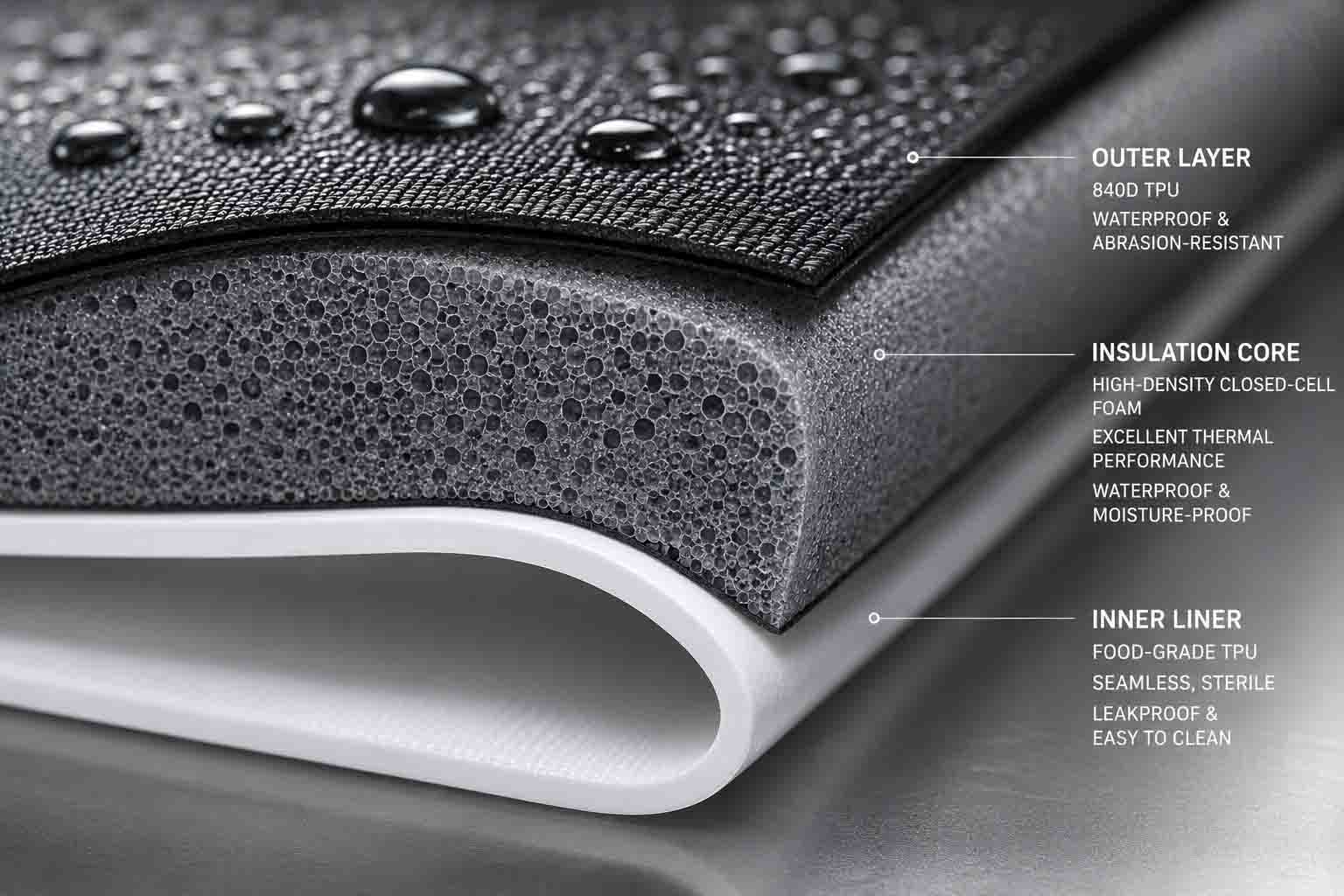
Chapter 4: The 27.12 MHz HF Welding Imperative
This is where the engineering of our soft coolers diverges most sharply from conventional manufacturing. The best foam and the most compliant TPU in the world don't function as designed if the panels holding them together are stitched. Stitching introduces exactly the capillary failure points described in Chapter 1. No amount of seam tape reliably compensates for that over the product's actual service life.
4.1 Molecular Fusion vs. Physical Stitching
Our manufacturing process uses directed electromagnetic energy instead of needles and thread. When two panels of TPU-coated fabric are placed beneath the welding die, a high-frequency alternating current tuned to 27.12 MHz oscillates the dipole molecules within the polyurethane at an extremely rapid rate. The friction generated by that molecular movement produces localized heat from the inside of the material outward — not applied from an external heat source, but generated within the material itself.
Under precisely calibrated pneumatic pressure applied simultaneously with the RF energy, the two layers melt and fuse at the molecular level. When the process completes and the material cools, the two panels aren't joined — they're unified. There's no seam in the conventional sense. The weld zone is structurally continuous with the surrounding material.
4.2 The Hermetic Basin
The practical result of building an interior liner entirely through HF welding is what we refer to internally as the Hermetic Basin. The interior of a Sealock soft cooler contains zero physical holes anywhere in its structure. It functions as a single, continuous, impenetrable vessel — capable of holding standing water indefinitely under pressurized conditions. No leakage at the seams. No moisture ingress along the weld lines. No microscopic pathways for biological contamination to establish itself.
For B2B buyers in medical logistics, marine applications, or high-stakes outdoor markets, the zero-leak guarantee isn't a marketing position. It's the basic engineering requirement that everything else is built around. HF welding is the only manufacturing method we've found that delivers it consistently at production scale.
Chapter 5: Advanced Closure Systems: Eliminating Thermal Leaks
A thermally optimized cooler body solves most of the problem — but the closure system is where a significant amount of real-world thermal performance is lost, and where most products that look competitive on paper fail in actual deployment.
Standard zippers are a thermal liability. The interlocking teeth and fabric tape create a continuous pathway for cold air to escape along the bottom of the zipper tract and for warm, humid ambient air to be drawn inward. In a cooler designed for 72-hour retention, that exchange adds up to a measurable reduction in effective performance over the transit duration.
To close the hermetic seal properly, Sealock integrates heavy-duty airtight and watertight zippers across our medical-grade cooler lines. These are specialized closure systems built around extruded polymer teeth that interlock with microscopic precision, encased in a flexible waterproof coating. Closing them fully requires engaging a designated terminal dock that creates a true airtight seal — not just a tight fit, but a verified pressure-sealed closure.
The practical benefits extend beyond thermal retention. If a courier drops the bag into standing water, or it tips over in the back of a transit vehicle, the closure prevents both ingress and egress of liquid. The payload stays isolated from whatever the exterior of the bag encounters in transit — which, in real-world logistics, is frequently unpredictable.
Chapter 6: The China-Vietnam Synergy: Scaling Medical-Grade Manufacturing
Engineering a product that performs to medical-grade specifications in a controlled R&D environment is one problem. Scaling that product into consistent, high-volume OEM production — while managing international tariff exposure and supply chain risk — is a different category of challenge entirely.
Sealock's dual-base manufacturing infrastructure was built specifically to address both sides of that challenge without compromise between them.
R&D and Prototyping — Dongguan, China: Our Dongguan engineering headquarters handles material sourcing, CAD structural design, thermodynamic testing, and the development of precise digital welding parameters. Every client engagement starts here. The output of this phase is what we call the Golden Sample — a prototype that meets the full specification before a single production unit is built.
High-Volume Production — Ho Chi Minh City, Vietnam: Once the SOPs are fully documented and validated against the Golden Sample, they're transferred digitally to our ISO-certified Vietnam facilities. Resident Chinese technical engineers from our Dongguan team oversee the production lines, ensuring that the translation from prototype to mass production doesn't introduce the quality drift that typically occurs when engineering oversight stops at the factory gate.
The result for our OEM clients is access to Chinese engineering precision and materials science at the front end, combined with production economics and tariff positioning that Vietnam provides at the back end. For brands that can't afford stockouts or a quality control failure in a medical supply chain, that combination — engineering excellence plus supply chain resilience — is the actual value proposition.
Conclusion: Partnering with the Pioneers of Thermal Logistics
The sewn soft cooler that leaks, contaminates, and loses thermal integrity within 24 hours hasn't disappeared from the market — but the industries that depend on cold chain reliability are moving away from it. The medical sector has been leading that transition, but premium commercial food logistics, marine applications, and high-performance outdoor markets are following closely behind. The performance gap between what those buyers now require and what conventional manufacturing can deliver has become too wide to paper over with marketing copy.
What Sealock has built is a manufacturing system where the engineering decisions are connected end-to-end: the closed-cell foam architecture, the PFAS-free TPU material selection, the 27.12 MHz HF molecular welding, and the airtight closure system all function as a single integrated thermal retention system rather than a collection of independently specified components.
For OEM and ODM clients in medical, tactical, and premium commercial sectors, that integration is what actually matters. Not individual component specifications, but a system that performs to a verified standard under the real conditions your payloads will encounter. That's the conversation we're built to have.
Frequently Asked Questions — B2B Sourcing
- Q1: What specific temperature ranges can Sealock soft coolers maintain for medical logistics?
- Depending on the phase-change materials used — standard gel packs, PCM sachets, or dry ice — and the target ambient environment, our coolers can be engineered to hold 2°C to 8°C for standard biologics, 15°C to 25°C for controlled room temperature payloads, or sub-zero conditions for frozen specimens. All of these are maintained for 48 to 72 hours. Our Dongguan R&D team works directly with clients to calibrate the closed-cell foam thickness and PCM specification to match the exact thermal profile their payload requires.
- Q2: How does 27.12 MHz HF welding ensure better hygiene than seam-taped construction?
- Seam tape applied over needle-stitched holes depends on chemical adhesives that degrade under repeated thermal cycling and moisture exposure. As they fail, the adhesive edges lift and create microscopic crevices — exactly the conditions that harbor bacterial growth and resist sterilization. HF welding eliminates the underlying needle holes by fusing the TPU at the molecular level. The resulting surface is continuous, smooth, and chemically identical to the surrounding material. It can be sterilized completely without any risk of moisture working its way into the insulation core.
- Q3: Are your materials compliant with current 2026 European and North American regulations?
- Yes. We maintain a strict PFAS-free manufacturing policy across our high-end cooler lines. Our TPU materials are fully compliant with the EU's REACH regulations, California Proposition 65, and certified FDA-safe for direct contact with food and biological payloads. Compliance documentation is available for review as part of our standard OEM onboarding process.
- Q4: Can internal compartments be customized for specific vial sizes or blood bag dimensions?
- Completely. Our OEM/ODM services include full internal architecture customization — HF-welded TPU dividers, precision foam inserts cut to accommodate specific vial arrays, and securement straps designed to prevent payload shifting during high-impact transit. If you have dimensional requirements for a specific medical device or biological container, our engineering team works from those specs directly.
- Q5: We require independent factory audits before establishing a manufacturing contract. Is this supported?
- It is, and we encourage it. Both our Dongguan R&D center and our Vietnam production facilities undergo continuous third-party auditing. We maintain current SCAN certification and ISO standards documentation. Independent auditors hired by prospective clients are welcome to inspect labor practices, QC procedures, environmental compliance, and manufacturing SOPs without restriction. Transparency in that process is something we treat as a basic requirement of serious B2B relationships, not a special accommodation.