

In the recreational market, a dry bag failure is an inconvenience. A wet phone, some damp snacks, a ruined paperback. The product gets returned, the brand takes a review hit, and the sourcing team hears about it at the next quarterly meeting.
In professional white-water, offshore marine, and tactical search and rescue applications, the failure calculus is different. Equipment loss has operational consequences. In some scenarios, it has safety ones. Sourcing managers supplying these markets aren't evaluating products against consumer-grade standards—they're evaluating them against the specific failure modes that occur when conditions stop being controllable.
This guide works through three of those scenarios in detail: what actually happens to a standard dry bag under each condition, where the construction method fails first, and what the manufacturing specifications need to look like to survive it.
Scenario 1: Class V White-Water Capsize — Impact, Abrasion, and Sudden Pressure
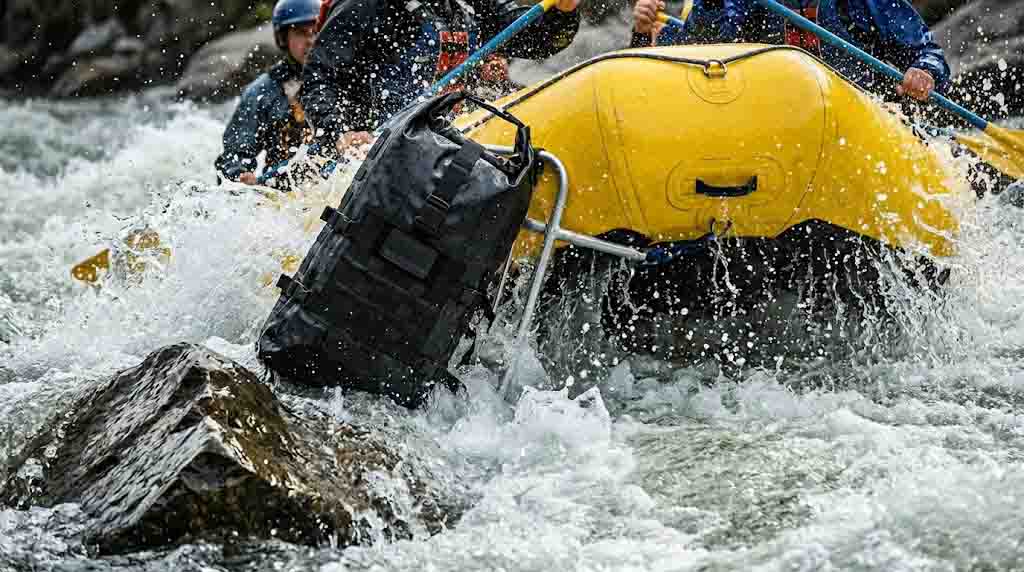
A raft flips in Class V rapids. The dry bag strapped to the frame goes with it—violently submerged, carried by current into rocks, pinned under hydrostatic load, and dragged across gravel and submerged ledge edges before it surfaces downstream. The whole sequence might take thirty seconds. The mechanical demands on the bag during those thirty seconds are more severe than anything a standard consumer product is designed to handle.
Standard construction fails at two points simultaneously. Thin PVC or low-denier nylon tears on contact with sharp rock edges—not because the material was defective, but because it wasn't specified for abrasion resistance at that intensity. And stitched seams, which are already the structural weak point of any waterproof bag, blow out under the sudden hydrostatic pressure spike of high-velocity submersion. The water hammer effect of a fast capsize generates localized pressure at seam lines that seam tape cannot survive. The bag leaks before it surfaces.
What the Construction Needs to Look Like
Abrasion resistance in a Class V environment requires 840-Denier TPU-coated nylon as the shell material. The 840D denier count reflects a base fabric dense enough to resist puncture propagation from sharp contact—the ripstop grid woven into the base fabric prevents a surface score from becoming a tear. TPU coating over that base provides a continuous waterproof film that maintains integrity even when the outer surface takes repeated contact with rock and gravel. This isn't a marginal upgrade from consumer-grade materials; it's a different material category.
Seam construction has to be RF welded. High-frequency welding fuses TPU panels at the molecular level—the join zone becomes a single continuous piece of material with no needle holes, no tape, and no structural discontinuity that concentrates stress under sudden pressure loading. In destructive burst testing, properly RF welded seams fail in the base fabric before the weld line gives way. That's the standard a seam needs to meet to survive water hammer impact in a capsize scenario. Stitched seams with tape, regardless of tape quality, do not meet it.
Scenario 2: Offshore Marine and Tactical Maritime Operations — Prolonged Submersion, UV, and Chemical Exposure
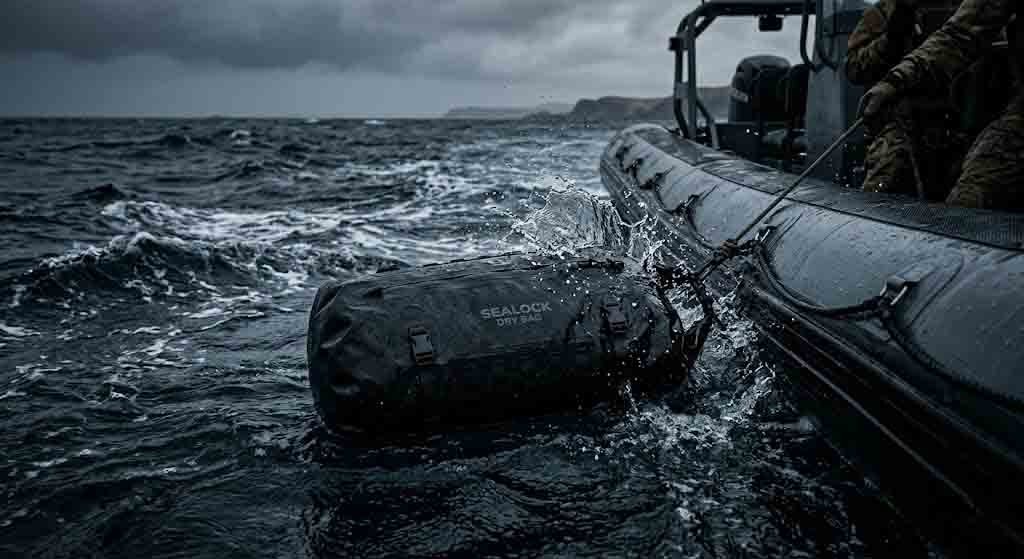
Offshore fishing vessels and tactical rigid hull inflatable boats are hard environments for gear. A dry bag on an offshore vessel might sit in a pooled mix of saltwater and engine oil for twelve hours, take direct sunlight at sea-level UV intensity for an equal period, and then get dropped overboard during a transfer. The bag may float for hours before retrieval. The contents need to be dry when it's opened.
PVC fails in this environment through a well-documented degradation pathway. The combination of UV exposure, saltwater, and hydrocarbon contact attacks the plasticizers that give PVC its flexibility. Over repeated exposure cycles—which is the normal service condition on a working vessel, not an edge case—PVC becomes progressively stiffer and more brittle. Surface cracking follows, and once the waterproof coating cracks, the bag has failed as a waterproof product regardless of whether the seams hold.
The roll-top closure introduces a separate failure mode. Roll-top sealing depends entirely on the precision of the fold and buckle tension. Under prolonged submersion—particularly when the bag is floating rather than held under controlled depth—water pressure at the fold edges is continuous. A fold that was tight enough for a brief splash or short submersion will wick water slowly over hours. For offshore retrieval scenarios where the bag may be in the water for an indeterminate period, user-dependent closure systems are an unreliable specification.
What the Construction Needs to Look Like
TPU is the correct shell material for offshore marine applications because its resistance to hydrolysis, UV degradation, and chemical exposure is built into the material chemistry rather than applied as a surface treatment. It doesn't rely on a coating layer that can delaminate—the waterproof performance is integral to the material structure. Flexibility is maintained at the operating temperatures relevant to marine use, including cold-water environments where PVC would have already stiffened.
For closure systems in prolonged submersion scenarios, airtight zipper systems replace roll-tops. These use extruded polymer closures—toothless or heavy-toothed depending on specification—that create a mechanical hermetic seal when engaged, independent of how the user operates them. Each zipper unit should be individually pressure-tested before it enters production. A bag closed with a properly specified airtight zipper can be submerged indefinitely without the seal degrading, which removes the user-error variable entirely from the waterproof performance equation.
Scenario 3: Alpine Search and Rescue — Sub-Zero Temperatures and Gloved-Hand Access
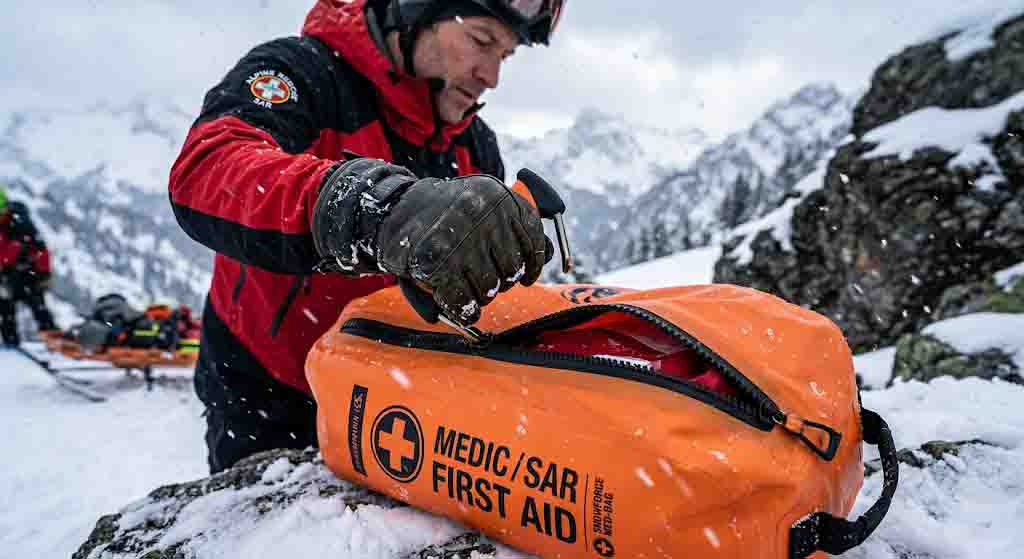
A search and rescue team operating in sub-zero alpine terrain has a different set of requirements than a white-water guide or a commercial fisherman. The environmental stress is thermal rather than hydraulic. The operational requirement is speed of access rather than sustained submersion. And the failure mode that ends a mission isn't necessarily a bag that leaks—it's a bag that can't be opened quickly with gloved hands in the dark at -20°C.
Budget waterproof plastics suffer from cold cracking—a failure mode where material that is flexible at ambient temperature becomes brittle below a threshold temperature and fractures under mechanical stress. A roll-top closure folded at -15°C may crack along the fold line when pressure is applied to unroll it. A closure buckle made from an inadequate polymer may snap. These are not abuse scenarios; they're normal operational conditions for alpine SAR equipment, and they produce equipment failures at moments when equipment failure has the worst possible timing.
The access problem is equally practical. A roll-top closure requires two hands, fine motor control to manage the fold sequence, and then buckle manipulation—all of which become significantly harder with heavy winter gloves that reduce grip sensitivity and hand dexterity. Under field stress conditions, the time required to access a roll-top bag versus a zipper-access bag is not a minor difference. In a medical emergency response, it matters.
What the Construction Needs to Look Like
Cold-crack resistance requires TPU formulated and tested for low-temperature performance. Premium TPU grades maintain flexibility to -30°C (-22°F), which covers the operational temperature range of alpine SAR deployments including extreme cold-weather environments. The material behaves the same when folded, compressed, and handled aggressively at -20°C as it does at ambient temperature—no stiffening, no cracking at fold lines, no buckle failures from brittle polymer components.
Wide-mouth airtight zipper integration solves the access problem directly. A T-handle zipper pull can be grasped and operated with heavily gloved hands in a single motion—open the bag, extract the gear, close and re-seal in seconds rather than the fifteen to thirty seconds a roll-top requires under the same conditions. The hermetic seal is maintained regardless of speed or precision of operation. For medical supply bags, communications equipment cases, and emergency gear deployed in cold-weather SAR operations, this is the access architecture that matches the operational reality.
Building the Specification From the Failure Mode
The sourcing logic for extreme-condition dry bags runs backward from the failure scenario rather than forward from a capability list. The right question isn't "what materials and construction methods does this factory offer?"—it's "what happens to this product when the worst case occurs, and does the construction method survive it?"
For white-water applications, the worst case is a capsize with rock contact and sudden hydrostatic pressure. The construction that survives it is 840D TPU shell with RF welded seams, validated to burst pressure above the expected impact load. For offshore marine, the worst case is extended uncontrolled submersion in a chemically aggressive environment. The construction that survives it is TPU shell with hydrolysis resistance and a mechanical airtight zipper closure that doesn't depend on user precision. For alpine SAR, the worst case is critical gear access at -20°C with gloved hands under time pressure. The construction that survives it is cold-crack resistant TPU with wide-mouth airtight zipper access designed for reduced dexterity operation.
When evaluating OEM partners for these applications, ask for test data specific to each scenario: hydrostatic burst pressure for seam validation, material cold-flex test results at the operational temperature floor, zipper submersion test records. A manufacturer with genuine capability in extreme-condition dry bags will have this data available because they generated it during product development—not because they compiled it in response to the audit question.
Frequently Asked Questions
What makes a dry bag suitable for tactical or extreme white-water use?
The material and construction method need to match the specific failure modes of the application. For white-water, that means 840D TPU shell fabric for abrasion and puncture resistance, RF welded seams that hold under sudden hydrostatic pressure loads without blowout, and closure systems that maintain waterproof integrity under dynamic submersion rather than static depth tests. IPX ratings are a starting point but don't capture the pressure spike of a capsize impact or the sustained abrasion of rock contact—ask for burst pressure test data and abrasion cycle test results in addition to submersion certification.
How does TPU perform differently from PVC in extreme environments?
The performance gap is most visible in three specific conditions. At low temperatures, TPU maintains flexibility to -30°C while PVC becomes progressively stiffer and prone to cracking below -10°C—a critical difference for alpine or cold-water marine applications. Under UV and chemical exposure, TPU resists degradation without relying on a surface coating that can delaminate, while PVC plasticizers break down under sustained saltwater and UV combination. And TPU is compatible with PFAS-free, REACH-compliant formulations, while PVC's phthalate plasticizer chemistry creates regulatory exposure in EU and California markets.
Why are airtight zippers preferred over roll-top closures for emergency and tactical gear?
Two reasons that are independent of each other. First, a mechanical airtight zipper creates a hermetic seal regardless of how precisely or quickly the user operates it—the seal is a function of the closure design, not the operator's technique. A roll-top closure requires correct fold sequence and tension to seal reliably, which introduces user-error variability into the waterproof performance. Second, zipper access is operationally faster and doesn't require fine motor control—relevant for gloved operation in cold environments or time-critical access to medical or communications equipment. For consumer recreational use, a roll-top is often adequate. For professional applications where the contents matter under stress conditions, the mechanical seal and access speed of an airtight zipper are the appropriate specification.