

That calculus has changed. A soft cooler failure today carries real consequences that extend well beyond a warm drink. For a professional offshore angler, it's hundreds of dollars of spoiled catch. For a medical courier, a temperature breach can compromise vaccines or biological samples with no viable replacement window. For a premium outdoor brand, a leaking cooler flooding the cargo area of a customer's SUV generates returns, reviews, and lasting reputational damage.
At our Dongguan R&D center, we stopped treating soft cooler design as a bag problem a long time ago. It's an applied thermodynamics problem—one that involves material selection, construction method, and the physics of heat transfer working together or against each other. This article breaks down exactly how we approach it.
1. The Insulation Core: Why Closed-Cell Foam Is the Only Serious Option
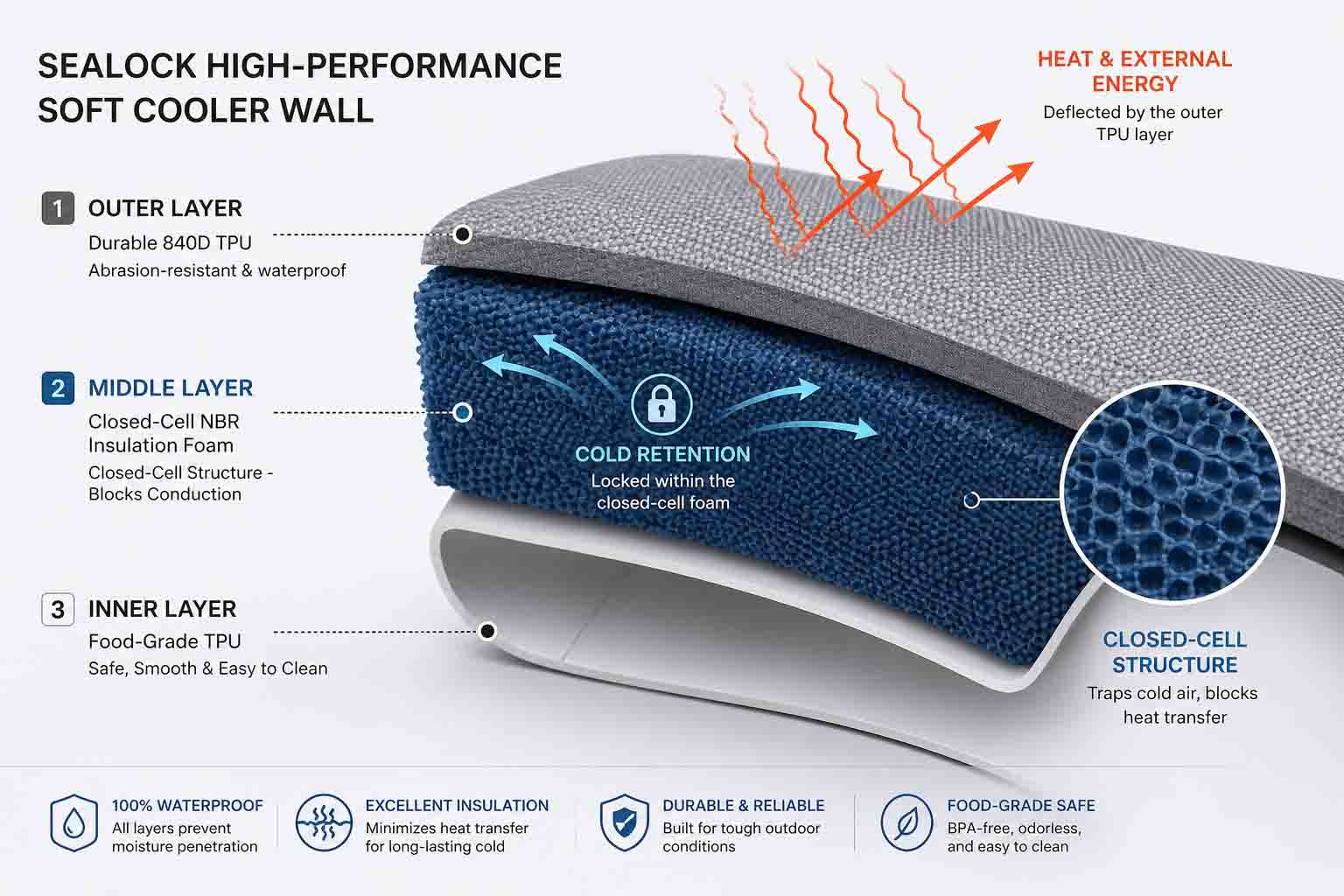
Start with the insulation layer, because everything else depends on it. Traditional manufacturers lean on open-cell foam or low-grade EVA and PE variations to keep costs down. These materials are light and inexpensive. They're also thermally mediocre and structurally problematic over time.
The core issue is water absorption. Open-cell foam has an interconnected internal structure—when moisture gets in, it spreads. In a cooler that experiences condensation, minor liner damage, or simple heavy use, that means the insulation layer gets wet and stays wet. Wet foam loses its thermal resistance rapidly and, in the enclosed environment of a sealed bag, becomes a reliable breeding ground for mold and bacteria.
Sealock's advanced soft cooler backpacks use High-Density Closed-Cell Foam—specifically NBR or premium high-density EVA grades—as the insulation core.
The structural difference matters: in a closed-cell configuration, each gas bubble is fully sealed from its neighbors. Heat transfer through convection is dramatically reduced because there's simply no pathway for air movement within the foam. In climate-controlled testing at our Dongguan facility—simulating a sustained ambient temperature of 90°F (32°C)—our closed-cell configurations consistently hold solid ice for 48 to 72 hours depending on foam thickness and load conditions.
The secondary benefit is equally important: closed-cell foam is inherently waterproof at the material level. Even if the liner sustains minor damage during extended field use, the insulation core won't absorb water. Thermal integrity holds. That's not a minor engineering footnote—for marine and off-grid applications, it's the difference between a product that keeps working and one that quietly fails.
2. The Seam Problem: Why Stitching Is Structurally Incompatible With Leakproof Design
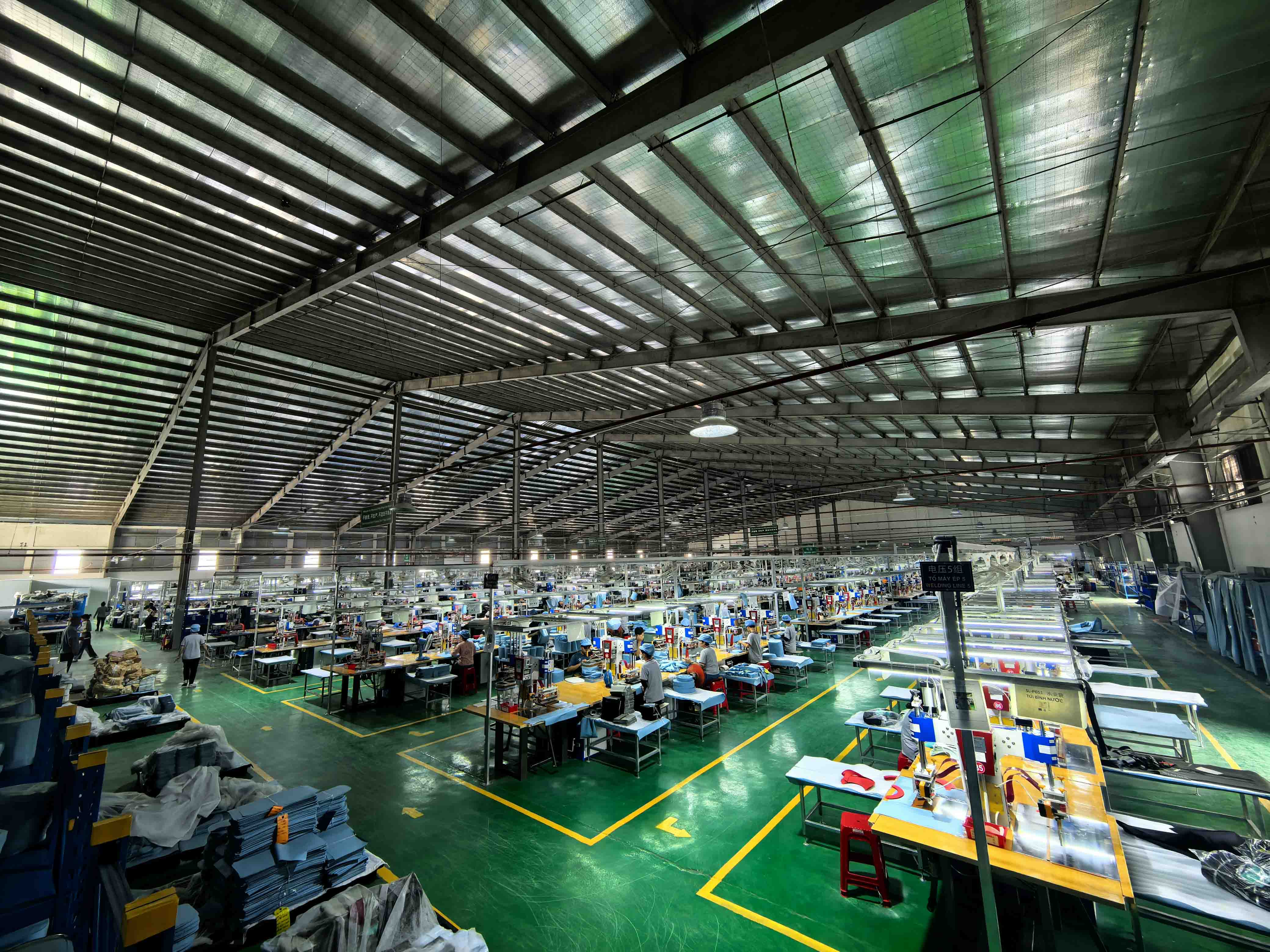
High-performance insulation foam solves one half of the problem. The other half is construction method—and this is where most manufacturers, even well-intentioned ones, leave performance on the table.
Industrial sewing is a mature, efficient manufacturing process. It's also fundamentally incompatible with true leakproof construction. Every needle pass through a fabric creates a hole. Seam tape helps—until it doesn't. Under the combined stress of ice weight, water pressure, and the flex loads of a backpack in motion, tape bonds degrade. The failure mode is predictable; only the timeline varies.
Sealock's soft coolers are assembled using 27.12 MHz High-Frequency (HF) welding—a process that works on a fundamentally different principle.
Rather than mechanically fastening panels together, HF welding uses electromagnetic energy to agitate the molecular structure of the TPU-coated fabrics at the join points. Under controlled pneumatic pressure, the materials reach a localized melt state and fuse together at the molecular level. When the process completes, there's no seam in the conventional sense—just a continuous, uninterrupted material bond.
The practical result is an interior liner that functions as a single watertight basin. There are no needle holes, no tape edges, no stress points waiting to open under load. For clients building products for marine environments, vehicle transport, or any application where a leaking cooler creates a real problem, this isn't a premium feature—it's a baseline requirement that stitched construction simply cannot meet.
3. The Mold Problem: A B2B Pain Point That Rarely Makes the Spec Sheet
During conversations with procurement officers from premium outdoor brands, one complaint comes up consistently when they describe experiences with previous suppliers: mold. Not sometimes—regularly.
The mechanism is straightforward. In a stitched cooler, melted ice water migrates through seam gaps into the space between the inner liner and the insulation foam. That cavity is dark, damp, and effectively sealed. It doesn't dry. Over weeks and months of normal use, it becomes a mold and mildew environment—one that produces persistent odors and, eventually, forces product disposal. For brands with a quality reputation to protect, the first customer complaint about a moldy cooler is usually not the last.
The HF welding process eliminates this failure mode structurally. Because the interior liner is molecularly bonded with no gaps, there is no cavity for water to enter. The insulation core remains dry by design, not by hope.
We pair this with food-grade, antimicrobial TPU for the interior liner surface. The material is non-porous, smooth, and straightforward to clean—a wipe-down or a quick inversion is sufficient. For brands developing products for medical transport, food delivery, or any regulated cold-chain application, this combination isn't a selling point so much as a prerequisite that eliminates a significant compliance risk.
4. The Closure System: Where Thermal Performance Either Holds or Collapses
A well-insulated, well-welded cooler body can still underperform if the closure system doesn't match. A standard zipper creates continuous thermal exchange along its length and will leak if the cooler tips or is submerged.
Sealock integrates heavy-duty airtight and watertight zipper systems into our soft cooler lineup. These closures use interlocking teeth encased in a continuous polymer seal. Closing the zipper requires overcoming a deliberate resistance—the friction of the airtight engagement—which creates a hermetic closure rather than a simple mechanical one.
In practical terms: cold air stays in, ambient air stays out, and the cooler can be inverted, dropped into water, or carried sideways in a kayak without leaking. The zipper system completes the thermal envelope rather than compromising it.
What This Means for Brands Sourcing in 2026
The soft cooler market is dividing. Consumers are actively moving away from cheap alternatives that underdeliver on their core promise. Brands that can offer genuinely reliable thermal performance—backed by construction methods they can actually stand behind—are capturing category share at meaningfully better margins.
Building that kind of product requires a manufacturing partner who understands the underlying engineering, not just the SKU specs. Our R&D process runs out of Dongguan, where new materials are tested, welding parameters are calibrated, and SOPs are validated before any production run. Those same parameters transfer directly to our Vietnam facilities, where scale and tariff structure align with what most international brands need from their supply chain.
If you're evaluating soft cooler manufacturing partners for 2026, the construction conversation is the right place to start.
Frequently Asked Questions
Q1: What's the measurable difference in ice retention between open-cell and closed-cell foam in your coolers?
Under controlled conditions at 90°F (32°C), standard open-cell foam coolers typically exhaust their ice within 12 to 18 hours. Our closed-cell foam configurations—combined with HF welded seams and airtight zipper closures—consistently hold solid ice for 48 to 72 hours. The range depends on foam thickness and how the cooler is loaded and used.
Q2: Are the TPU interior liners safe for direct food contact?
Yes. We use FDA-compliant, food-grade TPU exclusively for interior liner surfaces. The material is BPA-free, non-toxic, and resistant to microbial growth. It's suitable for direct contact with ice, fresh catch, and unsealed produce—and meets the baseline material requirements for most food-contact and medical-adjacent applications.
Q3: Can insulation thickness be customized for medical or commercial cold-chain applications?
Yes. Our standard outdoor soft coolers use 20mm to 25mm foam as a baseline. For OEM clients with specific thermal requirements—whether that's a defined temperature hold window for medical logistics or a precise range for commercial cold-chain transport—our Dongguan engineering team can develop and validate custom foam densities and thicknesses against your performance spec before any production commitment.
Q4: Is the technical quality consistent between your China and Vietnam production facilities?
There's no gap in output quality between the two. HF welding parameters, pneumatic pressure settings, and QA protocols—including 24-hour inversion leak testing—are developed and validated in Dongguan. The complete technical package transfers to our Vietnam facilities, where our resident engineering team oversees implementation directly. What gets approved in Dongguan is what gets produced in Ho Chi Minh City.